PCOS and Weight: What the Evidence Can Tell You
PCOS care can focus on blood sugar, cholesterol, and how you feel, not just a number on the scale.
Lifestyle support and medication are not simply competing weight-loss strategies. PCOS guidance described in a recent review includes lifestyle care across weight categories, while medication studies often measure weight separately from metabolic markers. In one review of drug trials, weight changed with some treatments, but insulin-resistance scores did not significantly improve; the analysis did not assess quality of life. 3
Start with the outcome you want to improve
With PCOS, it can be useful to separate two questions: Do you want support with weight, and are there metabolic or other health concerns you want to address? They can overlap, but they are not the same goal. Blood sugar, blood fats such as cholesterol, and blood pressure are among the measures used to assess metabolic risk; women with PCOS are identified as a group at increased risk of metabolic syndrome. 1
A recent review describes international and US PCOS guidance as recommending lifestyle support across weight categories. The aims it lists include metabolic health, body composition, quality of life, and weight management. That means care can be worthwhile even if weight loss isn’t your goal, or if your weight doesn’t change. 3
Weight is one measure, not a complete account of health. It includes muscle, bone, fat, and water, and it can’t by itself show what is happening with blood sugar or cholesterol. 2
Lifestyle support: look beyond the scale
Dietary research in adult women with PCOS has studied a wide range of approaches, including Mediterranean-style, lower-glycemic, calorie-restricted, and time-restricted eating patterns. A systematic review reported improvements in some studies in measures such as insulin sensitivity and menstrual regularity, as well as weight-related measures. Results for blood fats and some other markers were inconsistent, and the variety of approaches and study designs makes it difficult to identify one best diet. 6
One small trial offers a more specific example, not a universal prescription. In a six-week randomized study of 75 women with PCOS, both early and midday time-restricted eating groups had reductions in fasting blood sugar, fasting insulin, insulin-resistance scores, weight, and waist circumference compared with the control group. Some cholesterol measures improved in the early-eating group but not the midday group. The short timeframe and small sample mean the study can’t establish what works best long term or for every person with PCOS. 4
A practical way to evaluate lifestyle support is to ask what it is meant to help with besides weight. For example, you might discuss whether the approach is workable in your daily life and whether the care plan will consider metabolic measures or quality of life as well as weight. Evidence on nutrition approaches is mixed enough that a rigid plan or a promise of a particular result isn’t justified by these studies. 3 6
Medication studies measure different things
Medication can be considered alongside lifestyle support; the choice depends on the outcome being addressed. A 2026 network meta-analysis compared trials of metformin, GLP-1 receptor agonists, and myo-inositol, alone or in combinations, in non-menopausal women with PCOS. It found weight and body-mass-index reductions with some treatment comparisons, particularly GLP-1 treatment combined with metformin. But none of the interventions had a statistically significant effect on the insulin-resistance measure HOMA-IR in that analysis. 3
That difference matters: a change in body weight does not automatically mean a measured improvement in insulin resistance, and vice versa. The analysis was limited to a set of metabolic and body-size outcomes. It did not assess reproductive, hormonal, or patient-centered outcomes such as quality of life, and it called for longer-term and direct comparison trials. It therefore can’t establish one medication as the best overall PCOS treatment. Its findings also apply to the non-menopausal women included in the trials, not automatically to every life stage. 3
The evidence does not make lifestyle care and medication an either-or choice, nor does it say that weight loss is required before discussing metabolic health. Instead, it supports being clear about what a treatment is expected to change and checking that outcome rather than assuming the scale tells the whole story. 3 2
Questions that keep the conversation focused
You could ask:
- What health concern are we trying to address: blood sugar, cholesterol, blood pressure, symptoms, weight, or something else?
- If my weight stays the same, which measures would tell us whether this plan is helping?
- What are the likely benefits and limits of lifestyle support, metformin, or a GLP-1 medicine for the specific outcome I care about?
- Can we choose an approach that feels sustainable and takes my preferences and relationship with food into account?
PCOS care can involve weight stigma and eating-disorder concerns, as a recent nutrition-care perspective notes. If weight-focused care feels harmful or distracts from your health priorities, it’s reasonable to say so and ask to discuss other goals and measures. 5
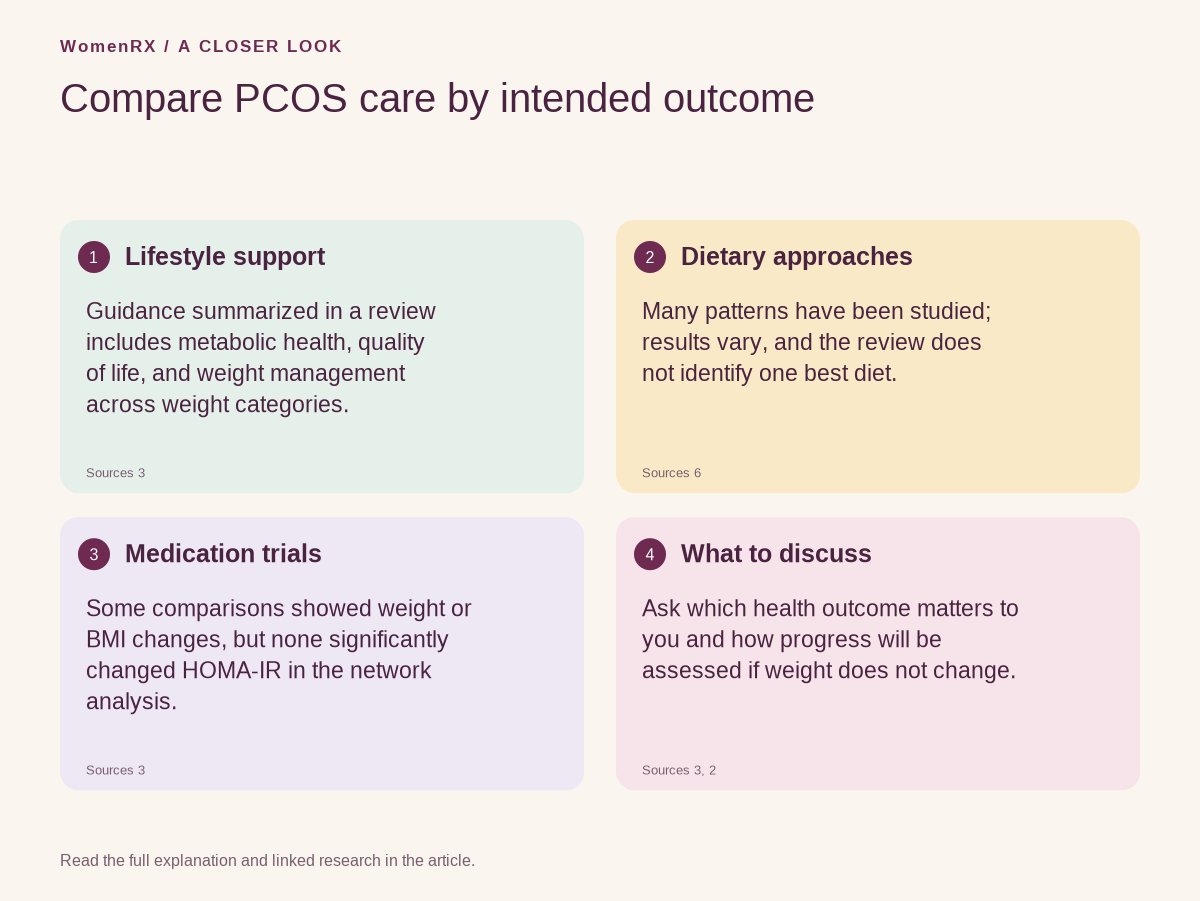
Compare PCOS care by intended outcome
Lifestyle support: Guidance summarized in a review includes metabolic health, quality of life, and weight management across weight categories.3
Dietary approaches: Many patterns have been studied; results vary, and the review does not identify one best diet.6
Medication trials: Some comparisons showed weight or BMI changes, but none significantly changed HOMA-IR in the network analysis.3
What to discuss: Ask which health outcome matters to you and how progress will be assessed if weight does not change.32
Read the figure as text
Different approaches may target different outcomes. The studies do not show that a change in weight guarantees a change in metabolic markers, or that one approach is best for everyone.- Lifestyle support: Guidance summarized in a review includes metabolic health, quality of life, and weight management across weight categories.3
- Dietary approaches: Many patterns have been studied; results vary, and the review does not identify one best diet.6
- Medication trials: Some comparisons showed weight or BMI changes, but none significantly changed HOMA-IR in the network analysis.3
- What to discuss: Ask which health outcome matters to you and how progress will be assessed if weight does not change.32
More questions, answered
Does PCOS treatment have to include weight loss?
No. A review describing PCOS guidance lists lifestyle goals across weight categories, including metabolic health and quality of life as well as weight management. The medication-trial review also studied metabolic outcomes separately from weight, though it found no significant effect on HOMA-IR in its analyses. 3
Does one diet work best for PCOS?
The nutrition review included many different dietary approaches and found mixed results across outcomes. Because the approaches and study designs varied, it called for longer-term trials rather than identifying one best diet. 6
Sources you can check
- Metabolic Syndrome | MedlinePlusAccessed 2026-09-25Return to first citation
- Body Weight: MedlinePlusAccessed 2026-09-25Return to first citation
- Comparative analysis of glucagon-like peptide-1 receptor agonists, metformin, and inositol in improving anthropometric and metabolic outcomes in women with polycystic ovary syndrome: a network meta-analysis.Omarion A, Ayasa Y, Omarion Z, Jayouse B, Ayesh H. · Frontiers in endocrinology · 2026Return to first citation
- Effect of two types of time-restricted eating on glycemic, lipid indices, and weight in women with polycystic ovary syndrome: a randomized controlled trial.Aminian M, Hajshafiha M, Heidari M, Daneghian S. · European journal of nutrition · 2026Return to first citation
- Nutrition care and Dietetic Practice in Managing Metabolic and Endocrine Dysfunction in Polyendocrine Metabolic Ovarian Syndrome (PMOS): Implications and Opportunities in the Context of the Name Change of Polycystic Ovarian Syndrome (PCOS) to PMOS.Vine D, Moran L, Teede H, Bahri-Khomami M. · Advances in nutrition (Bethesda, Md.) · 2026Return to first citation
- Nutrition interventions in women with polycystic ovary syndrome: a systematic review.Akbaş E, Samancı M, Öztürk YE. · European journal of nutrition · 2026Return to first citation