PCOS and Fertility: What Ovulation Can Tell You
PCOS can make ovulation less regular, which can make conception harder to predict, but it doesn’t mean pregnancy is out of reach.
PCOS can interfere with an egg developing or being released, so periods may be irregular and ovulation may happen less often. Many women with PCOS can still get pregnant. Cycle patterns offer clues, while a fertility evaluation can assess ovulatory function; in one study of women with anovulation, ovulation during monitored treatment was confirmed with a mid-luteal progesterone test. 1 4 5 Before trying, review PCOS medicines, particularly anti-androgens, which can cause problems during pregnancy. 1
PCOS affects ovulation, not your certainty of pregnancy
With PCOS, an egg may not develop as it usually does or may not be released. That can mean irregular periods, absent periods, or ovulation that is harder to predict. If ovulation happens less often, there may be fewer chances to conceive over time. But PCOS is not the same as infertility: many women with PCOS can still get pregnant. 1 2
A cycle is a clue, not a verdict. Irregular or missing periods can suggest that ovulation is infrequent, but they don’t tell you on their own whether you ovulated in a particular cycle. And a PCOS diagnosis is not itself a test confirming whether ovulation is happening now. MedlinePlus describes PCOS assessment as a physical exam and, when needed, blood tests for hormone levels; it also notes that there is no single specific test for diagnosing PCOS. 1
How a clinician can assess ovulation
An evaluation can start with your menstrual history: how often you bleed, how much your pattern varies, and whether you sometimes go for long stretches without a period. That history helps describe the pattern, but it is different from confirming ovulation. ACOG’s infertility-workup guidance says assessment of ovulatory function is part of the evaluation. 2 5
One way ovulation was confirmed in a study of women receiving monitored treatment for chronic anovulation was a mid-luteal blood progesterone measurement. The study included women with and without an ultrasound diagnosis of PCOS, so it illustrates a method used in a treatment setting, not a universal testing protocol for every person with PCOS. 4
If you seek a fertility evaluation, ovulation is only one part of the picture. ACOG also describes evaluating the reproductive organs for structural issues and considering tubal patency; a semen analysis can help assess sperm-related factors. This matters because difficulty conceiving may involve one partner, both partners, or more than one factor. 5
Before trying, review your PCOS medicines
Pregnancy planning is a separate conversation from a fertility evaluation. For example, a medicine you use to manage facial hair or acne may need attention before you try to conceive: MedlinePlus notes that anti-androgen medicines used for PCOS symptoms can cause problems during pregnancy. Bring up the medicines you currently take when you discuss your plans, rather than assuming that a treatment for PCOS symptoms is also suited to pregnancy planning. 1
When to bring pregnancy plans into the conversation
You don’t have to wait through a set period of trying before asking about irregular or absent periods. ACOG says an evaluation may be offered when someone is at high risk of infertility, and recommends offering immediate evaluation when a person has a condition known to cause infertility. If you’re planning pregnancy and your cycles are very irregular or absent, it’s reasonable to discuss whether your ovulation and other fertility factors should be assessed. 5
Age also affects timing. ACOG recommends an expedited evaluation for women older than 35, with treatment after six months of unsuccessful attempts or earlier when clinically indicated; for women older than 40, it says more immediate evaluation and treatment are warranted. These are evaluation recommendations, not a promise about how quickly pregnancy will happen. 5
If ovulation is not occurring regularly, fertility treatment may be one option; the appropriate next step depends on the cause and the rest of the evaluation. MedlinePlus describes fertility care as including medicines and procedures such as IVF, but no treatment guarantees pregnancy. 1 3
For a planning conversation, the useful distinction is whether you’re trying to understand your cycle, preparing to try, or have already been trying. Sharing your period pattern and how long you’ve been trying, if applicable, can help focus the discussion on ovulation assessment and whether other fertility factors need attention.
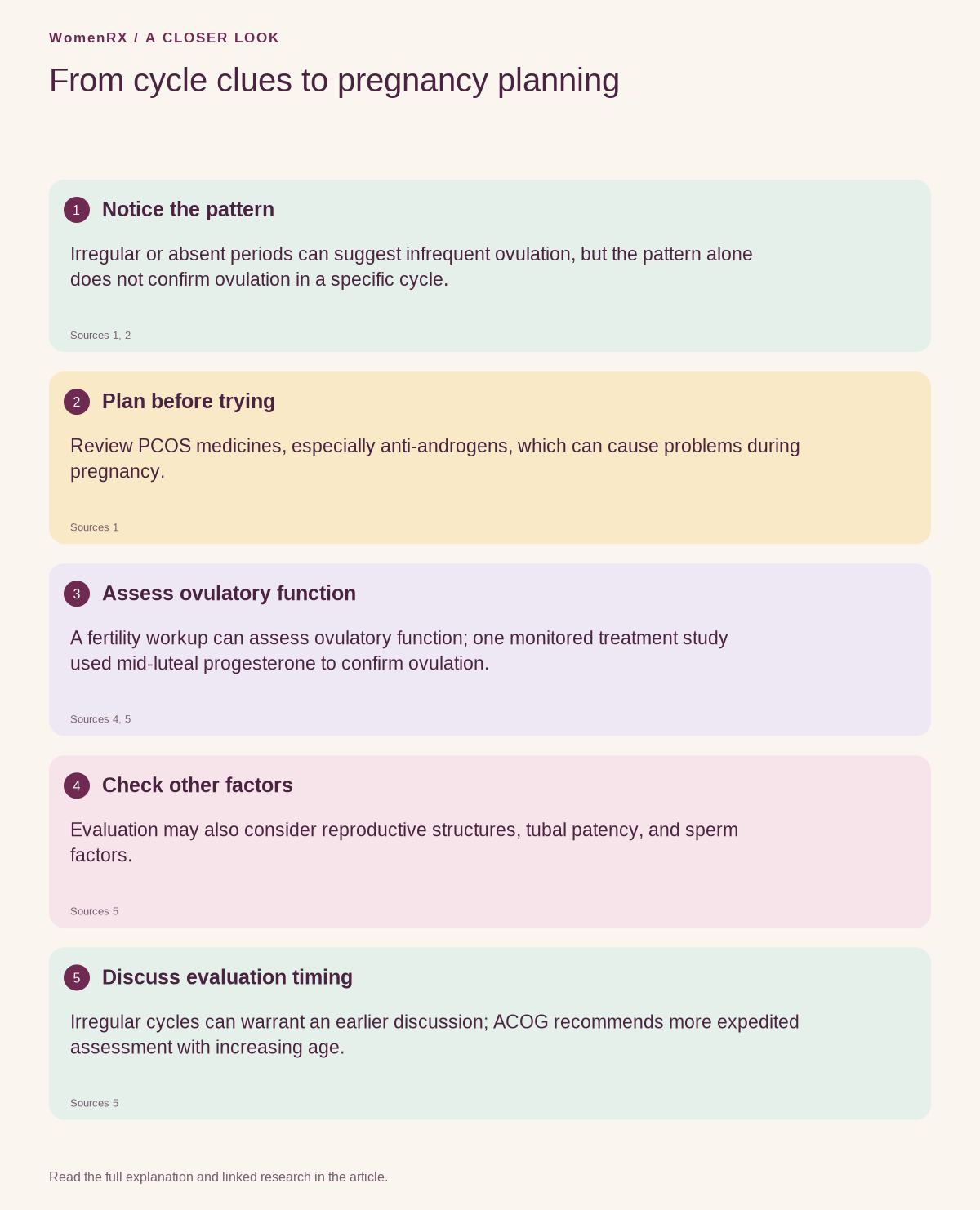
From cycle clues to pregnancy planning
Notice the pattern: Irregular or absent periods can suggest infrequent ovulation, but the pattern alone does not confirm ovulation in a specific cycle.12
Plan before trying: Review PCOS medicines, especially anti-androgens, which can cause problems during pregnancy.1
Assess ovulatory function: A fertility workup can assess ovulatory function; one monitored treatment study used mid-luteal progesterone to confirm ovulation.45
Check other factors: Evaluation may also consider reproductive structures, tubal patency, and sperm factors.5
Discuss evaluation timing: Irregular cycles can warrant an earlier discussion; ACOG recommends more expedited assessment with increasing age.5
Read the figure as text
This pathway shows how cycle patterns, pregnancy preparation, and fertility evaluation answer different questions.- Notice the pattern: Irregular or absent periods can suggest infrequent ovulation, but the pattern alone does not confirm ovulation in a specific cycle.12
- Plan before trying: Review PCOS medicines, especially anti-androgens, which can cause problems during pregnancy.1
- Assess ovulatory function: A fertility workup can assess ovulatory function; one monitored treatment study used mid-luteal progesterone to confirm ovulation.45
- Check other factors: Evaluation may also consider reproductive structures, tubal patency, and sperm factors.5
- Discuss evaluation timing: Irregular cycles can warrant an earlier discussion; ACOG recommends more expedited assessment with increasing age.5
More questions, answered
Should I wait a year before asking about fertility if I have PCOS?
Not necessarily. ACOG says an evaluation may be offered to someone at high risk of infertility and recommends immediate evaluation when a condition known to cause infertility is present. If you have PCOS and irregular or absent periods while planning pregnancy, ask whether an earlier evaluation makes sense for your situation. 5
Does a PCOS diagnosis mean I’m not ovulating?
No. PCOS can involve irregular or absent ovulation, but many women with PCOS can still get pregnant. A diagnosis of PCOS and an assessment of ovulation are related but distinct questions. 1
Sources you can check
- PCOS | Polycystic Ovary Syndrome | MedlinePlusAccessed 2026-09-25Return to first citation
- Irregular periods - NHSAccessed 2026-09-25Return to first citation
- Infertility | Infertility Treatments | MedlinePlusAccessed 2026-09-25Return to first citation
- Ovulation induction with a starting dose of 50 IU of recombinant follicle stimulating hormone in WHO group II anovulatory women: the IO-50 study, a prospective, observational, multicentre, open trial.Calaf Alsina J, Ruiz Balda JA, Romeu Sarrió A, Caballero Fernández V, Cano Trigo I, Gómez Parga JL, González Batres C, Rodríguez Escudero FJ. · BJOG : an international journal of obstetrics and gynaecology · 2003Return to first citation
- Infertility Workup for the Women's Health Specialist: ACOG Committee Opinion, Number 781.Obstetrics and gynecology · 2019Return to first citation