What Your AMH Result Can Tell You About Fertility
An AMH result can help describe ovarian activity, but your age, the test method, and what you’re trying to learn all change its meaning.
AMH is used to assess ovarian reserve, including in fertility-treatment settings, but it is not a verdict on whether you can conceive. There’s no single “normal” number that applies at every age or across every test method. A low result was linked to a modestly lower chance of conception in one large study, but it could not predict any one woman’s time to pregnancy.268
If you’re looking at an AMH result marked “low,” the first question isn’t simply whether the number falls inside a range. It’s what the number is being used to answer. Planning an egg retrieval and wondering whether you can conceive without treatment are different questions. AMH is considered in ovarian-reserve assessment in treatment settings, while research on natural conception shows only a group-level association.238
Why a “normal” number needs context
Anti-Müllerian hormone, or AMH, is produced by cells surrounding growing follicles in the ovaries. A blood test captures a signal from that activity. It doesn’t count all the eggs you have, measure egg quality directly, or reveal whether an egg will lead to a pregnancy.2
Age matters when you compare results. In one study of a healthy Korean reference population, the median AMH was 3.5 μg/L among participants ages 21-34 and 1.0 μg/L among those ages 35-46. Those are descriptions of two groups, not fertility cutoffs for an individual. The ranges within the groups were wide, too.7 A separate Korean population study found that AMH results also differed between testing platforms; its authors cautioned that differences in calibration and laboratory methods can affect comparisons.6
That’s why a number found online may be a poor match for the number on your report. Look at the units and the laboratory’s stated reference interval, including whether it’s age-specific and which assay was used. That interval can help put the result in context, but being inside or outside it doesn’t establish whether you can conceive: reference intervals describe measured values in a defined population, not pregnancy outcomes.67
Ovarian-reserve assessment is not a pregnancy prediction
In fertility treatment, AMH may be considered alongside age and an ultrasound-based antral follicle count when assessing ovarian reserve in the context of ovarian stimulation. AMH can help put a possible response to ovarian stimulation in context, but it cannot tell you exactly how many follicles will develop in your cycle. Assessing ovarian reserve is also different from predicting whether a particular egg will lead to a pregnancy.23
Even these reserve markers don’t always tell an identical story. In a cross-sectional study of 372 women attending a fertility hospital in Ghana, AMH and antral follicle count showed poor agreement when classifying participants as having normal or diminished ovarian reserve. That result doesn’t make either test useless; it shows why one marker shouldn’t be treated as the whole picture.5
If you aren’t considering fertility treatment, the distinction matters. A result suggesting fewer actively growing follicles isn’t a countdown to your last chance to conceive. AMH reflects follicular activity, while conception depends on more than this one blood measurement.28
What the natural-conception research found
A prospective study followed 3,150 US women who had been trying to conceive for less than three months and had purchased a hormone test. Among the 427 women with AMH below 1 ng/mL, the adjusted relative rate of conception was lower than among women with AMH from 1 to 5.5 ng/mL (hazard ratio 0.77). Pregnancy was measured by a self-reported positive test.8
That’s a meaningful group-level association, not a personal forecast. The study participants were people who had bought a test, and the result cannot tell you which month you’ll conceive or whether you’ll conceive without treatment. It also doesn’t turn 1 ng/mL into a universal boundary between fertile and infertile. A review of AMH and ovarian function likewise describes limited ability to distinguish who will conceive naturally.28
When the usual interpretation may mislead
Your cycle pattern and medical history can change what a low result suggests. For example, in women with hypothalamic anovulation, a systematic review found that AMH and antral follicle count varied widely compared with women who were ovulating. The authors cautioned that prolonged hormonal suppression may make these markers underestimate ovarian reserve in this particular setting.1 A small case-control study of functional hypothalamic amenorrhea also found different AMH patterns depending on whether polycystic ovarian morphology was present. Its findings need confirmation, but they reinforce that absent periods and a low AMH shouldn’t automatically be read as depleted eggs.4
The useful next question depends on your goal. If you’re considering egg freezing or IVF, ask how your result fits with your age and antral follicle count in assessing ovarian reserve for treatment. If you’re trying to conceive without treatment, ask what the result adds beyond your cycle pattern and how long you’ve been trying. And if your periods have stopped, make sure that change is considered rather than interpreting AMH on its own.12348
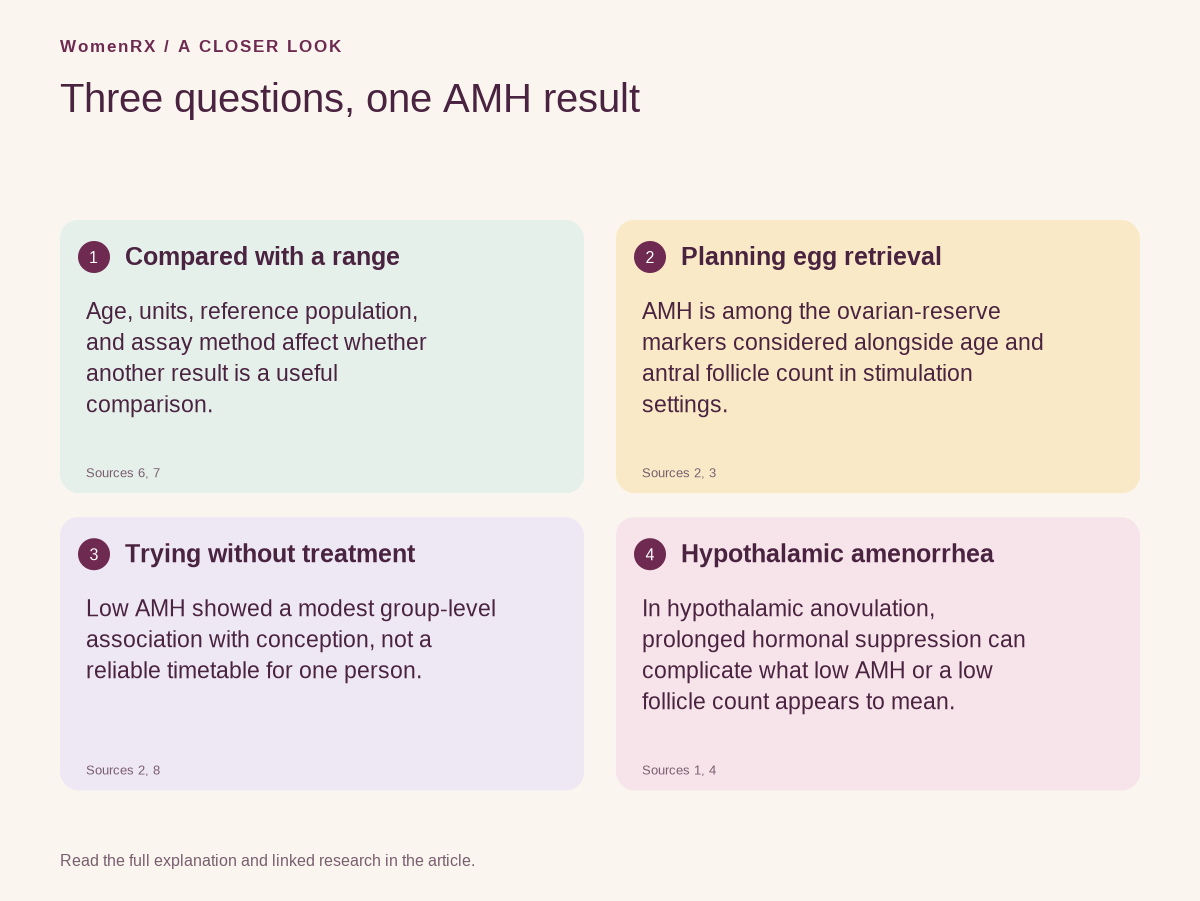
Three questions, one AMH result
Compared with a range: Age, units, reference population, and assay method affect whether another result is a useful comparison.67
Planning egg retrieval: AMH is among the ovarian-reserve markers considered alongside age and antral follicle count in stimulation settings.23
Trying without treatment: Low AMH showed a modest group-level association with conception, not a reliable timetable for one person.28
Hypothalamic amenorrhea: In hypothalamic anovulation, prolonged hormonal suppression can complicate what low AMH or a low follicle count appears to mean.14
Read the figure as text
The meaning of an AMH result changes with the comparison you’re making.- Compared with a range: Age, units, reference population, and assay method affect whether another result is a useful comparison.67
- Planning egg retrieval: AMH is among the ovarian-reserve markers considered alongside age and antral follicle count in stimulation settings.23
- Trying without treatment: Low AMH showed a modest group-level association with conception, not a reliable timetable for one person.28
- Hypothalamic amenorrhea: In hypothalamic anovulation, prolonged hormonal suppression can complicate what low AMH or a low follicle count appears to mean.14
More questions, answered
Does a high AMH mean I’m more likely to conceive?
Not necessarily. In the US prospective study, women in the high-AMH category (at least 5.5 ng/mL) did not have a statistically clear difference in conception rate compared with those in the study’s 1-5.5 ng/mL category. Those categories describe that study; they aren’t universal lab ranges.8
Sources you can check
- Ovarian reserve markers in World Health Organization type 1 anovulatory disorders: a systematic review and meta-analysis.de Jong SMH, de Kat AC, Schoonmade LJ, Hillebrand JJ, van Wely M, van Loendersloot LL. · Reproductive biomedicine online · 2026Return to first citation
- Anti-Müllerian hormone and somatic ovarian function: a new perspective.Çelik Ö, Çelik N, Ersahin A, Gungor N, Gungor K, Celik S. · Journal of assisted reproduction and genetics · 2026Return to first citation
- Ovarian response to controlled ovarian stimulation for medical fertility preservation: a retrospective comparison of oncological and benign indications.Mercier M, Leperlier F, Perennec A, Freour T, Chaillot M. · Journal of gynecology obstetrics and human reproduction · 2026Return to first citation
- Functional hypothalamic amenorrhea and anti-Müllerian hormone: insights for fertility assessment.Notaristefano G, Tropea A, Samasiuk A, Ranalli M, Policriti MA, Diterlizzi A, Ghi T, Lanzone A, Apa R. · Journal of endocrinological investigation · 2026Return to first citation
- Anti-Müllerian hormone versus antral follicle count as first-choice biomarkers in a low-resource setting: A cross-sectional study in Kumasi, Ghana.Damalie FJMK, Bedu-Addo K, Senaya CM, Dassah ET, Anning A, Baidoo PK, Owusu-Daaku K, Addo-Fordjour P. · The Journal of international medical research · 2026Return to first citation
- Age Group-specific Reference Intervals for the Elecsys Anti-Müllerian Hormone Assay in Healthy Korean Women: a Nationwide Population-based Study.Ji M, Kim KR, Kim HK, Lee W, Yun YM, Chun S, Min WK. · Annals of laboratory medicine · 2022Return to first citation
- Age-group-specific reference intervals for anti-Müllerian hormone and its diagnostic performance for polycystic ovary syndrome in a Korean population.Song J, Park Y, Cho HW, Lee SG, Kim S, Lim JB. · Journal of clinical laboratory analysis · 2021Return to first citation
- Antimüllerian hormone levels are associated with time to pregnancy in a cohort study of 3,150 women.Nelson SM, Shaw M, Ewing BJ, McLean K, Vechery A, Briggs SF. · Fertility and sterility · 2024Return to first citation