What an AMH Result Can Tell You About Fertility
AMH can help estimate ovarian response to fertility treatment, but it cannot tell you whether you’ll conceive naturally.
An anti-Müllerian hormone (AMH) result offers a clue about the follicles currently growing in your ovaries. A lower result may suggest fewer of those follicles; a higher result may suggest more. That information can help plan fertility treatment, but AMH is a poor predictor of natural pregnancy and cannot precisely tell you when menopause will happen. Age and your wider health history matter too. 4 5 7
What a low or high result is actually measuring
AMH is released by cells surrounding follicles as they grow. A blood test measures that hormone, not the eggs themselves and not a direct count of every follicle remaining in an ovary. That’s why an AMH result is best understood as a marker of the growing-follicle cohort, rather than an inventory of all the eggs you have left. 2
In general, lower AMH suggests fewer follicles in that growing cohort, while higher AMH suggests more. The result becomes more useful when interpreted alongside your age, menstrual history and, when appropriate, an ultrasound antral follicle count. It isn’t a stand-alone diagnosis of your fertility. 2 4
For example, if your AMH is lower than expected for your age and you’re considering egg freezing or IVF, it may help shape a discussion about how your ovaries might respond to stimulation. If your AMH is higher, that may suggest a different expected response. Neither result tells you how many usable eggs you would retrieve in a particular cycle or whether treatment would lead to a baby. Ovarian reserve measures can help guide fertility treatment, but they are poor predictors of fertility itself. 4 5
Why the number isn’t an egg-quality test
It’s understandable to see a low result and think, “Are my eggs bad?” AMH doesn’t answer that question. It reflects hormone released by growing follicles, not a direct measure of an egg’s quality. Age remains a more important consideration when discussing the likelihood of conception; the American Society for Reproductive Medicine identifies age as the single most important predictor of female fecundity. 2 4 6
The same distinction works in the other direction. A higher AMH result doesn’t cancel out age-related changes or promise that conception will be easy. Think of AMH as one piece of information about ovarian activity, not a grade for your eggs. 2 4 6
Does low AMH mean you can’t get pregnant naturally?
No. In a systematic review and meta-analysis of 11 studies involving 4,388 women trying to conceive naturally, AMH performed poorly at distinguishing who would achieve a clinical pregnancy. Its predictive performance was poor in both the younger-than-35 and older-than-35 subgroups. A low AMH result therefore should not be turned into a personal probability of pregnancy, and a reassuring result shouldn’t be treated as a guarantee. 5
Natural conception depends on more than ovarian reserve. In a fertility evaluation, menstrual patterns and ovulation, the uterus and fallopian tubes, and the circumstances of conception attempts may all matter. AMH cannot check those things. 4
There’s another reason to resist reading too much into one number: its meaning can change with the clinical situation. In women with hypothalamic anovulation, such as functional hypothalamic amenorrhea, a systematic review found that AMH and ultrasound follicle counts varied widely; lower values may not accurately reflect underlying ovarian reserve in this group. A small case-control study also found that AMH differed according to whether polycystic ovarian morphology was present. These findings don’t mean every low result is misleading. They do mean that absent or irregular periods deserve an explanation rather than an AMH-only conclusion. 1 3
Can AMH tell you when menopause will start?
Not with the precision you’d need to plan around a particular year. A systematic review found that, across groups of women, lower AMH relative to age was generally associated with earlier menopause. But an individual prediction from AMH alone remained imprecise, especially when menopause was not close. Very low AMH can be clinically meaningful in some younger women being evaluated for premature ovarian insufficiency, particularly alongside symptoms or relevant family history; it still isn’t a menopause date. 7
That distinction matters if you’re deciding when to try for pregnancy. AMH is not a clock that tells you how many years you can safely wait, just as it isn’t a verdict on whether you can conceive now. 4 5 7
Make the result useful for your decision
Start with the decision in front of you, not the number alone. If you’re already having a fertility evaluation, ask how your AMH compares with what’s expected for your age, whether an ultrasound follicle count adds useful information, and what the result might change about treatment planning. If you’re trying to understand irregular or absent periods, ask what could be affecting ovulation and whether that changes how AMH should be read. 1 3 4
If you’re thinking of ordering AMH simply to find out whether you’re fertile before trying to conceive, its limits are worth knowing first. ASRM advises against using ovarian reserve testing as a screening test for women who do not meet criteria for infertility. A conversation about your age, reproductive goals and health history is more useful than treating one blood-test result as a forecast. 4
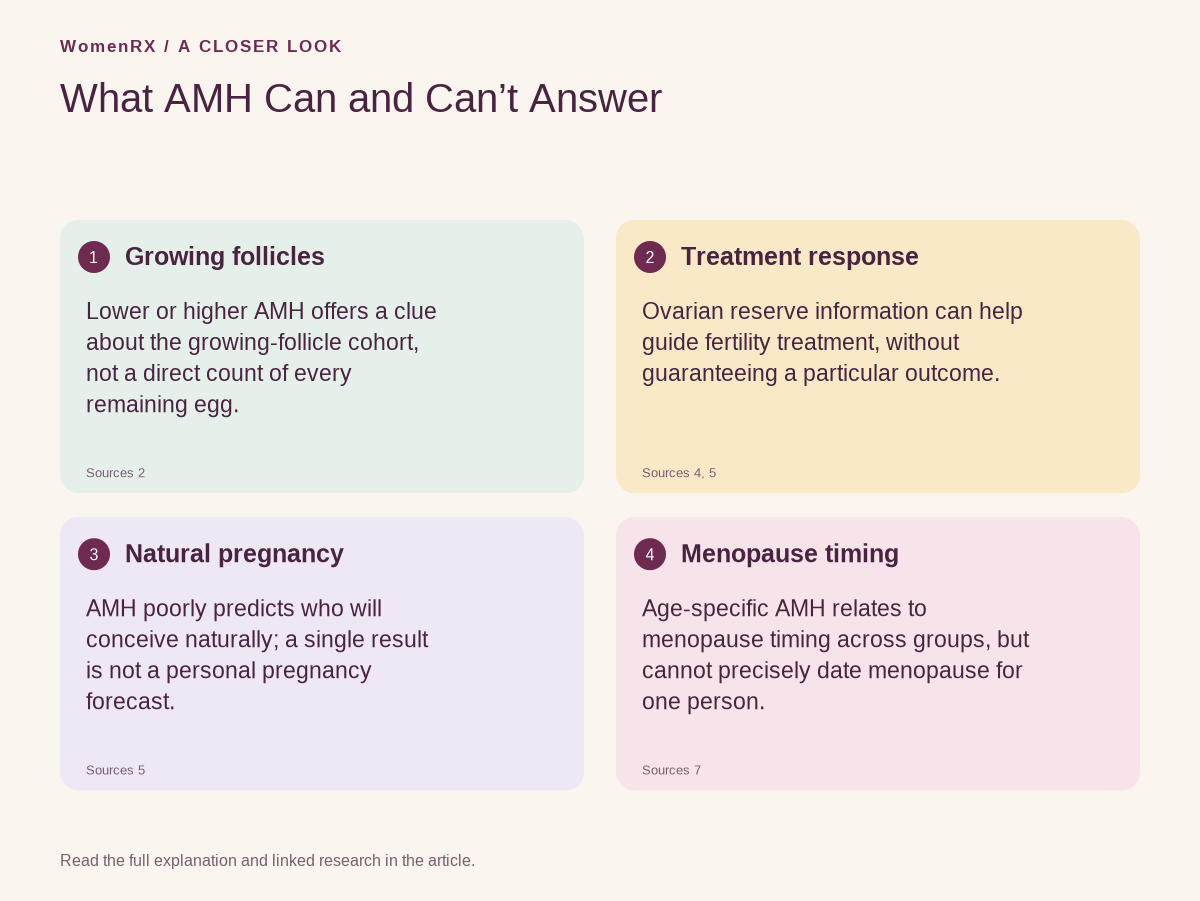
What AMH Can and Can’t Answer
Growing follicles: Lower or higher AMH offers a clue about the growing-follicle cohort, not a direct count of every remaining egg.2
Treatment response: Ovarian reserve information can help guide fertility treatment, without guaranteeing a particular outcome.45
Natural pregnancy: AMH poorly predicts who will conceive naturally; a single result is not a personal pregnancy forecast.5
Menopause timing: Age-specific AMH relates to menopause timing across groups, but cannot precisely date menopause for one person.7
Read the figure as text
Read the result according to the question you’re trying to answer.- Growing follicles: Lower or higher AMH offers a clue about the growing-follicle cohort, not a direct count of every remaining egg.2
- Treatment response: Ovarian reserve information can help guide fertility treatment, without guaranteeing a particular outcome.45
- Natural pregnancy: AMH poorly predicts who will conceive naturally; a single result is not a personal pregnancy forecast.5
- Menopause timing: Age-specific AMH relates to menopause timing across groups, but cannot precisely date menopause for one person.7
Sources you can check
- Ovarian reserve markers in World Health Organization type 1 anovulatory disorders: a systematic review and meta-analysis.de Jong SMH, de Kat AC, Schoonmade LJ, Hillebrand JJ, van Wely M, van Loendersloot LL. · Reproductive biomedicine online · 2026Return to first citation
- Anti-Müllerian hormone and somatic ovarian function: a new perspective.Çelik Ö, Çelik N, Ersahin A, Gungor N, Gungor K, Celik S. · Journal of assisted reproduction and genetics · 2026Return to first citation
- Functional hypothalamic amenorrhea and anti-Müllerian hormone: insights for fertility assessment.Notaristefano G, Tropea A, Samasiuk A, Ranalli M, Policriti MA, Diterlizzi A, Ghi T, Lanzone A, Apa R. · Journal of endocrinological investigation · 2026Return to first citation
- Fertility evaluation of infertile women: a committee opinion (2021) | American Society for Reproductive Medicine | ASRMAccessed 2026-09-25Return to first citation
- The Value of Anti-Müllerian Hormone in the Prediction of Spontaneous Pregnancy: A Systematic Review and Meta-Analysis.Lin C, Jing M, Zhu W, Tu X, Chen Q, Wang X, Zheng Y, Zhang R. · Frontiers in endocrinology · 2021Return to first citation
- Investigating the Clinical Utility of the Anti-Mullerian Hormone Testing for the Prediction of Age at Menopause and Assessment of Functional Ovarian Reserve: A Practical Approach and Recent Updates.Tehrani FR, Firouzi F, Behboudi-Gandevani S. · Aging and disease · 2022Return to first citation
- Anti-Müllerian hormone for the diagnosis and prediction of menopause: a systematic review.Nelson SM, Davis SR, Kalantaridou S, Lumsden MA, Panay N, Anderson RA. · Human reproduction update · 2023Return to first citation