What Your FSH Result Can Tell You About Menopause
FSH generally rises through the menopausal transition, but your age and period history give the result its meaning.
An FSH result can add to the picture, but it can’t independently tell you your menopause stage or date your final period. FSH tends to rise across the transition, while reproductive staging also considers age and menstrual patterns. If periods become infrequent or stop before age 40, FSH has a different role in evaluating possible premature ovarian insufficiency. 1 2 6
Start with the question behind the test
Follicle-stimulating hormone, or FSH, tends to increase as women move through the menopausal transition. In a longitudinal analysis of women in the US Study of Women’s Health Across the Nation, the group’s FSH trajectory rose progressively and peaked after the final menstrual period. A separate longitudinal study of Korean women also found that FSH increased as menopausal stage advanced. Those findings describe patterns over time, not a number that dates one person’s final period. 2 3
So before comparing your result with an online chart, ask what you’re trying to learn. Are your periods changing in midlife? Have they stopped? Or were you tested because they became infrequent at a younger age? The same FSH result can be part of a different assessment in each situation. A research staging protocol, for example, considers age and menstrual-cycle patterns alongside FSH and other measures rather than using FSH alone. 1
If your periods are changing in midlife
A changing cycle is information in its own right. For example, if your periods have become less predictable and you’ve begun having hot flashes or night sweats, those details help explain why menopause is being considered; FSH adds another piece rather than replacing that history. Hot flashes and night sweats can occur during the transition, while FSH follows a changing trajectory across it. 1 2
A lab report may flag a result against a reference range. That flag answers a narrower question than “Am I in menopause?” It doesn’t account on its own for your age, bleeding pattern or the reason the test was ordered. In particular, a threshold used to assess ovarian insufficiency before age 40 should not be borrowed as a universal midlife menopause cutoff. 1 6
If you’ve had no period for a year
Menopause is generally identified after the final menstrual period, using the history of 12 months without menstruation. A systematic review discussing menopause diagnosis found no study testing whether an AMH blood test could shorten that 12-month interval. An FSH result likewise shouldn’t be treated as a way to date your final period more precisely than your history allows. 5 2
If bleeding history is hard to interpret, say so when discussing the result. For example, researchers using menstrual patterns to stage reproductive aging considered IUD status separately in their protocol. That doesn’t provide a do-it-yourself rule for interpreting an FSH value, but it shows why the circumstances behind a period history matter. 1
If periods became sparse or stopped before 40
This calls for a different assessment: possible premature ovarian insufficiency, or POI. A 2025 international evidence-based guideline says one elevated FSH measurement can meet its laboratory criterion for POI; repeat FSH and/or AMH testing may be needed when the diagnosis is uncertain. A 2026 expert opinion describes POI before age 40 in the setting of at least four months of infrequent or absent periods together with elevated FSH. These sources address suspected POI, not a cutoff for assigning every woman in midlife a menopause stage. 6 4
If that’s why your test was ordered, the useful follow-up is specific: how does the result fit the duration and pattern of missed periods, and is there any uncertainty that needs resolving? If you’re instead in the midlife transition, ask what your period history and symptoms already suggest and whether the FSH result changes that interpretation. You don’t need to make the number answer a question it wasn’t designed to settle. 1 4 6
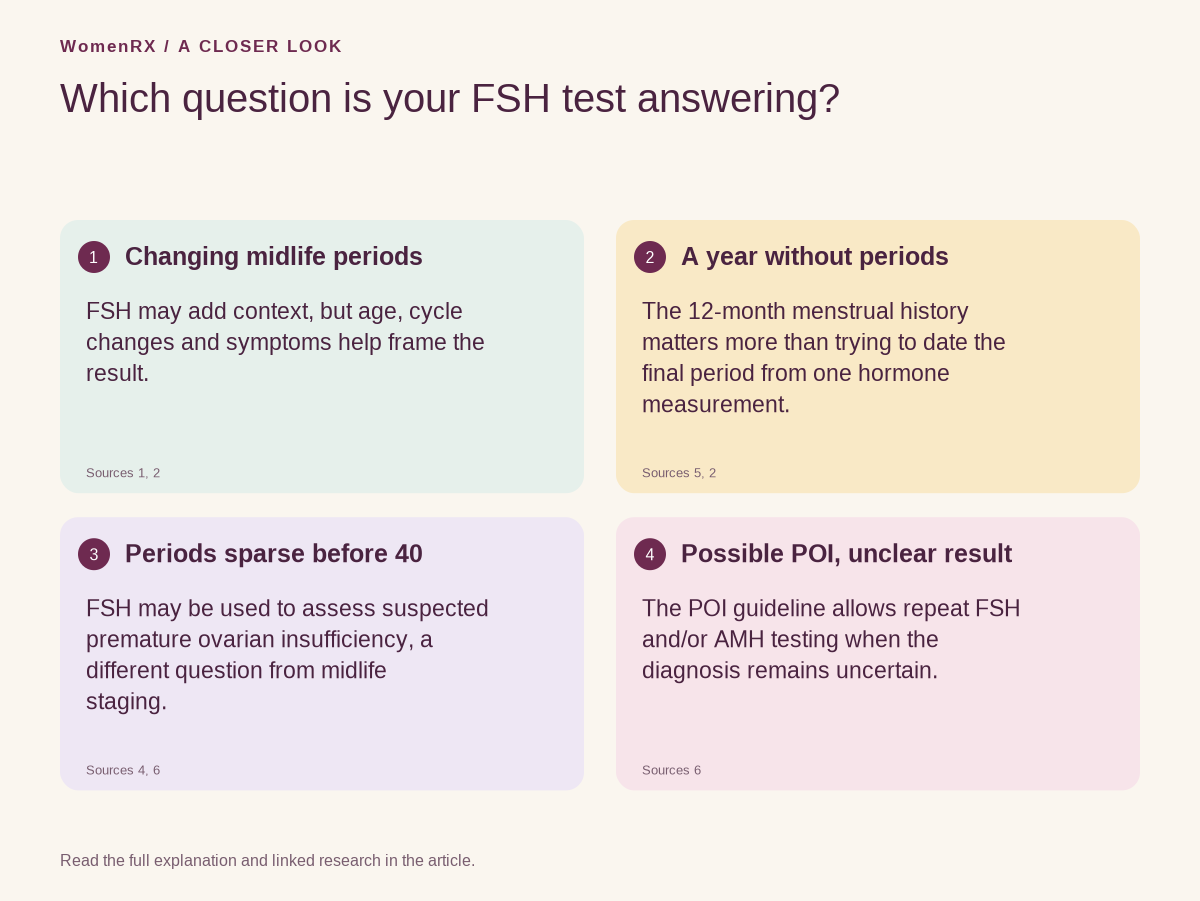
Which question is your FSH test answering?
Changing midlife periods: FSH may add context, but age, cycle changes and symptoms help frame the result.12
A year without periods: The 12-month menstrual history matters more than trying to date the final period from one hormone measurement.52
Periods sparse before 40: FSH may be used to assess suspected premature ovarian insufficiency, a different question from midlife staging.46
Possible POI, unclear result: The POI guideline allows repeat FSH and/or AMH testing when the diagnosis remains uncertain.6
Read the figure as text
Match the result to your period history and age before looking for a cutoff.- Changing midlife periods: FSH may add context, but age, cycle changes and symptoms help frame the result.12
- A year without periods: The 12-month menstrual history matters more than trying to date the final period from one hormone measurement.52
- Periods sparse before 40: FSH may be used to assess suspected premature ovarian insufficiency, a different question from midlife staging.46
- Possible POI, unclear result: The POI guideline allows repeat FSH and/or AMH testing when the diagnosis remains uncertain.6
Sources you can check
- Women in healthy transition deep phenotyping cohort study protocol (KiSO-DP): a within-participant multidisciplinary longitudinal cohort study across the menopausal transition.Tamariz-Ellemann A, Kleis-Olsen AS, Andersen AB, Thomsen LB, Rocha MP, Frydenholm JF, Jensen JS, Loekkegaard ECL, Hellsten Y, Hybholt M, Gliemann L. · BMJ open · 2026Return to first citation
- Insulin Levels Early in Perimenopause Inform Vasomotor Symptom Incidence Across the Menopausal Transition.Athar F, Gregory S, Houston EJ, Templeman NM. · The Journal of clinical endocrinology and metabolism · 2026Return to first citation
- Longitudinal changes in mammographic density and reproductive hormones during the menopausal transition in middle-aged Korean women: effect modification by obesity.Cho Y, Jang Y, Woo HY, Chang Y, Ryu S. · Breast cancer research : BCR · 2025Return to first citation
- Expert opinion by the Italian Society of Gynecology of the Third Age (SIGiTE) and the Italian Society of Menopause (SIM) on diagnosis and treatment of premature ovarian insufficiency.Capozzi A, Ambroggio S, Cagnacci A, Gambacciani M, Lello S, DI Carlo C, Executive Committee of the Italian Society of Gynecology of the Third Age (SIGiTE) and the Italian Society o... · Minerva endocrinology · 2026Return to first citation
- Anti-Müllerian hormone for the diagnosis and prediction of menopause: a systematic review.Nelson SM, Davis SR, Kalantaridou S, Lumsden MA, Panay N, Anderson RA. · Human reproduction update · 2023Return to first citation
- Evidence-based guideline: Premature Ovarian Insufficiency.ESHRE, ASRM, CREWHIRL and IMS Guideline Group on POI, Panay N, Anderson RA, Bennie A, Cedars M, Davies M, Ee C, Gravholt CH, Kalantaridou S, Kallen A, Kim KQ, Misrahi M, Mousa A, N... · Fertility and sterility · 2025Return to first citation