When Does an FSH Test Help Explain Menopause?
Your age, period pattern, and use of hormonal contraception matter more to the testing decision than a single FSH number.
An FSH blood test measures follicle-stimulating hormone, but it can’t tell you exactly when your final period will happen. At 45 or older, recently started hot flashes with menstrual changes can provide a basis for identifying perimenopause.5 FSH has a defined diagnostic role when premature ovarian insufficiency (POI) is suspected before 40, with the result interpreted alongside your cycle history and hormone use.2 For ages 40 to 45, the question is what testing would clarify; the POI cutoff is not a general menopause cutoff.25
What the number can tell you
FSH stands for follicle-stimulating hormone. A blood test measures its concentration at the time your sample is taken. An elevated result can help support a diagnosis of premature ovarian insufficiency (POI) when periods have become irregular or stopped before age 40.2 It isn’t a countdown to your final period.4 A number on its own doesn’t establish why your periods have changed.2
That distinction matters because the useful question isn’t simply, “Is my FSH high?” It’s, “Would this result change how we understand what’s happening?”
If you’re 45 or older, start with the pattern
For example, if you’re 48, your periods have become less predictable, and you’ve recently started having hot flashes, that pattern can help identify perimenopause. NICE guidance describes recently started vasomotor symptoms alongside menstrual changes as a basis for identifying perimenopause at age 45 or older.5
A test also won’t tell you how much relief you need. If hot flashes are disrupting sleep or daily life, that’s worth discussing in its own right. The North American Menopause Society’s hormone-therapy statement frames treatment decisions around symptoms and an individual assessment of benefits and risks.3
Before 45, the question changes
Changes that suggest menopause in your early 40s deserve a closer look than the same pattern later on. NICE guidance separately addresses people ages 40 to 45 who have menopause-associated symptoms, including a change in their menstrual cycle. In this age group, the useful discussion is what the test is intended to clarify and how its result would be interpreted with your symptoms and history. These age-group recommendations do not establish an FSH cutoff for menopause in your early 40s; the POI criteria below address suspected POI before 40.25
Before 40, prolonged irregular or absent periods raise a more specific question: could this be POI? The 2024 international POI guideline recommends diagnosing it from at least four months of disordered menstrual cycles together with an elevated FSH concentration above 25 IU/L. That threshold is for suspected POI, not a general cutoff that diagnoses menopause at every age. The guideline says to repeat FSH after four to six weeks if the diagnosis remains uncertain; testing for POI doesn’t have to fall on a particular cycle day.2
There’s a reason to take that distinction seriously. POI can affect fertility and longer-term health as well as symptoms, so identifying it may lead to conversations that differ from those in a typical midlife transition.12
What can make a result hard to read?
When FSH is being used to assess suspected POI, hormonal contraception can change the picture in two ways: it may conceal or cause absent or irregular bleeding, and it may lower FSH. That includes oral, injectable, and long-acting hormonal methods. If you’re using one, make sure the person interpreting your result knows which method you use. The POI guideline notes that some hormonal therapy may need to be stopped before POI can be confirmed, but that decision needs to account for why you’re using it. Don’t treat a low result while on hormones as proof that ovarian function is unchanged.2
If your periods have stopped and pregnancy is possible, that’s another question to resolve rather than assuming the change is menopause; the POI guideline specifically calls for excluding pregnancy when assessing absent periods.2
An FSH result is most useful when it answers a defined clinical question. At 48 with a recognizable symptom and cycle pattern, those changes may identify perimenopause. At 38 with months of unexpected period changes, testing may be part of finding out whether POI is the explanation. Neither situation is settled by reading one number in isolation.25
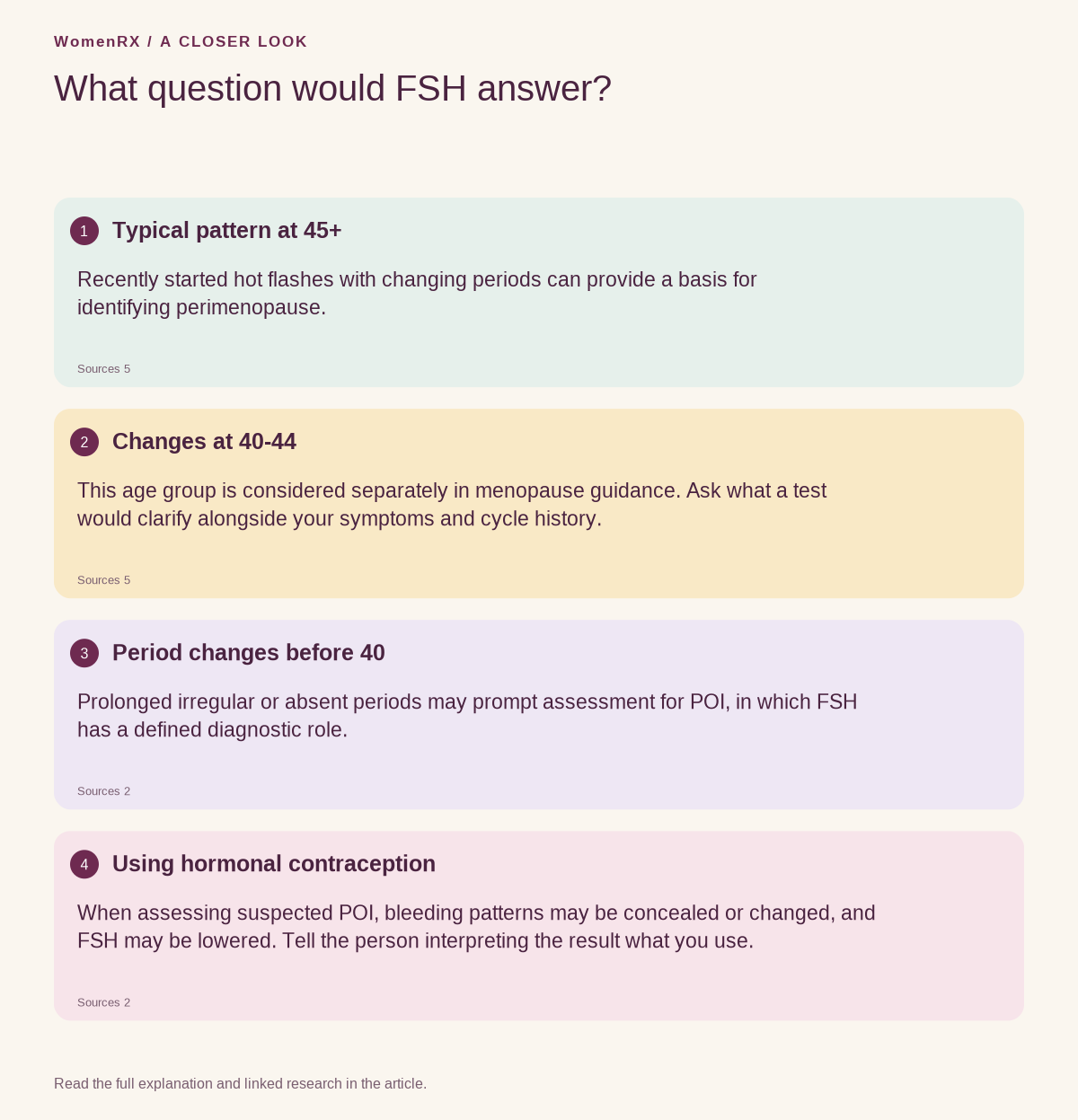
What question would FSH answer?
Typical pattern at 45+: Recently started hot flashes with changing periods can provide a basis for identifying perimenopause.5
Changes at 40-44: This age group is considered separately in menopause guidance. Ask what a test would clarify alongside your symptoms and cycle history.5
Period changes before 40: Prolonged irregular or absent periods may prompt assessment for POI, in which FSH has a defined diagnostic role.2
Using hormonal contraception: When assessing suspected POI, bleeding patterns may be concealed or changed, and FSH may be lowered. Tell the person interpreting the result what you use.2
Read the figure as text
Start with your age and menstrual pattern, then consider anything that could change how a result is read.- Typical pattern at 45+: Recently started hot flashes with changing periods can provide a basis for identifying perimenopause.5
- Changes at 40-44: This age group is considered separately in menopause guidance. Ask what a test would clarify alongside your symptoms and cycle history.5
- Period changes before 40: Prolonged irregular or absent periods may prompt assessment for POI, in which FSH has a defined diagnostic role.2
- Using hormonal contraception: When assessing suspected POI, bleeding patterns may be concealed or changed, and FSH may be lowered. Tell the person interpreting the result what you use.2
More questions, answered
Does FSH testing have to be done on a particular day of my cycle?
Not when it’s being used to assess suspected premature ovarian insufficiency. The 2024 POI guideline says it needn’t be timed to a specific cycle day and recommends a repeat test after four to six weeks if the diagnosis is uncertain. That guidance shouldn’t be assumed to cover every other reason for ordering FSH.2
Can FSH tell me how soon menopause will happen?
No single FSH result gives you a reliable date for your final period. A review of research on predicting natural menopause found no established screening tool for predicting that age; it also found that another marker, AMH, appeared more predictive of time to menopause than FSH, while proposed prediction models still needed more study.4
Sources you can check
- Evidence-based guideline: premature ovarian insufficiency†‡.ESHRE, ASRM, CREWHIRL and IMS Guideline Group on POI, Panay N, Anderson RA, Bennie A, Cedars M, Davies M, Ee C, Gravholt CH, Kalantaridou S, Kallen A, Kim KQ, Misrahi M, Mousa A, N... · Climacteric : the journal of the International Menopause Society · 2024Return to first citation
- Evidence-based guideline: premature ovarian insufficiency.Panay N, Anderson RA, Bennie A, Cedars M, Davies M, Ee C, Gravholt CH, Kalantaridou S, Kallen A, Kim KQ, Misrahi M, Mousa A, Nappi RE, Rocca WA, Ruan X, Teede H, Vermeulen N, Vogt ... · Human reproduction open · 2024Return to first citation
- The 2022 hormone therapy position statement of The North American Menopause Society.“The 2022 Hormone Therapy Position Statement of The North American Menopause Society” Advisory Panel. · Menopause (New York, N.Y.) · 2022Return to first citation
- Anti-Mullerian hormone - a marker of upcoming menopause or a questionable guesswork?Warzecha D, Szymusik I, Pietrzak B, Wielgos M. · Neuro endocrinology letters · 2017Return to first citation
- Recommendations | Menopause: identification and management | Guidance | NICEAccessed 2026-09-25Return to first citation