Can the Pill Hide Early Menopause?
Hormonal contraception can change bleeding patterns and affect hormone testing, so age and the specific method matter when early menopause is being assessed.
Yes. Hormonal contraception can cause absent or irregular bleeding and may lower follicle-stimulating hormone (FSH), making ovarian changes harder to assess. Symptoms may prompt a conversation, but symptoms alone cannot establish the cause. Premature ovarian insufficiency (POI) concerns ovarian function before age 40; menopause between 40 and 45 is called early menopause, and POI testing criteria don’t automatically apply to that older group. 1 3
Why bleeding may not tell the whole story
A missed period can be a meaningful clue when it happens naturally. On hormonal contraception, it may instead reflect how the method affects bleeding. The 2024 international guideline on premature ovarian insufficiency (POI) says hormonal treatments, including oral, injectable, and long-acting contraceptives, can conceal or cause absent or irregular periods and may lower FSH. The guideline specifically names combined oral contraceptives as a method that may need to be stopped before POI can be confirmed. Its warning about bleeding and FSH applies to hormonal contraception more broadly, so tell a clinician if you take a progestogen-only pill rather than assuming the same testing approach applies to every method. Whether or how to change a method is a clinical decision, not a reason to stop contraception on your own. 1
Symptoms can add context, but they don’t settle the diagnosis. Vasomotor symptoms are associated with menopause. Their timing matters, especially if they began before you started the pill, but they cannot confirm that your ovaries are the cause. For people with POI, combined hormonal contraception can be used as sex-steroid replacement and may help control symptoms. That doesn’t establish that every pill affects symptoms in the same way. The POI guideline bases diagnosis on cycle history and biochemical confirmation, not symptoms alone. 2 3 1
Age changes the question
POI refers to reduced ovarian function before age 40. Menopause between 40 and 45 is generally called early menopause. These terms describe different age groups, so it helps to tell a clinician your age and when you started the current method. 3
For POI before age 40, the guideline’s diagnostic criteria include naturally absent or irregular menstrual cycles for at least four months and an FSH concentration above 25 IU/L. The test does not need to be timed to a particular cycle day. If the result or clinical picture is uncertain, the guideline recommends repeating FSH after four to six weeks. Pregnancy should also be excluded when someone presents with absent periods. 1
Those criteria are specifically for POI. If you’re 40 to 45, an assessment can still consider vasomotor symptoms, whether bleeding changed before you began hormonal contraception, and whether your current method makes bleeding or FSH difficult to interpret. If you have absent periods, pregnancy may also need to be ruled out. Those pieces of history give the clinician something more useful than pill-related bleeding alone, but the POI threshold above should not automatically be treated as a diagnostic rule for early menopause. 1 2 3
What to bring into the assessment
A useful conversation starts with details that help separate your body’s pattern from the method’s effects: your age; the name and type of contraception; whether you take it continuously or have scheduled breaks; when bleeding changed; and any vasomotor symptoms. If you know when those symptoms began, mention that too. These details don’t diagnose POI, but they help frame whether bleeding is a reliable clue and how test results should be interpreted. The guideline also highlights that contraceptive hormones can affect both bleeding and FSH. 1 2
Ask what the assessment is meant to answer: whether POI is being considered, whether the current method makes testing difficult, and what the findings would mean at your age. For POI, a single elevated FSH can meet the guideline’s laboratory threshold when the other criteria fit, but repeat testing may be appropriate when there is diagnostic uncertainty. The guideline does not recommend diagnosing POI from estradiol alone; a low result may add support when FSH is elevated. 1
Keep contraception and diagnosis as separate needs
A test plan should account for pregnancy prevention as well as diagnosis. If a combined pill or another hormonal method is affecting the assessment, ask how any proposed change would be handled and what contraception to use during that time. The guideline says some hormonal therapy may need to be ceased before POI can be confirmed, but it does not mean everyone taking the pill needs to stop it. 1
The practical point is simple: bleeding on the pill may not reveal what your ovaries are doing, and hormone results may also need careful interpretation. Your age and method help determine what can be learned from symptoms, menstrual history, and testing. 1
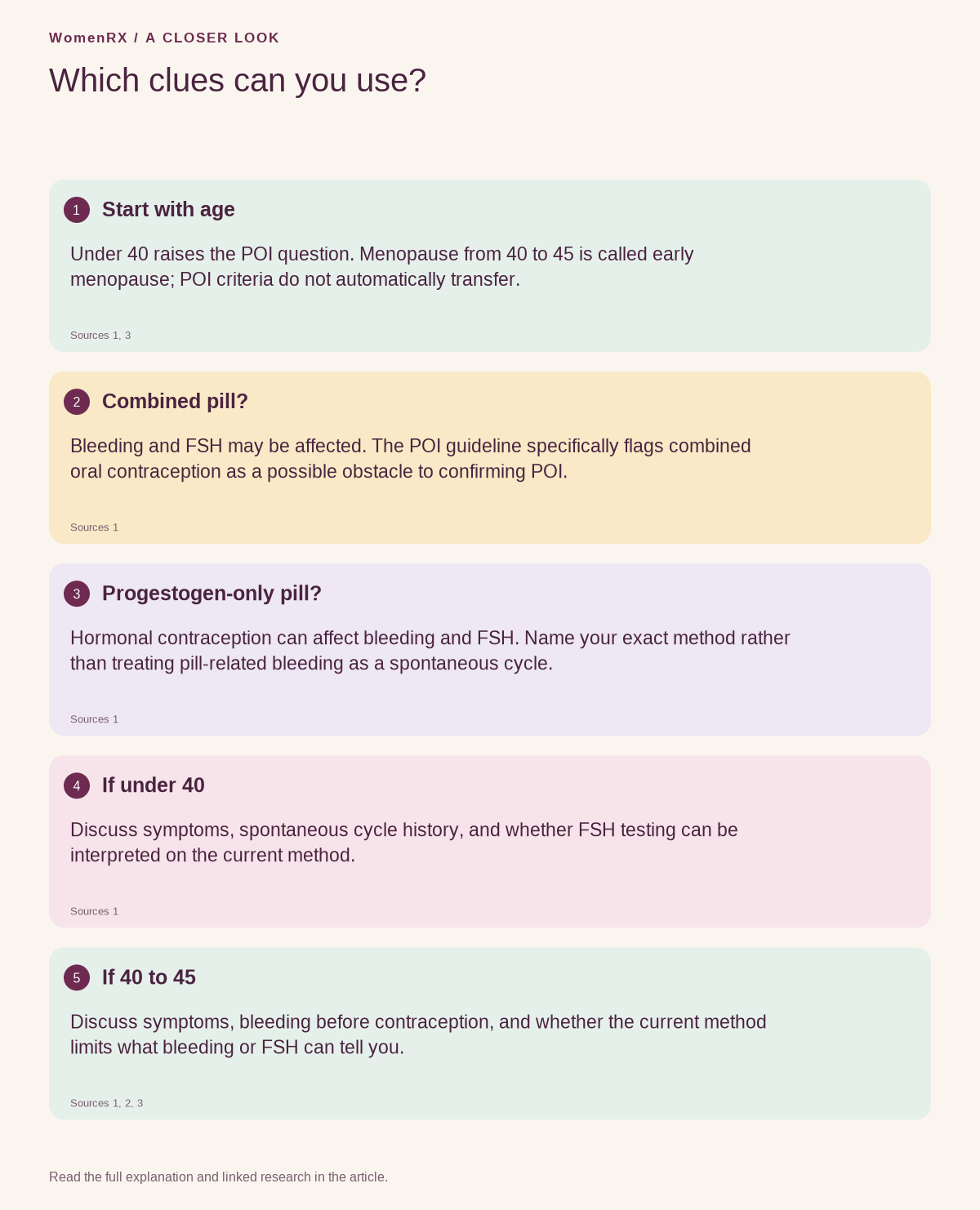
Which clues can you use?
Start with age: Under 40 raises the POI question. Menopause from 40 to 45 is called early menopause; POI criteria do not automatically transfer.13
Combined pill?: Bleeding and FSH may be affected. The POI guideline specifically flags combined oral contraception as a possible obstacle to confirming POI.1
Progestogen-only pill?: Hormonal contraception can affect bleeding and FSH. Name your exact method rather than treating pill-related bleeding as a spontaneous cycle.1
If under 40: Discuss symptoms, spontaneous cycle history, and whether FSH testing can be interpreted on the current method.1
If 40 to 45: Discuss symptoms, bleeding before contraception, and whether the current method limits what bleeding or FSH can tell you.123
Read the figure as text
Start with age, then consider how the contraceptive method affects the clues. This is a discussion pathway, not a diagnostic test.- Start with age: Under 40 raises the POI question. Menopause from 40 to 45 is called early menopause; POI criteria do not automatically transfer.13
- Combined pill?: Bleeding and FSH may be affected. The POI guideline specifically flags combined oral contraception as a possible obstacle to confirming POI.1
- Progestogen-only pill?: Hormonal contraception can affect bleeding and FSH. Name your exact method rather than treating pill-related bleeding as a spontaneous cycle.1
- If under 40: Discuss symptoms, spontaneous cycle history, and whether FSH testing can be interpreted on the current method.1
- If 40 to 45: Discuss symptoms, bleeding before contraception, and whether the current method limits what bleeding or FSH can tell you.123
More questions, answered
Can an FSH blood test diagnose POI while I’m taking the pill?
Hormonal contraception may affect bleeding and may lower FSH. The POI guideline specifically says a combined oral contraceptive may need to be stopped before POI can be confirmed. Tell the clinician your exact method so you can discuss how to interpret a result and maintain pregnancy prevention if a change is proposed. Don’t stop a method just to take a test. 1
Is early menopause the same as POI?
No. POI refers to ovarian insufficiency before age 40, while menopause between 40 and 45 is described as early menopause. The diagnostic criteria described above address POI, not early menopause. 1 3
Sources you can check
- Evidence-based guideline: premature ovarian insufficiency.Panay N, Anderson RA, Bennie A, Cedars M, Davies M, Ee C, Gravholt CH, Kalantaridou S, Kallen A, Kim KQ, Misrahi M, Mousa A, Nappi RE, Rocca WA, Ruan X, Teede H, Vermeulen N, Vogt ... · Human reproduction open · 2024Return to first citation
- The 2022 hormone therapy position statement of The North American Menopause Society.“The 2022 Hormone Therapy Position Statement of The North American Menopause Society” Advisory Panel. · Menopause (New York, N.Y.) · 2022Return to first citation
- Premature ovarian insufficiency, early menopause, and induced menopause.Hamoda H, Sharma A. · Best practice & research. Clinical endocrinology & metabolism · 2024Return to first citation