Period Five Days Early: What Matters More Than the Date
A five-day shift means more when you compare it with your usual cycle, the bleeding itself, and whether pregnancy is possible.
A period arriving five days early isn’t a diagnosis by itself. Count from the first day of your last period to the first day of this bleeding, then compare that gap with your usual cycles. A familiar flow on a shifted date is different from spotting between periods or unusually heavy bleeding. If pregnancy is possible, don’t use the bleeding date to rule it out. 157
Start with the gap between periods
Your expected date is a prediction, not a deadline your body has to meet. A menstrual cycle runs from the first day of one period to the day before the next. Cycles average about 28 days, but regular cycles can be shorter or longer, from 21 to 35 days. What’s usual for you matters alongside that range. 67
For example, if you expected a period 28 days after the last one started and bleeding began five days earlier, the gap was 23 days. That’s different from expecting a period after 24 days and bleeding on day 19. Neither calculation identifies a cause on its own; it shows why “five days early” leaves out a useful piece of the story. A repeated gap of less than 21 days, or a change in your normal pattern, is a reason to discuss it with a clinician. 56
If this is one earlier start and the flow, length, and symptoms feel like your usual period, you can note the date and see what happens next cycle. Record the first day of bleeding, how long it lasts, and whether the amount is familiar. Tracking helps you see a pattern rather than relying on one predicted date. 56
Is it a period or bleeding between periods?
A shifted period and spotting partway through a cycle can look similar when they first appear. The distinction becomes clearer as you watch what happens: does the bleeding develop into your usual flow and last about as long as your periods normally do, or is it light, brief, and separate from the period you expected? This is an observation to make, not a way to diagnose the cause at home. 16
Bleeding between periods deserves a medical check, even when it’s light. Possible causes include hormonal contraception, polyps or fibroids, and sexually transmitted infections. Bleeding after sex also warrants evaluation. Likewise, contact a clinician if your periods keep changing pattern, the gap between them is repeatedly outside 21 to 35 days, or bleeding lasts longer than seven days. 58
Amount matters as much as timing. A period that’s much heavier than yours normally is, or heavy enough to disrupt daily life, deserves attention rather than being dismissed because it arrived early. Contact a clinician about a marked change in bleeding. 16
When pregnancy could change the next step
Bleeding five days before an expected period cannot, by its timing alone, tell you whether you’re pregnant. If pregnancy is possible and this bleeding is unusual for you, taking a pregnancy test is a sensible next step. Arrange a medical check for unexpected bleeding rather than assuming an early bleed settles the pregnancy question. 78
There’s one combination of symptoms that shouldn’t wait for another cycle: a recently missed period, unusual vaginal bleeding, and pain anywhere in your abdomen or pelvis. Seek prompt medical assessment because this can be a sign of ectopic pregnancy. If you already know you’re pregnant and have vaginal bleeding, contact your pregnancy care team promptly. 18
Why your predicted date may be less reliable right now
A recent change in contraception can disturb your usual bleeding pattern. Hormonal contraception is also a recognized cause of irregular periods or bleeding between periods. That includes reasons to consider your method and when it changed, not reasons to assume the method explains every new bleed. In a randomized trial of two specific combined oral contraceptive regimens, researchers recorded both scheduled bleeding and unscheduled bleeding or spotting; the patterns differed between the regimens. Those results don’t predict what will happen with every pill or with progestin-only contraception. 2568
The years approaching menopause can make periods less predictable, too. Irregular cycles are more likely during that transition, but a new bleeding pattern still merits attention rather than an automatic “it’s perimenopause” explanation. Hormonal changes and conditions such as fibroids can coexist. Bleeding after menopause is different from an early period and should be assessed. 1345
The useful question isn’t simply, “Was it five days early?” It’s: How long was this cycle compared with my usual ones, and is this bleeding otherwise familiar? That comparison helps you decide whether to watch a single shift, check on possible pregnancy, or get new, recurrent, between-period, or unusually heavy bleeding assessed. 1568
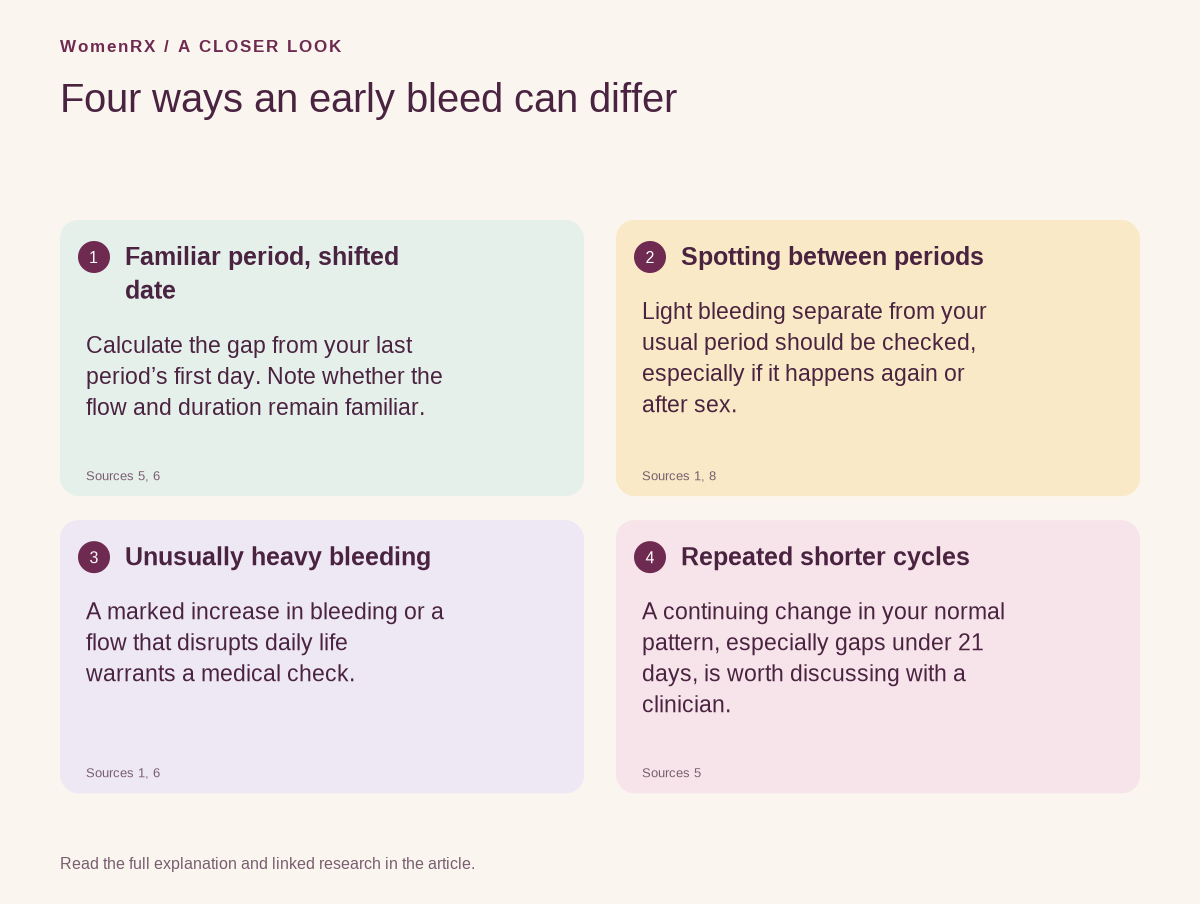
Four ways an early bleed can differ
Familiar period, shifted date: Calculate the gap from your last period’s first day. Note whether the flow and duration remain familiar.56
Spotting between periods: Light bleeding separate from your usual period should be checked, especially if it happens again or after sex.18
Unusually heavy bleeding: A marked increase in bleeding or a flow that disrupts daily life warrants a medical check.16
Repeated shorter cycles: A continuing change in your normal pattern, especially gaps under 21 days, is worth discussing with a clinician.5
Read the figure as text
Compare the bleeding with your usual period, not just the date you expected it.- Familiar period, shifted date: Calculate the gap from your last period’s first day. Note whether the flow and duration remain familiar.56
- Spotting between periods: Light bleeding separate from your usual period should be checked, especially if it happens again or after sex.18
- Unusually heavy bleeding: A marked increase in bleeding or a flow that disrupts daily life warrants a medical check.16
- Repeated shorter cycles: A continuing change in your normal pattern, especially gaps under 21 days, is worth discussing with a clinician.5
More questions, answered
Can stress make a period come early?
Stress and anxiety are listed among possible causes of irregular periods, but they can’t confirm why one particular period arrived early. Compare this cycle with your usual pattern rather than assigning a cause from timing alone. 5
What if the bleeding stops after a little spotting?
If it never becomes your usual period, think of it as unexpected bleeding rather than automatically counting it as a new cycle. Bleeding between periods should be checked, particularly if it recurs or happens after sex. 18
Sources you can check
- Vaginal Bleeding | Uterine Fibroids | MedlinePlusAccessed 2026-09-25Return to first citation
- Scheduled and unscheduled bleeding patterns with two combined hormonal contraceptives: application of new recommendations for standardization.Hampton RM, Fisher AC, Pagano S, LaGuardia KD. · Fertility and sterility · 2009Return to first citation
- Uterine Leiomyomas Across the Menopausal Transition.Encalada-Soto D, Hochberg LS, Laughlin-Tommaso S. · Obstetrics and gynecology · 2026Return to first citation
- Complex benign gynecology in perimenopause: current evidence and future directions.Goren R, Shats M, Ciesielski K, Siedhoff M, Meyer R. · Current opinion in obstetrics & gynecology · 2026Return to first citation
- Irregular periods - NHSAccessed 2026-09-25Return to first citation
- Period problems - NHSAccessed 2026-09-25Return to first citation
- Periods and fertility in the menstrual cycle - NHSAccessed 2026-09-25Return to first citation
- Vaginal bleeding between periods or after sex - NHSAccessed 2026-09-25Return to first citation