A Period 10 Days Early or Unexpected Bleeding?
Count from your last period’s first day, then consider the bleeding in the context of your usual cycle and any pregnancy possibility.
Bleeding 10 days before you expected a period could be an early period or bleeding between periods. The predicted date alone can’t tell you which. Count the days from the start of your last period to the start of this bleeding, and note whether you use hormonal contraception. If the gap is under 21 days, or the bleeding seems to be between periods, arrange a medical assessment. If pregnancy is possible, ask about pregnancy testing. 568
Start with the date you know, not the date you predicted
A menstrual cycle is counted from the first day of one period to the first day of the next. It isn’t counted from the day bleeding stops, and an app’s predicted date isn’t a measurement of this cycle. Cycles can be shorter or longer than the often-quoted 28 days; a regular gap of 21 to 35 days can be normal. 57
Here’s the useful calculation: if your last period began 18 days ago and you expected your next one after 28 days, bleeding today is 10 days earlier than expected, but the observed gap is 18 days. That’s different from a period arriving 10 days earlier than predicted while still leaving, say, a 25-day gap. The first gap is below 21 days; the second falls within the usual range. This calculation tells you how short the interval is. It cannot, by itself, establish that today’s bleeding is a new period. 58
What the bleeding pattern can, and can’t, tell you
A period is bleeding that occurs as part of the menstrual cycle. Bleeding between periods is a different pattern of vaginal bleeding. If you’ve had only a little blood on wiping, you may call it spotting; if the bleeding becomes more like your usual period, you may think of it as an early period. Those descriptions are worth recording, but neither the amount nor the calendar date reliably identifies the cause. 17
Note the first day of bleeding, how much there is compared with your usual flow, how long it lasts, and whether it occurs after sex. Keep the start dates of your next periods too. That record helps show whether this was a single unexpected episode, a repeatedly short gap, or bleeding between otherwise recognizable periods. Tracking can reveal a change in your usual pattern; it isn’t a test that proves what happened this time. 678
If the gap between apparent periods is less than 21 days, or you’re bleeding between periods or after sex, arrange an appointment with a clinician. A change in your normal pattern also deserves a conversation, even if one interval falls within the usual range. Bleeding between periods has several possible explanations, including hormonal contraception, polyps or fibroids, and sexually transmitted infections. The date alone can’t distinguish among them. 68
Two details that change the next step
Hormonal contraception: If you use it, tell the clinician which method you use and whether the bleeding was expected with that method. Unscheduled bleeding or spotting can occur with progestin-only contraception and with extended or continuous combined hormonal contraception. In those situations, a bleed on an unexpected date doesn’t necessarily represent a newly shortened natural cycle. New or concerning bleeding can still be assessed rather than simply attributed to contraception. 346
Pregnancy possibility: If pregnancy is possible, don’t use the bleeding date to rule it out. A pregnancy test is among the tests used to investigate bleeding between periods. If you already know you’re pregnant and are bleeding, contact your pregnancy care team promptly. If you’ve recently missed a period and have unusual bleeding plus abdominal or pelvic pain, seek urgent medical assessment; that combination can be a sign of an ectopic pregnancy. 16
Near menopause is not the same as after menopause
Periods can become irregular as menopause approaches. Even then, bleeding between periods or a change in your usual pattern is worth discussing, rather than assuming it’s due to perimenopause. After menopause, any new vaginal bleeding or spotting needs assessment, even if it happens only once or is very light. Menopause is usually diagnosed in women over 45 after more than a year without periods. This bleeding shouldn’t be counted as an early period. 28
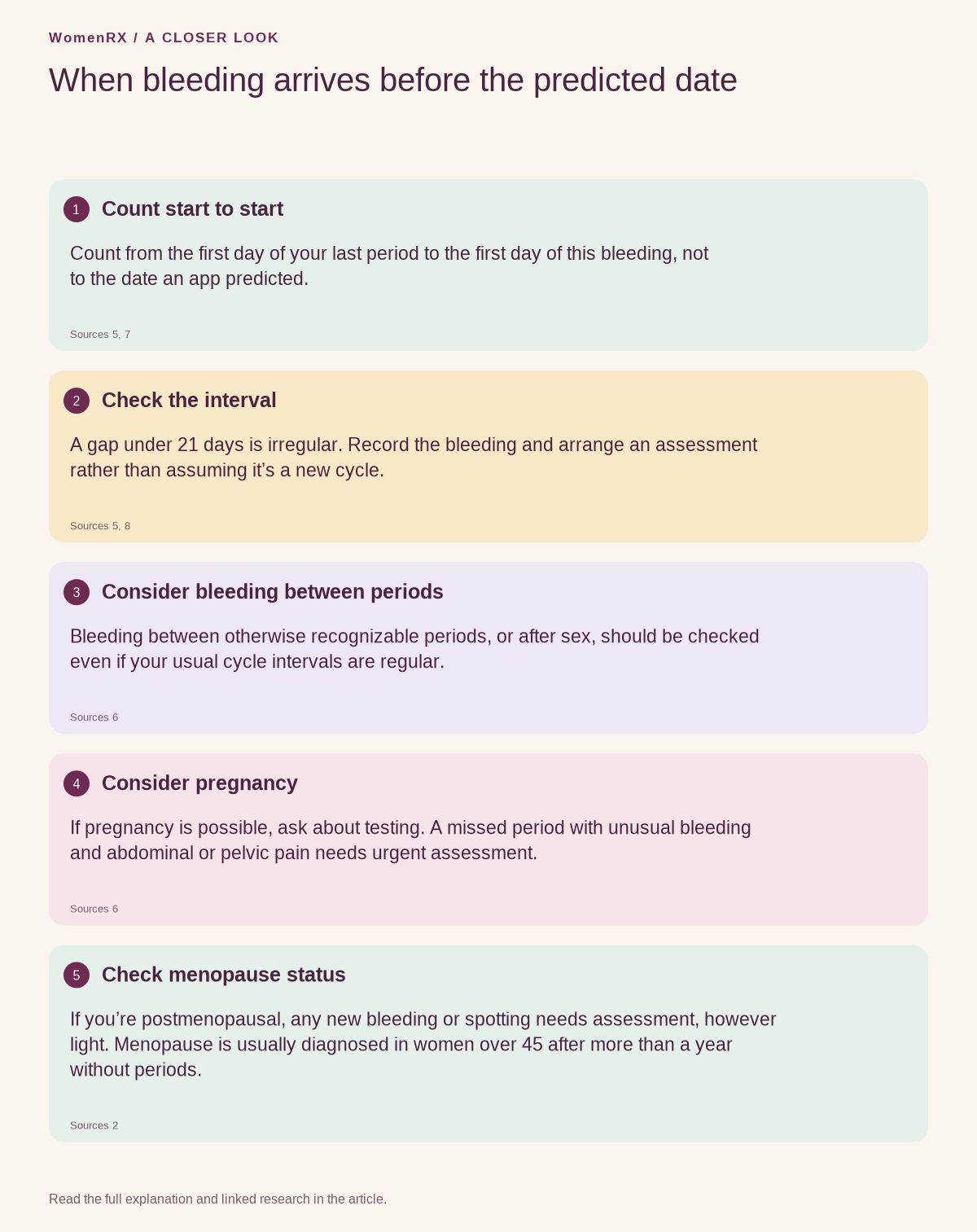
When bleeding arrives before the predicted date
Count start to start: Count from the first day of your last period to the first day of this bleeding, not to the date an app predicted.57
Check the interval: A gap under 21 days is irregular. Record the bleeding and arrange an assessment rather than assuming it’s a new cycle.58
Consider bleeding between periods: Bleeding between otherwise recognizable periods, or after sex, should be checked even if your usual cycle intervals are regular.6
Consider pregnancy: If pregnancy is possible, ask about testing. A missed period with unusual bleeding and abdominal or pelvic pain needs urgent assessment.6
Check menopause status: If you’re postmenopausal, any new bleeding or spotting needs assessment, however light. Menopause is usually diagnosed in women over 45 after more than a year without periods.2
Read the figure as text
Use the actual cycle interval and your circumstances to choose the next step; this flow cannot diagnose the bleed.- Count start to start: Count from the first day of your last period to the first day of this bleeding, not to the date an app predicted.57
- Check the interval: A gap under 21 days is irregular. Record the bleeding and arrange an assessment rather than assuming it’s a new cycle.58
- Consider bleeding between periods: Bleeding between otherwise recognizable periods, or after sex, should be checked even if your usual cycle intervals are regular.6
- Consider pregnancy: If pregnancy is possible, ask about testing. A missed period with unusual bleeding and abdominal or pelvic pain needs urgent assessment.6
- Check menopause status: If you’re postmenopausal, any new bleeding or spotting needs assessment, however light. Menopause is usually diagnosed in women over 45 after more than a year without periods.2
More questions, answered
Does bleeding 10 days early mean I ovulated early?
No. Ovulation is difficult to pinpoint from a calendar estimate, and an unexpected bleed doesn’t establish when ovulation happened or whether it happened. Start by counting the actual gap between bleeding episodes rather than assigning an ovulation date. 58
Sources you can check
- Vaginal Bleeding | Uterine Fibroids | MedlinePlusAccessed 2026-09-25Return to first citation
- Postmenopausal bleeding - NHSAccessed 2026-09-25Return to first citation
- Unscheduled vaginal bleeding with progestin-only contraceptive use.Zigler RE, McNicholas C. · American journal of obstetrics and gynecology · 2017Return to first citation
- Treatment of unscheduled bleeding in women using extended- or continuous-use combined hormonal contraception: a systematic review.Godfrey EM, Whiteman MK, Curtis KM. · Contraception · 2013Return to first citation
- Periods and fertility in the menstrual cycle - NHSAccessed 2026-09-25Return to first citation
- Vaginal bleeding between periods or after sex - NHSAccessed 2026-09-25Return to first citation
- Menstruation | Period | MedlinePlusAccessed 2026-09-25Return to first citation
- Irregular periods - NHSAccessed 2026-09-25Return to first citation