Bleeding Two Weeks Early: Spotting or a New Period?
Bleeding halfway through your usual cycle may be bleeding between periods, but timing and flow alone can’t tell you why it happened.
If you usually have a predictable cycle and notice a little blood about two weeks before your next expected period, it may be spotting between periods rather than a new period. A fuller flow that begins a new cycle is another possibility. What happens next, whether pregnancy is possible, and symptoms such as pelvic pain or heavy bleeding change the next step. 124
Start with your usual pattern, not the calendar date
“Two weeks early” means something different if your periods normally come every four weeks than if the time between them varies. Count from the start of one period to the start of the next. Bleeding that appears between otherwise regular periods is called intermenstrual bleeding. It can be a brief episode or recur at a similar point in each cycle. An earlier start to a period, by contrast, changes the length of that cycle. 1
Here’s a practical example, not a way to diagnose the cause: if your periods usually start about 28 days apart and you see a little blood around day 14, notice whether it stops and your next period arrives near its usual time. That pattern would fit bleeding between periods. If a flow much like your usual period begins on day 14 and your following period is counted from there, it may be an unusually short cycle. You may not be able to tell which pattern you’re seeing until more time has passed. Record the date, how much you bleed, and whether it develops into your usual flow. 13
What the amount of blood can and can’t tell you
People often use spotting to mean a small amount of blood and period to mean a familiar menstrual flow. Those descriptions are useful, but they aren’t diagnoses. Bleeding between periods can be light or more substantial, and one episode’s appearance can’t establish whether you ovulated or identify another cause. Ovulation is one phase of the menstrual cycle; midpoint timing by itself does not show that it caused the bleeding. 12
The amount matters for a different reason: it helps you decide how promptly to seek care. Bleeding that makes you change a pad or tampon every one to two hours, lasts more than seven days, or interferes with daily life deserves medical attention. Tell the clinician how often you’re changing products rather than relying only on the word “heavy.” 34
Check the context before calling it an early period
Hormonal contraception can cause bleeding between periods, and changing contraceptive methods can disturb your usual bleeding pattern. If you use hormonal contraception, note the method and whether you recently started or changed it. Don’t assume contraception explains a new episode, though. Other possible causes of bleeding between periods include polyps, fibroids, and sexually transmitted infections such as chlamydia. Bleeding that happens after sex is another useful distinction to mention because it can have different causes, including changes to the cervix or vaginal dryness. 23
Reproductive stage matters too. Irregular cycles can be common soon after periods begin and in the years approaching menopause. That context may make an early period more plausible, but it doesn’t identify the cause of bleeding between periods. 3
When the next step changes
If pregnancy is possible, don’t use cycle timing to rule it out. Pregnancy testing is one of the ways clinicians assess unexpected bleeding. If you’ve recently missed a period and have unusual bleeding plus abdominal or pelvic pain, seek urgent medical assessment: that combination can be a sign of ectopic pregnancy. 2
If the bleeding is between your periods or occurs after sex, arrange a medical assessment, even if it’s light. These patterns have several possible causes, and an assessment may include a pregnancy test, STI testing, an examination, or other tests depending on your situation. If it keeps happening, note whether it falls at the same point in each cycle or follows sex. That detail helps describe the pattern, but recurrence isn’t required before you get it checked. 12
If it seems to be a full period that arrived early, compare it with your usual cycles. A single earlier start and an ongoing change in cycle timing aren’t the same pattern. Note the start dates and whether the flow is unusually heavy, prolonged, or affecting your life. Those details make it easier to describe what changed and to get help for heavy or irregular periods when you need it. 34
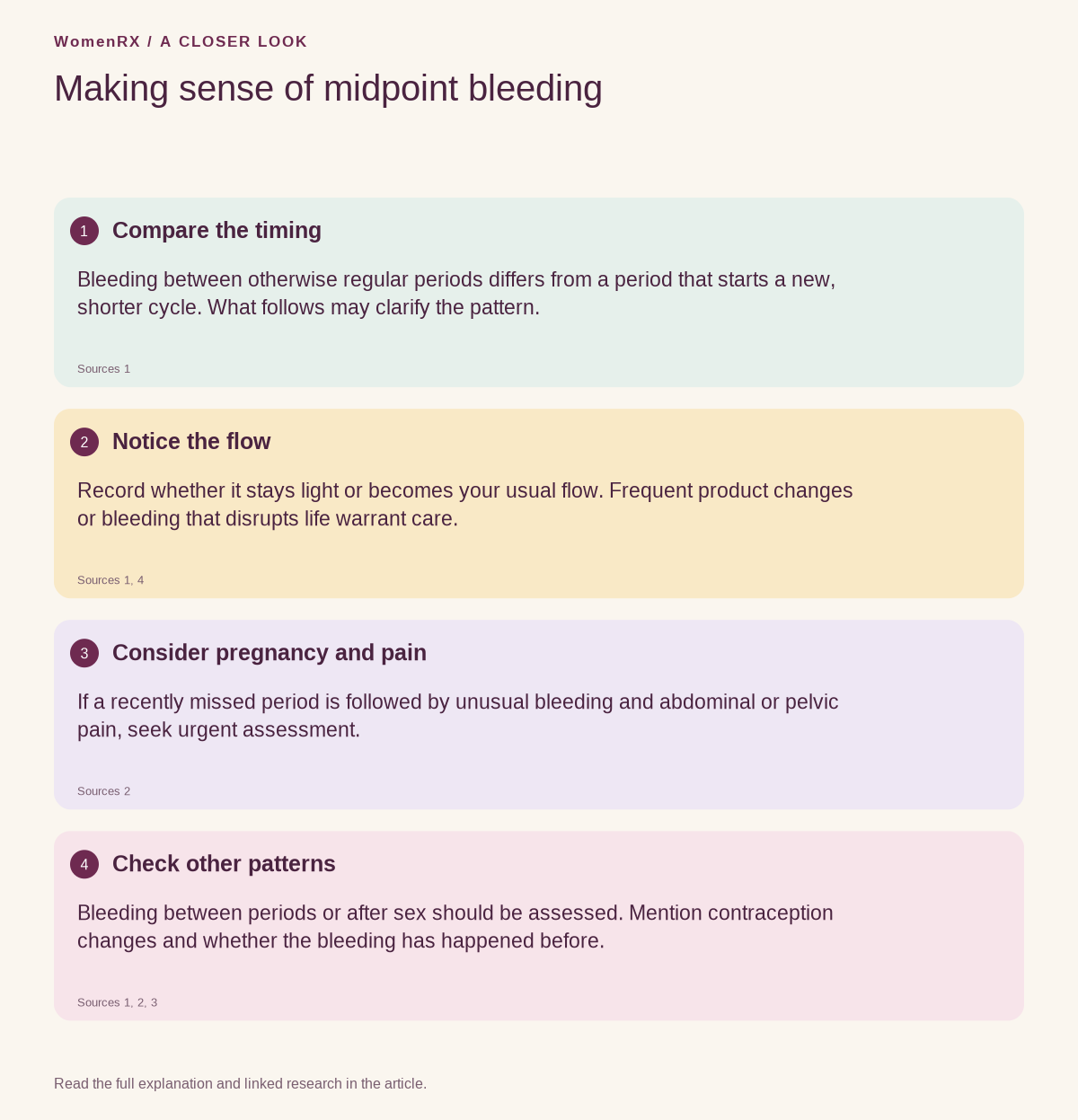
Making sense of midpoint bleeding
Compare the timing: Bleeding between otherwise regular periods differs from a period that starts a new, shorter cycle. What follows may clarify the pattern.1
Notice the flow: Record whether it stays light or becomes your usual flow. Frequent product changes or bleeding that disrupts life warrant care.14
Consider pregnancy and pain: If a recently missed period is followed by unusual bleeding and abdominal or pelvic pain, seek urgent assessment.2
Check other patterns: Bleeding between periods or after sex should be assessed. Mention contraception changes and whether the bleeding has happened before.123
Read the figure as text
Use your usual cycle as a reference, then check the details that affect your next step. This is a guide to describing bleeding, not a diagnostic test.- Compare the timing: Bleeding between otherwise regular periods differs from a period that starts a new, shorter cycle. What follows may clarify the pattern.1
- Notice the flow: Record whether it stays light or becomes your usual flow. Frequent product changes or bleeding that disrupts life warrant care.14
- Consider pregnancy and pain: If a recently missed period is followed by unusual bleeding and abdominal or pelvic pain, seek urgent assessment.2
- Check other patterns: Bleeding between periods or after sex should be assessed. Mention contraception changes and whether the bleeding has happened before.123
More questions, answered
Does bleeding exactly halfway through my cycle mean I’m ovulating?
No. Ovulation is part of the menstrual cycle, but the timing of bleeding alone can’t show that ovulation caused it. Bleeding between periods has several possible causes, including hormonal contraception, polyps, fibroids, and infections. 12
Sources you can check
- Physiology, Menstrual CycleThiyagarajan DK, Basit H, Jeanmonod R. · 2024Return to first citation
- Vaginal bleeding between periods or after sex - NHSAccessed 2026-09-25Return to first citation
- Period problems - NHSAccessed 2026-09-25Return to first citation
- Heavy periods - NHSAccessed 2026-09-25Return to first citation