A Period One Week Early or Bleeding Between Periods?
The date tells you when bleeding started, but your usual cycle and the way the bleeding unfolds give it context.
Bleeding a week before you expected your period could be the start of a shorter cycle or bleeding between periods. Count from the first day of your last period to the first day of this bleeding, then compare that gap with your usual cycles. Familiar period-like bleeding with no second bleed near the expected date points toward a shorter cycle; a separate bleed followed by your expected period points toward bleeding between periods. Neither pattern is definitive. If pregnancy is possible, consider taking a pregnancy test rather than assuming the bleeding rules it out. 246
Start with the last period, not the predicted date
A cycle runs from the first day of one period to the first day of the next. An app’s predicted date is an estimate, not the date your body has to follow. Cycles can be shorter or longer than the often-quoted 28 days and still be normal. 6
For example, if your last period began May 1 and you expected the next one around May 29, bleeding that begins May 22 is seven days earlier than predicted. If it turns out to be your next period, that cycle was 21 days long. For adults, 21 days is below the 24-to-38-day reference range; one such interval is different from a recurring pattern of short cycles. Cycles can be more irregular in adolescence. 25 If it’s a separate episode of bleeding and your period comes later, May 22 wasn’t the start of a new cycle. The calendar alone can’t settle that question: bleeding between otherwise regular periods is a distinct pattern from menstrual bleeding. 26
What the bleeding pattern can and can’t tell you
Notice whether the bleeding stays light and brief or develops into the flow and duration you usually recognize as a period. Also note whether another period-like bleed arrives around your expected date. Familiar period-like bleeding without a second bleed near the expected date points toward a shorter cycle. A separate bleed followed by a period near the expected date points toward bleeding between periods. These are tentative interpretations: even familiar-looking flow can’t reliably prove what the earlier bleeding was. 126
Your range matters more than one predicted date. If your recent periods have started at varying intervals, an earlier start may fit your pattern. Cycles are more likely to be irregular when periods first begin in adolescence and as menopause approaches. Periods may also change after childbirth or while breastfeeding. A new change in a previously steady pattern still deserves attention, especially if it keeps happening. 56
If the bleeding seems separate from your periods, don’t feel you have to identify its cause by its color or amount. Bleeding between periods has several possible causes, including hormonal contraception, polyps or fibroids, and sexually transmitted infections. Bleeding after sex can have different causes, including cervical changes or vaginal dryness. These are possibilities, not ways to diagnose yourself from a single episode. 4
One specific timing clue may be useful: in a prospective study of 232 women in Cameroon who took levonorgestrel emergency contraception, researchers observed both changes in cycle length and new bleeding between periods. Most of those changes were gone by the following cycle. If you recently used this form of emergency contraception, record when you took it, but don’t assume it explains every unexpected bleed. 3
What to record, and when to get help
For this episode, write down the start date of your last period, the start and end dates of the new bleeding, whether it was light or period-like for you, and whether you bleed again near the date you expected your period. Keep the next cycle’s start date too. That small record can show whether this was one shorter interval or bleeding that occurred between periods. Tracking period dates can help you notice changes in your usual pattern. 56
If pregnancy is possible, consider taking a pregnancy test rather than relying on how period-like the bleeding looks. A pregnancy test may also be part of a medical assessment for bleeding between periods. If you recently missed a period and have unusual bleeding with abdominal or pelvic pain, seek urgent medical assessment because this can be a sign of ectopic pregnancy. 4
Arrange a medical assessment for bleeding between periods or after sex, or for a continuing change in your usual cycle pattern. Very heavy bleeding or severe pain also warrants medical attention. Bleeding after menopause should be assessed rather than counted as an early period. 1456
Put unexpected bleeding in context
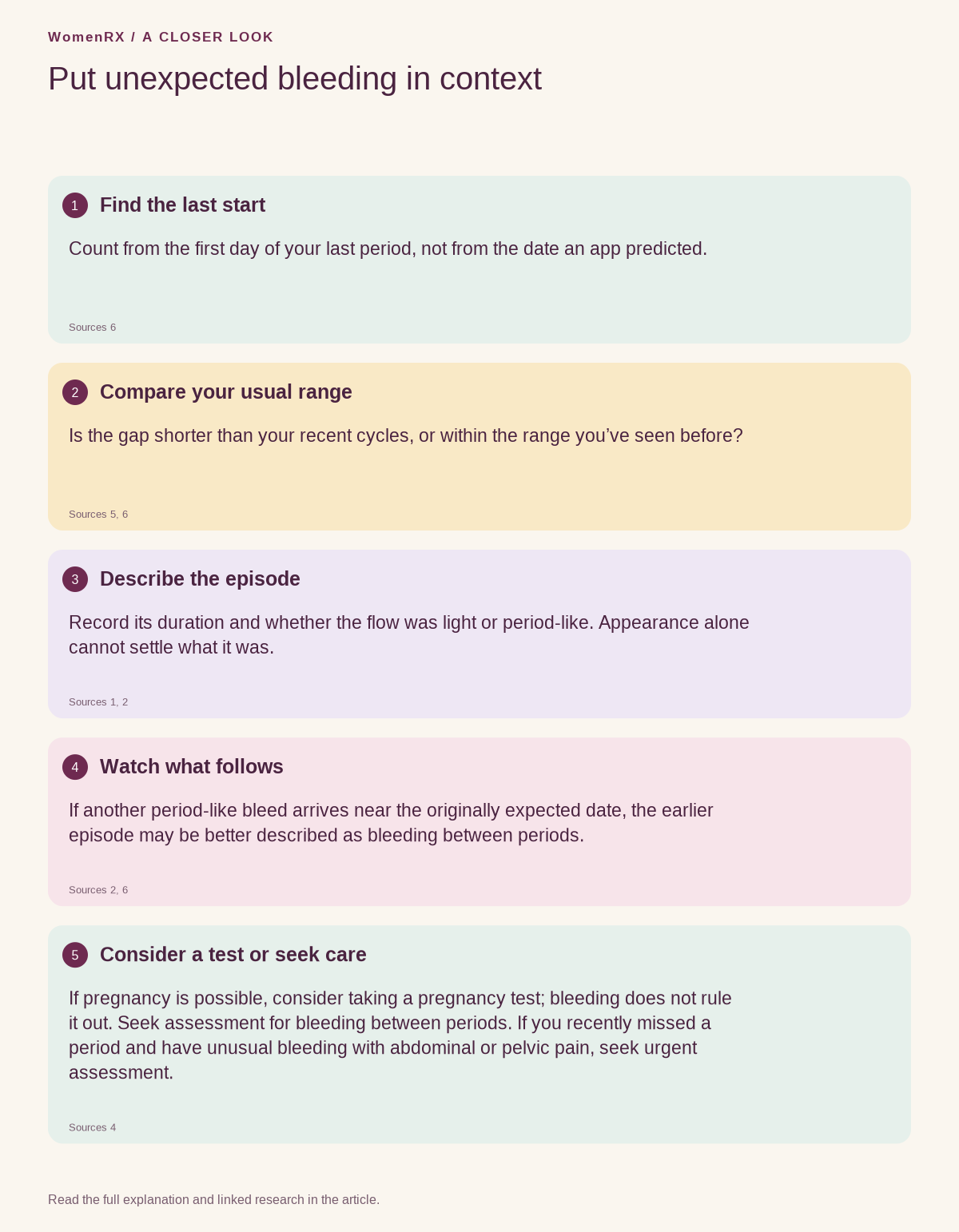
Find the last start: Count from the first day of your last period, not from the date an app predicted.6
Compare your usual range: Is the gap shorter than your recent cycles, or within the range you’ve seen before?56
Describe the episode: Record its duration and whether the flow was light or period-like. Appearance alone cannot settle what it was.12
Watch what follows: If another period-like bleed arrives near the originally expected date, the earlier episode may be better described as bleeding between periods.26
Consider a test or seek care: If pregnancy is possible, consider taking a pregnancy test; bleeding does not rule it out. Seek assessment for bleeding between periods. If you recently missed a period and have unusual bleeding with abdominal or pelvic pain, seek urgent assessment.4
Read the figure as text
Use the dates and what happens next to describe the bleeding without assuming an early start is necessarily a period.- Find the last start: Count from the first day of your last period, not from the date an app predicted.6
- Compare your usual range: Is the gap shorter than your recent cycles, or within the range you’ve seen before?56
- Describe the episode: Record its duration and whether the flow was light or period-like. Appearance alone cannot settle what it was.12
- Watch what follows: If another period-like bleed arrives near the originally expected date, the earlier episode may be better described as bleeding between periods.26
- Consider a test or seek care: If pregnancy is possible, consider taking a pregnancy test; bleeding does not rule it out. Seek assessment for bleeding between periods. If you recently missed a period and have unusual bleeding with abdominal or pelvic pain, seek urgent assessment.4
Sources you can check
- Vaginal Bleeding | Uterine Fibroids | MedlinePlusAccessed 2026-09-25Return to first citation
- Physiology, Menstrual CycleThiyagarajan DK, Basit H, Jeanmonod R. · 2024Return to first citation
- Menstrual bleeding patterns following levonorgestrel emergency contraception.Gainer E, Kenfack B, Mboudou E, Doh AS, Bouyer J. · Contraception · 2006Return to first citation
- Vaginal bleeding between periods or after sex - NHSAccessed 2026-09-25Return to first citation
- Irregular periods - NHSAccessed 2026-09-25Return to first citation
- Menstruation | Period | MedlinePlusAccessed 2026-09-25Return to first citation