Why Your Period Might Come Early
An early bleed may be a shorter cycle or bleeding between periods, and the dates and pattern help you tell which needs attention.
A period can arrive earlier than expected because cycle length varies, especially when periods first begin or as menopause approaches. Hormonal contraception, weight changes, stress, and some health conditions can also change the pattern. But bleeding before your expected date isn’t automatically a new period. Record when it starts and what it’s like; if pregnancy is possible or the bleeding keeps happening between periods, that changes what to check next. 134
First, count from one start date to the next
A menstrual cycle begins on the first day of a period and ends the day before the next period begins. To find its length, count from the first day of one period to the first day of the next. For example, if bleeding began on April 1 and your next period began on April 27, that cycle was 26 days long. You don’t count from the day bleeding stopped. 13
That distinction matters if an app predicted a period for Friday and bleeding began Tuesday. The prediction was early, but the cycle itself might still fall within your usual range. Regular cycles from 21 to 35 days can be normal, and a cycle doesn’t have to be exactly 28 days to be healthy. 5 Recording start dates is more useful than relying only on what you remember as your “usual” length: in a study of 55,458 premenopausal participants, recalled cycle-length categories and lengths calculated from recorded start dates matched exactly for 44.9%. 2
Is this your period, or bleeding between periods?
Look at the pattern before giving the bleed a label. Does it resemble your usual period in flow and duration, just earlier? Or is it an episode of bleeding between otherwise familiar periods? Note the start date, how many days it lasts, whether it’s light or heavy for you, and whether it occurs after sex. A calendar can show whether the next familiar period still arrives when you’d expect it. These observations are clues, not a way to diagnose the cause at home. 134
Bleeding between periods or after sex deserves a medical check, even when it’s light. Possible causes include hormonal contraception, polyps or fibroids, and sexually transmitted infections; bleeding after sex can also come from changes on the cervix or vaginal dryness. The timing alone can’t tell you which applies. 4
What can make the next period arrive sooner?
Periods happen when changing hormone levels lead the uterus to shed its lining. The timing of ovulation isn’t fixed to the same calendar day for everyone, so an expected date is an estimate rather than a deadline. 6 Irregular timing is more likely when periods are first starting and when menopause is approaching. That doesn’t mean every early bleed at either stage should be dismissed, particularly if it’s bleeding between periods or a marked change from your own pattern. 34
Other possibilities include starting or changing hormonal contraception, substantial weight change, stress or anxiety, and excessive exercise. Thyroid problems and polycystic ovary syndrome can also affect regularity. These are possibilities, not conclusions to draw from one early bleed. If cycles have changed repeatedly, a clinician can consider the broader pattern and any accompanying symptoms. 35
Let the pattern guide your next move
If this is one earlier-than-expected bleed that otherwise resembles your period, record its start and see what the following cycles do. If periods repeatedly start closer together than they used to, or your normal pattern changes, arrange an assessment rather than trying to assign a cause from an app prediction. A gap of less than 21 days between period start dates is one definition of an irregular cycle, but a number on its own doesn’t explain the bleeding. 13
If the bleeding falls between periods or happens after sex, get it checked rather than counting it automatically as day one of a new cycle. If pregnancy is possible, say so when seeking care: a pregnancy test may be part of assessing unusual bleeding. Recently missing a period, then having unusual bleeding with abdominal or pelvic pain, needs prompt medical assessment because an ectopic pregnancy is a possibility. 4
Bleeding that’s very heavy, severe pain, or a major change in your cycle also calls for medical attention. The useful question isn’t simply “How early was it?” It’s whether this was a new period, an episode between periods, or the beginning of a different pattern. 14
What an early bleed might mean
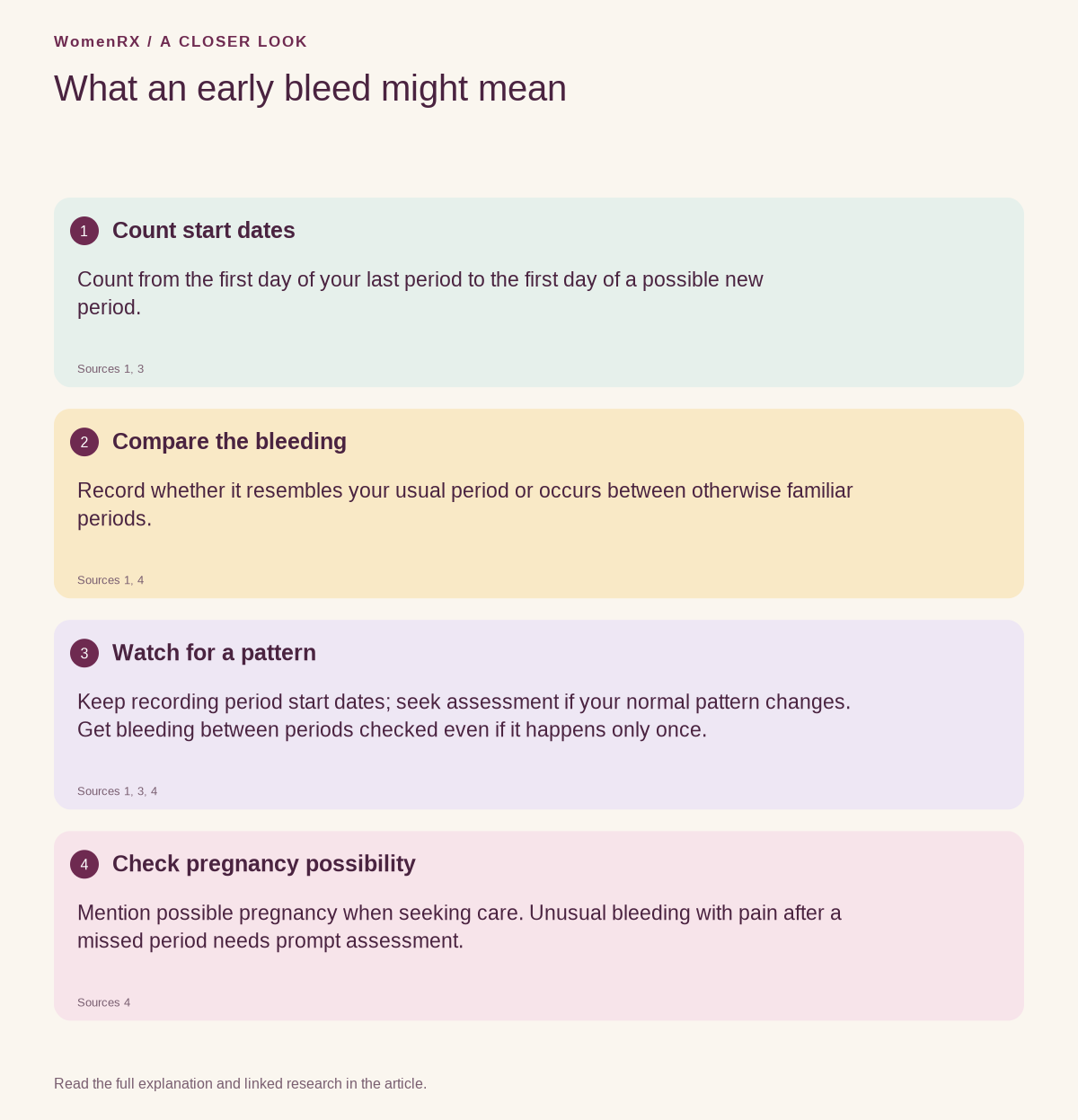
Count start dates: Count from the first day of your last period to the first day of a possible new period.13
Compare the bleeding: Record whether it resembles your usual period or occurs between otherwise familiar periods.14
Watch for a pattern: Keep recording period start dates; seek assessment if your normal pattern changes. Get bleeding between periods checked even if it happens only once.134
Check pregnancy possibility: Mention possible pregnancy when seeking care. Unusual bleeding with pain after a missed period needs prompt assessment.4
Read the figure as text
Follow the timing and pattern, rather than an app prediction alone.- Count start dates: Count from the first day of your last period to the first day of a possible new period.13
- Compare the bleeding: Record whether it resembles your usual period or occurs between otherwise familiar periods.14
- Watch for a pattern: Keep recording period start dates; seek assessment if your normal pattern changes. Get bleeding between periods checked even if it happens only once.134
- Check pregnancy possibility: Mention possible pregnancy when seeking care. Unusual bleeding with pain after a missed period needs prompt assessment.4
More questions, answered
Does a 26-day cycle mean my period came too early?
Not necessarily. Count from the first day of one period to the first day of the next; regular cycles between 21 and 35 days can be normal. Compare 26 days with your own recorded pattern, not just a 28-day average. 15
Should I count light bleeding between periods as day one?
Don’t assume it’s a new period just because blood appeared. Record it separately, including when it happened and how it compared with your usual flow. Bleeding between periods should be checked, and its cause may not be a change in cycle length. 34
Sources you can check
- Menstruation | Period | MedlinePlusAccessed 2026-09-25Return to first citation
- Validity of self-reported menstrual cycle length.Bates-Fraser LC, Wong M, Gaudet MM, Chiang KE, Deubler EL, Teras LR, Patel AV. · Annals of epidemiology · 2026Return to first citation
- Irregular periods - NHSAccessed 2026-09-25Return to first citation
- Vaginal bleeding between periods or after sex - NHSAccessed 2026-09-25Return to first citation
- Period problems - NHSAccessed 2026-09-25Return to first citation
- Periods and fertility in the menstrual cycle - NHSAccessed 2026-09-25Return to first citation