Your Period Came Early: What to Track Next
One early bleed doesn’t reveal its cause; dates and details can show whether it’s a one-off or a changing pattern.
Count a cycle from the first day of one period to the first day of the next, and write down each start date, bleeding duration, flow, and symptoms. Note recent illness or contraception changes as context, not proof of a cause. A single shift doesn’t explain what happened; repeated changes, bleeding between periods, very heavy flow, or severe pain are reasons to seek advice. 1 2
First, check what “early” means
A menstrual cycle is counted from the first day of one period to the first day of the next. So a bleed that starts sooner than expected may mean the interval between periods was shorter. But if it’s just a little bleeding between your usual periods, it may be more useful to record it as unexpected bleeding rather than automatically counting it as a new period. Bleeding between periods is a reason to seek medical advice, even if it hasn’t happened before. 1 2
For nonpregnant people of reproductive age, a 2026 joint practice guideline defines abnormal bleeding frequency as cycles less than 24 or more than 38 days apart. It also describes cycle-to-cycle variation of 8-10 days or more as irregular, depending on age. These are clinical reference points, not a way to diagnose the cause from one cycle, and they shouldn’t be applied to every age group. 3
Make a short, useful cycle log
Use a calendar or notes app. Keep the entries simple and consistent:
- Start date: Mark the first day of each period. Count from one start date to the next, rather than from the day bleeding ends. 1
- Bleeding: Record how many days it lasts, whether the flow seems lighter, usual, or heavier than your normal, and whether there was bleeding between periods.
- Symptoms: Note pain and any other symptoms that stand out. You don’t need to record every sensation; focus on what changed or affected your day.
- Context: Add recent illness or a contraception change if either occurred. These details can help describe what was happening, but the timing alone doesn’t show that either caused the bleeding.
The goal isn’t to monitor perfectly. It’s to be able to say, for example: “My last three periods began on these dates; this one started sooner, lasted longer, and was heavier than usual.” That summary is more useful than “my cycle feels off.” MedlinePlus recommends keeping track of periods to understand your usual cycle and notice changes. 1
Age changes what counts as your baseline
In the first few years after periods begin, cycles may take time to become regular. A pattern that differs from an adult’s usual cycle expectations may not mean the same thing for a teenager who recently started menstruating. Keep the dates and describe any major change, heavy bleeding, or severe pain rather than judging every cycle against an adult benchmark. 1
Around perimenopause, bleeding can change too: heavy periods may occur at different times, including as menopause approaches. That doesn’t establish why a particular period came early. If changes are recurring or concerning, a record can help explain the pattern; abnormal bleeding and pelvic pain during the menopausal transition warrant evaluation. 2 4
If you’ve already gone 12 months without a period, bleeding afterward is considered postmenopausal bleeding, not an early period, and should be evaluated. 3
When to share the pattern
A change in timing by itself doesn’t identify a cause. Share your log if the timing keeps changing, if you have bleeding between periods or after sex, or if flow is very heavy or pain is severe. MedlinePlus advises seeking care for major cycle changes, very heavy bleeding, or severe pain; heavy bleeding that affects daily life is also a reason to get advice. 1 2
Bring the dates, duration, flow notes, symptoms, and any relevant illness or contraception changes. You don’t need to wait until you have a perfect record: the notes are there to make the conversation clearer, not to decide on your own what caused the change.
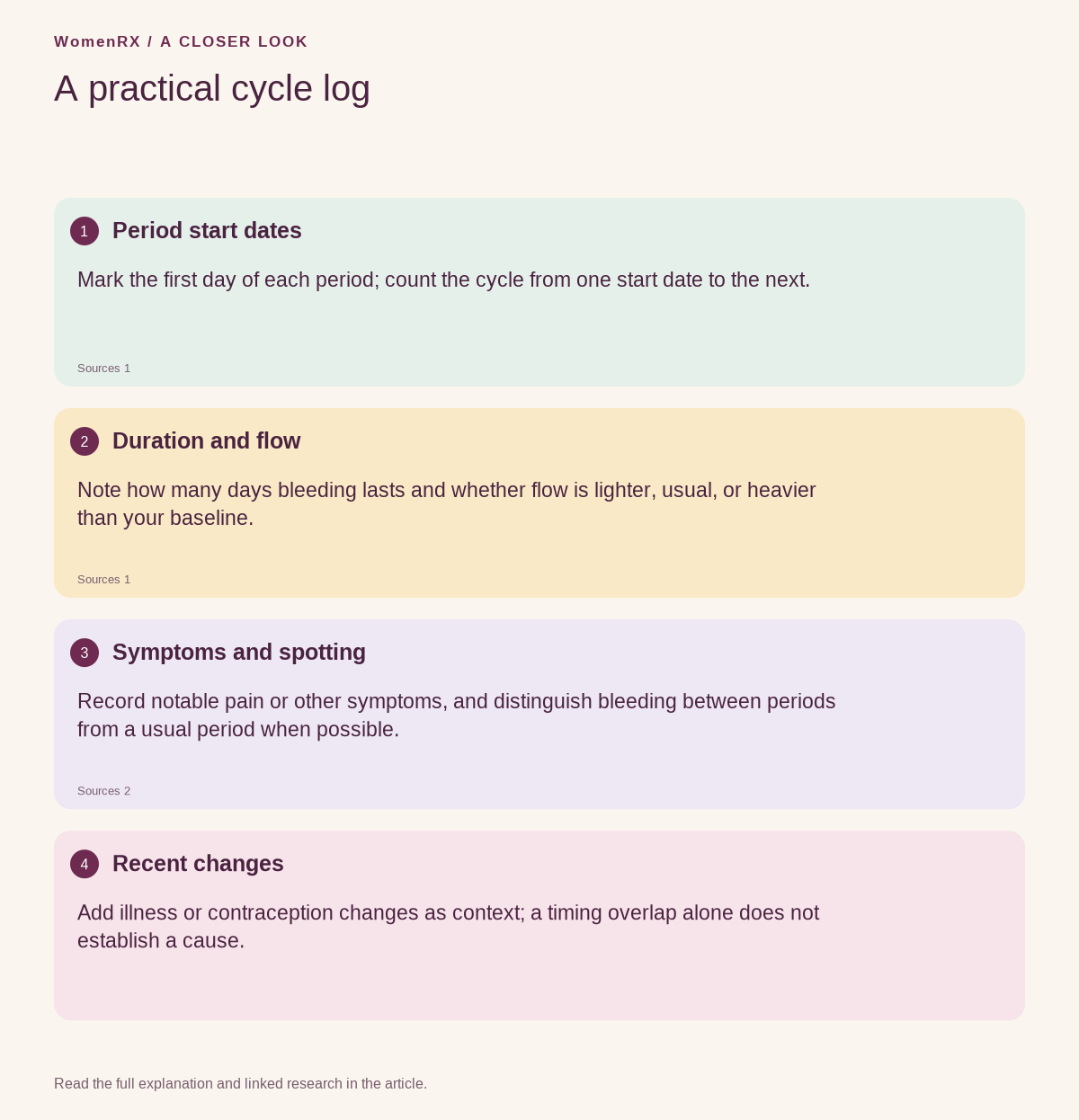
A practical cycle log
Period start dates: Mark the first day of each period; count the cycle from one start date to the next.1
Duration and flow: Note how many days bleeding lasts and whether flow is lighter, usual, or heavier than your baseline.1
Symptoms and spotting: Record notable pain or other symptoms, and distinguish bleeding between periods from a usual period when possible.2
Recent changes: Add illness or contraception changes as context; a timing overlap alone does not establish a cause.
Read the figure as text
Record these details consistently to distinguish cycle timing from bleeding features and contextual changes.- Period start dates: Mark the first day of each period; count the cycle from one start date to the next.1
- Duration and flow: Note how many days bleeding lasts and whether flow is lighter, usual, or heavier than your baseline.1
- Symptoms and spotting: Record notable pain or other symptoms, and distinguish bleeding between periods from a usual period when possible.2
- Recent changes: Add illness or contraception changes as context; a timing overlap alone does not establish a cause.
More questions, answered
How do I count the days in my cycle?
Count from the first day of one period to the first day of the next. The number of bleeding days is a separate note in your log. 1
Should I record a contraception change or illness?
Yes, note when it happened so you can share the context. A timing overlap alone doesn’t prove it caused the bleeding; a survey after COVID-19 infection found self-reported menstrual changes, but its design cannot establish that infection caused them. 5
Sources you can check
- Menstruation | Period | MedlinePlusAccessed 2026-09-25Return to first citation
- Heavy periods - NHSAccessed 2026-09-25Return to first citation
- Visually directed hysteroscopic biopsy in the evaluation of abnormal uterine bleeding and postmenopausal bleeding: a Joint Society Practice Guideline. Joint Society Practice Guideline from AAGL-ESGE-GCH. · Facts, views & vision in ObGyn · 2026Return to first citation
- Uterine Leiomyomas Across the Menopausal Transition.Encalada-Soto D, Hochberg LS, Laughlin-Tommaso S. · Obstetrics and gynecology · 2026Return to first citation
- Menstrual vulnerability to acute systemic stress: evidence from 884 women after COVID-19 infection.Jiang X, Han R, Yang X. · BMC women's health · 2026Return to first citation