An Early Period: What the Timing Can Tell You
One early bleed may be normal cycle variation, but bleeding between periods, a recurring change, or possible pregnancy deserves a closer look.
Count from the first day of your last period to the first day of this bleed, then compare its flow and duration with your usual period. A shorter cycle can be normal; a little bleeding between periods isn’t necessarily a period. If you could be pregnant, take a pregnancy test rather than using the bleeding to rule pregnancy out. Bleeding can occur during pregnancy.1247
First, check what “early” means
A period can arrive before your calendar predicts and still fall within a normal cycle range. Count from the first day of one period to the first day of the next, not from the day bleeding stopped. Regular cycles from 21 to 35 days can be normal, and your own cycles needn’t land on the same date each month.27
For example, if your last period began on the 1st and this bleed begins on the 27th, that’s a 26-day cycle. It may feel early if you expected a 28-day cycle, but the date alone doesn’t suggest a problem. A single shorter cycle is more useful as a point of comparison than as a diagnosis. Cycle length can change because the time before ovulation varies; an early period doesn’t reliably identify a particular hormone problem.5
Is this your next period or bleeding between periods?
Timing is only half the picture. Ask whether the bleeding develops into your familiar menstrual flow and lasts roughly as long as it usually does, or whether it’s a small amount that appears and stops between expected periods. You may not be able to classify it on the first day. Note what happens rather than assuming every spot of blood resets your cycle calendar.
That distinction matters because bleeding between periods, bleeding that is very heavy, and bleeding that lasts much longer than usual are forms of abnormal vaginal bleeding. Possible causes include fibroids or polyps, but the pattern alone can’t tell you which cause, if any, applies.1 If bleeding between periods keeps happening, your periods repeatedly come much closer together, or the amount or duration changes substantially, arrange a clinical review. The evaluation starts with the timing and bleeding history; a clinician may recommend tests based on your circumstances rather than one standard test for everyone.24
The context can change the interpretation
In the first few years after periods begin, cycles may take time to become regular. That makes a changing start date less surprising, though very heavy bleeding or severe pain still merits attention.2
After childbirth, spotting or bleeding can come and go for up to six weeks and may resemble a period. Breastfeeding and the months after childbirth can also change when menstrual periods return. If you’re recently postpartum, don’t assume every new episode of bleeding is a new cycle.23
Around perimenopause, cycle timing can become less predictable as ovulation becomes less regular. That context helps explain variation, but it doesn’t make persistent bleeding between periods or a major change in flow something to dismiss. Bleeding after menopause is not a period and should be assessed.125
If you use hormonal contraception, first identify the method before interpreting the date. Some methods, including the combined pill, stop ovulation, so their bleeding patterns aren’t a straightforward measure of when you ovulated.7 With the levonorgestrel IUD Mirena, periods may stop; its patient instructions advise a urine pregnancy test and a call to your clinician if you’re concerned you might be pregnant while using it.6
If pregnancy could be involved, don’t rely on the bleed
Bleeding can happen during pregnancy, so an early bleed cannot, by itself, confirm or exclude it.1 Ovulation doesn’t always happen on a predictable calendar day, and pregnancy can be possible even soon after a period ends.7 If you could be pregnant, take a pregnancy test rather than treating this bleed as proof you’re not. Pregnancy testing is also among the tests a clinician may use when evaluating unexpected bleeding.4
If you know you’re pregnant and have vaginal bleeding, contact your pregnancy care team right away. Bleeding in pregnancy has several possible causes and isn’t always serious, but it needs prompt attention.1 If you use Mirena and think you might be pregnant, follow its patient instructions to do a urine pregnancy test and call your clinician. Unusual bleeding or abdominal pain, especially with missed periods, can be a sign of a pregnancy outside the uterus.6
The most useful record is brief and specific: when your last usual period started, when this bleeding began, whether it stayed light or became a typical flow, how long it lasted, and whether pain or pregnancy possibility changes the picture. Those details make it easier to tell a shifted period from bleeding between periods, and to recognize a pattern if it happens again.24
How to read an early bleed
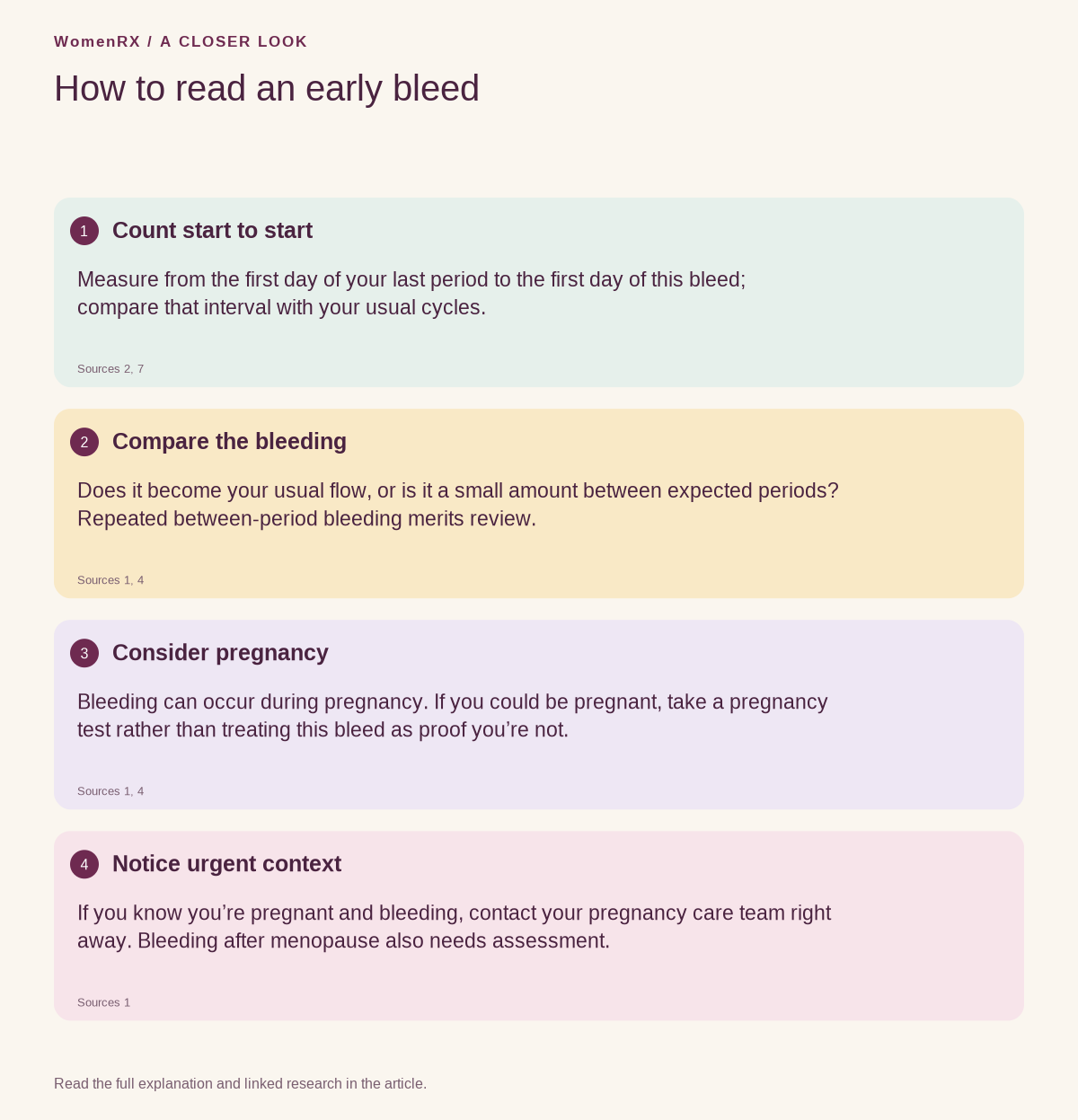
Count start to start: Measure from the first day of your last period to the first day of this bleed; compare that interval with your usual cycles.27
Compare the bleeding: Does it become your usual flow, or is it a small amount between expected periods? Repeated between-period bleeding merits review.14
Consider pregnancy: Bleeding can occur during pregnancy. If you could be pregnant, take a pregnancy test rather than treating this bleed as proof you’re not.14
Notice urgent context: If you know you’re pregnant and bleeding, contact your pregnancy care team right away. Bleeding after menopause also needs assessment.1
Read the figure as text
Use timing, flow, and context to decide what the bleeding may represent and what to do next.- Count start to start: Measure from the first day of your last period to the first day of this bleed; compare that interval with your usual cycles.27
- Compare the bleeding: Does it become your usual flow, or is it a small amount between expected periods? Repeated between-period bleeding merits review.14
- Consider pregnancy: Bleeding can occur during pregnancy. If you could be pregnant, take a pregnancy test rather than treating this bleed as proof you’re not.14
- Notice urgent context: If you know you’re pregnant and bleeding, contact your pregnancy care team right away. Bleeding after menopause also needs assessment.1
More questions, answered
Does a 26-day cycle mean my period is abnormal?
Not on its own. Cycle length is counted from the first day of one period to the first day of the next, and regular cycles between 21 and 35 days can be normal. Compare the bleed’s flow and duration with what’s usual for you, especially if the timing changes again.27
Sources you can check
- Vaginal Bleeding | Uterine Fibroids | MedlinePlusAccessed 2026-09-25Return to first citation
- Menstruation | Period | MedlinePlusAccessed 2026-09-25Return to first citation
- Postpartum Care: MedlinePlusAccessed 2026-09-25Return to first citation
- 2020 Hong Kong College of Obstetricians and Gynaecologists guideline on investigations of premenopausal women with abnormal uterine bleeding.Lee JHS, Cheng EOL, Choi KM, Ngu SF, Cheung RYK, Hong Kong College of Obstetricians and Gynaecologists. · Hong Kong medical journal = Xianggang yi xue za zhi · 2020Return to first citation
- The Normal Menstrual Cycle and the Control of OvulationReed BG, Carr BR. · 2000Return to first citation
- MIRENA (LEVONORGESTREL) INTRAUTERINE DEVICE [BAYER HEALTHCARE PHARMACEUTICALS INC.] | US prescribing information and patient instructionsAccessed 2026-09-25Return to first citation
- Periods and fertility in the menstrual cycle - NHSAccessed 2026-09-25Return to first citation