Ovarian Cysts and Hormones: What Your Ultrasound Can Tell You
A functional cyst is tied to ovulation, but finding a cyst doesn’t automatically explain a late or irregular period.
Functional cysts form from structures involved in ovulation, so they have the clearest connection to the menstrual cycle. Other cysts, including those associated with endometriosis, do not form through that same process. A cyst on ultrasound cannot, by itself, tell you whether your hormone levels changed or why a period came late. The cyst’s appearance and whether you’ve reached menopause change how it’s assessed. 562
The distinction is how the cyst formed
Your ovaries develop follicles as part of the menstrual cycle. A follicle holds an egg and normally opens to release it. A functional cyst can form when a follicle doesn’t release the egg, or when it doesn’t release its fluid and shrink after ovulation. These cysts are common before menopause and most disappear within a few months without treatment. 5
That makes a functional cyst cycle-linked, not proof that it has disrupted your hormones. Estrogen helps drive egg development during the cycle; progesterone plays a role in the second half; and both hormone levels fall before a period if pregnancy doesn’t occur. An ultrasound image shows a structure, not a record of those hormone changes or the exact day you ovulated. 65
Ovarian cysts can occur alongside heavy, light, or irregular periods, but many cause no symptoms at all. If your period is late, it’s worth keeping other explanations in view too: pregnancy, hormonal contraception, changes in weight or exercise, thyroid problems, and the transition toward menopause can all affect menstrual timing. 13
Other cysts don’t follow the same ovulation pattern
An endometrioma is a blood-filled cyst that can form when tissue similar to the uterine lining grows on an ovary. It’s associated with endometriosis, rather than a follicle that didn’t open or shrink. Other ovarian cysts can arise from abnormal cell growth and are not related to the menstrual cycle. That distinction does not mean every nonfunctional cyst is hormonally inactive; it means you shouldn’t assume it affects your cycle in the same way as a functional cyst. 5
PCOS is a different question from one cyst found on ultrasound. Polycystic ovary syndrome can involve altered hormone levels, follicles that do not develop to ovulation, and irregular or absent periods. Finding a single ovarian cyst does not, on its own, establish PCOS or explain an irregular cycle. 57
There are less common ovarian masses associated with hormone-related changes. For example, a small retrospective series of children and adolescents with ovarian masses and unusual sexual development included several different tumor types and menstrual or pubertal changes. That finding is a reason not to declare every nonfunctional mass hormone-inert, but it cannot predict what an ordinary cyst means for an adult’s next period. 4
What changes the next step
If an ultrasound report names a likely cyst type, that description is more useful than trying to identify the cyst from bloating, pain, or a late period. Decisions about follow-up depend on the cyst’s size and appearance, whether it causes symptoms, and whether you’ve been through menopause. Watchful waiting, sometimes with another ultrasound, is common; a large, persistent, symptomatic, or concerning cyst may need a different approach. 12
After menopause, the usual ovulation-linked explanation is less applicable. Cysts can still occur, and the risk that an ovarian cyst is cancerous is higher than it is before menopause. A new finding therefore needs assessment based on its appearance and your circumstances, rather than an assumption that it’s a routine functional cyst. 512
If your usual bleeding pattern changes, especially if you have bleeding between periods, bring up the change rather than attributing it automatically to the cyst. If a cyst may have ruptured or is causing bleeding, seek medical help promptly. 37
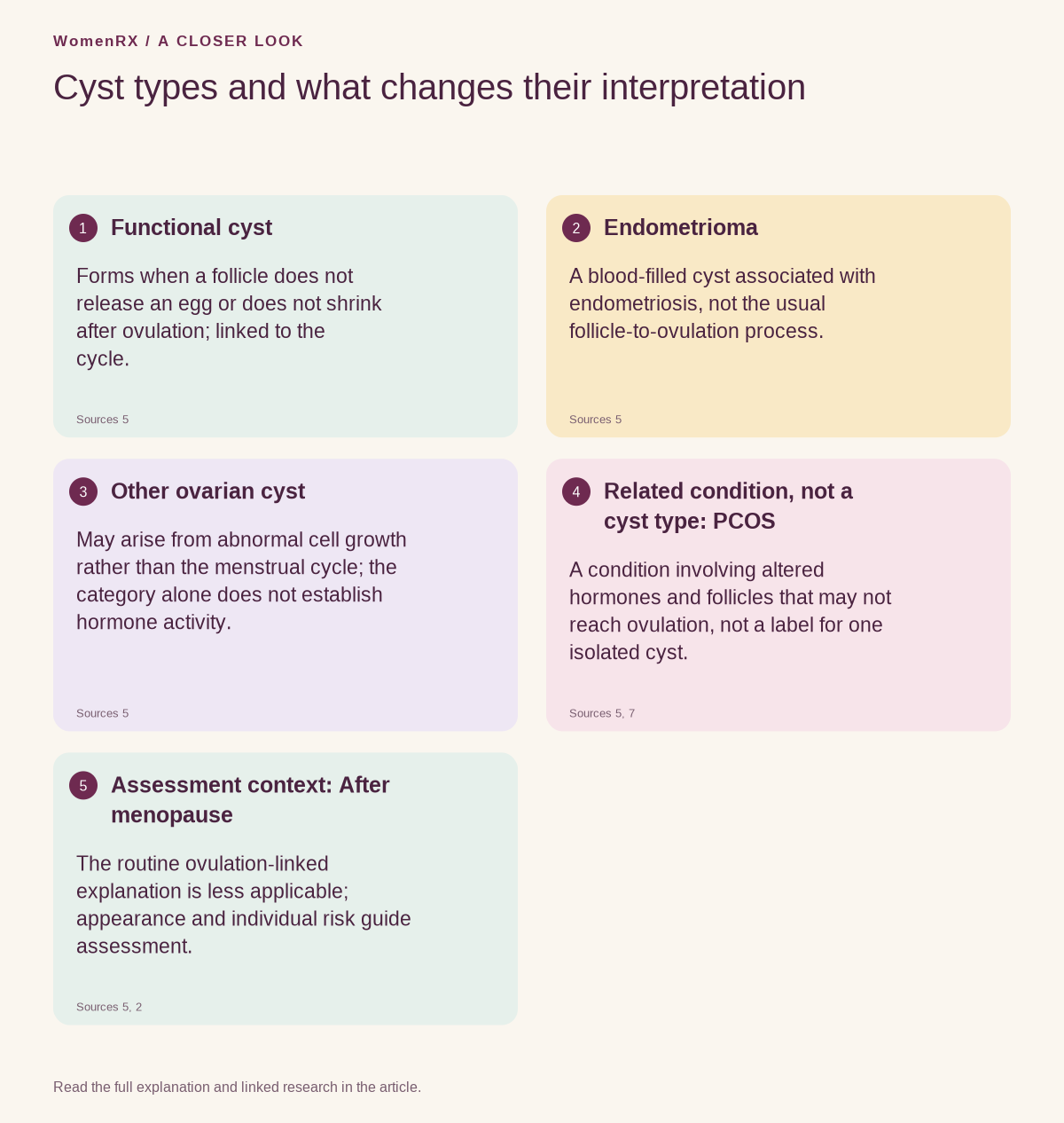
Cyst types and what changes their interpretation
Functional cyst: Forms when a follicle does not release an egg or does not shrink after ovulation; linked to the cycle.5
Endometrioma: A blood-filled cyst associated with endometriosis, not the usual follicle-to-ovulation process.5
Other ovarian cyst: May arise from abnormal cell growth rather than the menstrual cycle; the category alone does not establish hormone activity.5
Related condition, not a cyst type: PCOS: A condition involving altered hormones and follicles that may not reach ovulation, not a label for one isolated cyst.57
Assessment context: After menopause: The routine ovulation-linked explanation is less applicable; appearance and individual risk guide assessment.52
Read the figure as text
The first three entries compare cyst types. PCOS is a related condition, while menopause changes how a cyst is assessed.- Functional cyst: Forms when a follicle does not release an egg or does not shrink after ovulation; linked to the cycle.5
- Endometrioma: A blood-filled cyst associated with endometriosis, not the usual follicle-to-ovulation process.5
- Other ovarian cyst: May arise from abnormal cell growth rather than the menstrual cycle; the category alone does not establish hormone activity.5
- Related condition, not a cyst type: PCOS: A condition involving altered hormones and follicles that may not reach ovulation, not a label for one isolated cyst.57
- Assessment context: After menopause: The routine ovulation-linked explanation is less applicable; appearance and individual risk guide assessment.52
More questions, answered
Do birth control pills make an existing cyst go away?
MedlinePlus says birth control pills can help prevent new cysts. That is a different question from whether medication will resolve a cyst already seen on ultrasound; the cyst’s appearance, symptoms, and follow-up findings matter when deciding what to do next. 72
Sources you can check
- Ovarian cyst - NHSAccessed 2026-09-25Return to first citation
- Ovarian cyst - Treatment - NHSAccessed 2026-09-25Return to first citation
- Irregular periods - NHSAccessed 2026-09-25Return to first citation
- [Clinical Characterization of Patients with Ovarian Mass Combined with Dysplasia of Secondary Sexual Characteristics].Liu Q, Zhou HM, Yang JX, Cao DY, Shen K, Lang JH. · Zhongguo yi xue ke xue yuan xue bao. Acta Academiae Medicinae Sinicae · 2022Return to first citation
- Ovarian cyst - Causes - NHSAccessed 2026-09-25Return to first citation
- Periods and fertility in the menstrual cycle - NHSAccessed 2026-09-25Return to first citation
- Ovarian Cysts | Polycystic Ovary Syndrome | MedlinePlusAccessed 2026-09-25Return to first citation