What an Ovarian Cyst Ultrasound Can Tell You
An ultrasound can show a cyst, but the finding alone doesn’t tell you whether it caused symptoms or needs treatment.
Ovarian cysts are commonly found with a pelvic ultrasound, often using a probe inside the vagina. 1 A report may describe the cyst’s size or include an O-RADS category, which helps organize risk assessment and follow-up guidance. 1 4 What happens next also depends on your symptoms and whether you’re pregnant or have been through menopause. A cyst finding doesn’t automatically mean treatment is needed. 1 2 4
What the scan can tell you
An ovarian cyst is a fluid-filled sac on an ovary. Many cause no symptoms, so a cyst may turn up during imaging for another reason. When a clinician suspects one, an ultrasound, often performed with a probe inside the vagina, is a common way to look at the ovaries. 1
The result can confirm that a cyst is visible, but it doesn’t by itself prove that the cyst caused pelvic pain or unexpected bleeding. Pelvic pain has many possible causes, including conditions affecting the bowel, bladder, or reproductive organs. If you have unexpected bleeding along with pelvic pain, the cyst finding shouldn’t end the search for a cause. 1 3
A description is not a treatment decision
Some ultrasound reports use O-RADS, a standardized system for describing ovarian and nearby masses and supporting risk assessment and management decisions. Its category is one part of the evaluation, not a stand-alone answer about what will happen next. The system may not apply as usual in some situations, including acute symptoms, and pregnancy can make its use more challenging. 4
Report details answer different questions. A cyst’s size may matter when weighing symptoms or further evaluation, but size alone doesn’t decide treatment. An O-RADS category helps organize the imaging assessment, while a repeat ultrasound can show whether a cyst has gone away or remains. Ask how those findings fit with your symptoms, pregnancy status if relevant, and menopausal stage. 1 2 4
Why follow-up can differ
For some cysts, the plan is watchful waiting with another ultrasound after a period of time; some cysts go away without treatment. A clinician may recommend specialist evaluation or additional tests when there’s concern about the finding. Blood-test results can add information, but an elevated result alone doesn’t prove cancer because noncancerous conditions can also affect it. 1 2
Menopausal stage matters: ovarian cysts that are cancerous are more common after menopause, so clinicians may recommend closer monitoring or further evaluation for a postmenopausal finding. That doesn’t mean every cyst after menopause is cancerous. 1 2
If you’re pregnant or could be, make sure the clinician interpreting the finding knows. Pregnancy can affect how standardized ultrasound guidance is applied, and a cyst report shouldn’t be interpreted without that context. 4
Questions that make the report more useful
When you discuss the result, you might ask:
- Does the report include an O-RADS category, and what does it mean in my situation?
- Is the cyst a likely explanation for my symptoms, or should other causes be considered?
- Does my menopausal stage or pregnancy status change the interpretation?
- Is the next step monitoring, another evaluation, or no further testing? When should that decision be revisited?
Sudden, severe pelvic pain, especially with nausea or vomiting, can signal a problem that needs urgent assessment. Don’t wait for a routine follow-up scan if that happens. 1
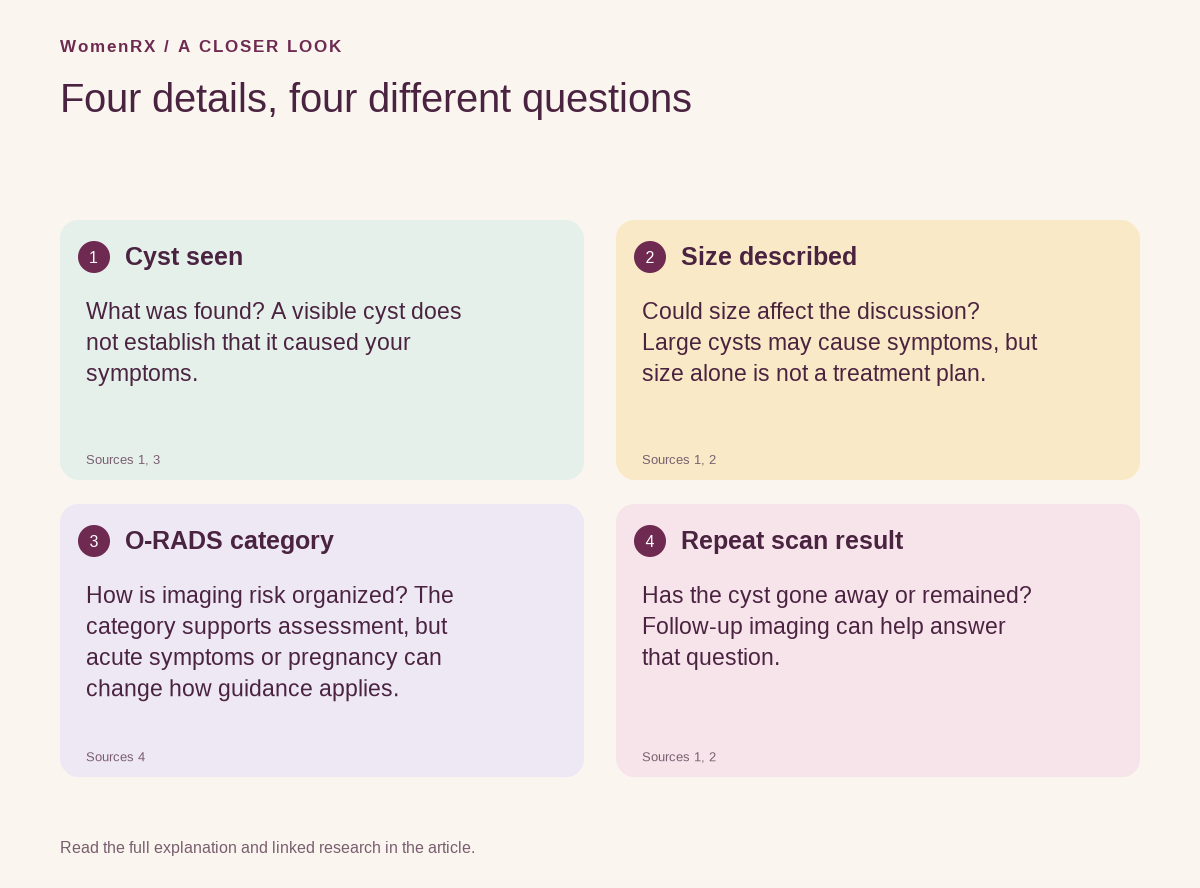
Four details, four different questions
Cyst seen: What was found? A visible cyst does not establish that it caused your symptoms.13
Size described: Could size affect the discussion? Large cysts may cause symptoms, but size alone is not a treatment plan.12
O-RADS category: How is imaging risk organized? The category supports assessment, but acute symptoms or pregnancy can change how guidance applies.4
Repeat scan result: Has the cyst gone away or remained? Follow-up imaging can help answer that question.12
Read the figure as text
These parts of a scan report contribute different information; none decides treatment on its own.- Cyst seen: What was found? A visible cyst does not establish that it caused your symptoms.13
- Size described: Could size affect the discussion? Large cysts may cause symptoms, but size alone is not a treatment plan.12
- O-RADS category: How is imaging risk organized? The category supports assessment, but acute symptoms or pregnancy can change how guidance applies.4
- Repeat scan result: Has the cyst gone away or remained? Follow-up imaging can help answer that question.12
More questions, answered
Does finding a cyst mean it caused my pelvic pain?
Not necessarily. Cysts often cause no symptoms, and pelvic pain can come from several different pelvic or abdominal conditions. The scan finding needs to be considered alongside your symptoms and other possible causes. 1 3
Does a cyst always need treatment?
No. Some cysts are monitored with repeat ultrasound, and some disappear without treatment. Whether further evaluation or treatment is considered depends on the scan and your situation, including symptoms and menopausal stage. 1 2
Sources you can check
- Ovarian cyst - NHSAccessed 2026-09-25Return to first citation
- Ovarian cyst - Treatment - NHSAccessed 2026-09-25Return to first citation
- Pelvic pain - NHSAccessed 2026-09-25Return to first citation
- O-RADS Ultrasound Version 1: A Scenario-Based Review of Implementation Challenges.Gargan ML, Frates MC, Benson CB, Guo Y. · AJR. American journal of roentgenology · 2022Return to first citation