Can an Ovarian Cyst Change Your Abdominal Size?
A large cyst may cause visible abdominal distension, but a change on the scale alone can’t tell you whether a cyst is present.
An ovarian cyst may affect abdominal size if it is very large, but abdominal distension is not the same as weight gain. A very large cyst can cause you to feel full after eating only a little, and a small surgical series found distension or discomfort in some patients with very large cysts. Weight change alone cannot identify a cyst; persistent or worsening symptoms deserve evaluation. 1 5 3
An ovarian cyst can sometimes make the abdomen look or feel larger, especially if it is very large. That does not mean a cyst is a usual explanation for a change in body weight. Ovarian cysts are common, often cause no symptoms, and many go away on their own within a few months. 1
Distension, bloating, and scale weight aren’t the same
Bloating often describes a sensation of pressure or a change that comes and goes. Abdominal distension describes an increase in abdominal size, which can come and go or persist. In a study of 124 women referred to UK hospitals with suspected ovarian cancer, persistent distension was associated with cancer, while fluctuating bloating alone was not. This was a selected group already referred for evaluation, so the finding cannot tell you what is causing a change for an individual person. 6
A cyst can be one possible cause of distension when it is large. In a small surgical series of 15 patients with cysts larger than 10 centimeters, 10 had abdominal distension and discomfort. Because these were patients selected for surgery, the series shows that very large cysts can cause these symptoms, not how often cysts cause them overall. 5
A scale measures body weight; it does not show whether the abdomen is distended or what is causing a change in its size. Unintentional weight loss can be a symptom of ovarian cancer, but weight gain alone is not evidence of an ovarian cyst. Symptoms such as bloating and abdominal swelling can also have many other causes. 3
When a change deserves attention
Consider making an appointment if you have new abdominal swelling or bloating that is frequent, does not go away, or is getting worse, especially if you also have pelvic or abdominal pain, feel full quickly, or need to urinate more often. These symptoms are common and do not mean you have cancer, but persistent or worsening symptoms are worth discussing rather than assuming they are from a cyst. 3
One study of women referred with suspected ovarian cancer found that persistent distension was more informative than fluctuating bloating alone. That distinction can help describe what you’re noticing: does the abdomen stay enlarged, or does the feeling and size come and go? It cannot diagnose the cause. 6
A clinician can assess your symptoms and decide whether imaging is appropriate. An ultrasound can identify a cyst, and its size and appearance, your symptoms, and whether you have gone through menopause can all affect what follow-up is recommended. Many cysts are monitored and disappear without treatment. 1 2
Menopause changes the context
Functional cysts are more common before menopause and often resolve on their own. After menopause, the chance that a cyst is cancerous is higher than it is before menopause, so a new or persistent abdominal change should not be written off as ordinary weight fluctuation. This does not mean a cyst or cancer is the cause; symptoms and ultrasound findings help guide evaluation. 1 2 4
The useful distinction is not simply “weight gain or cyst.” Notice whether the change is a temporary sensation, a persistent increase in abdominal size, or a change in scale weight. If the abdominal change is new and keeps returning or worsening, describe that pattern when seeking an evaluation.
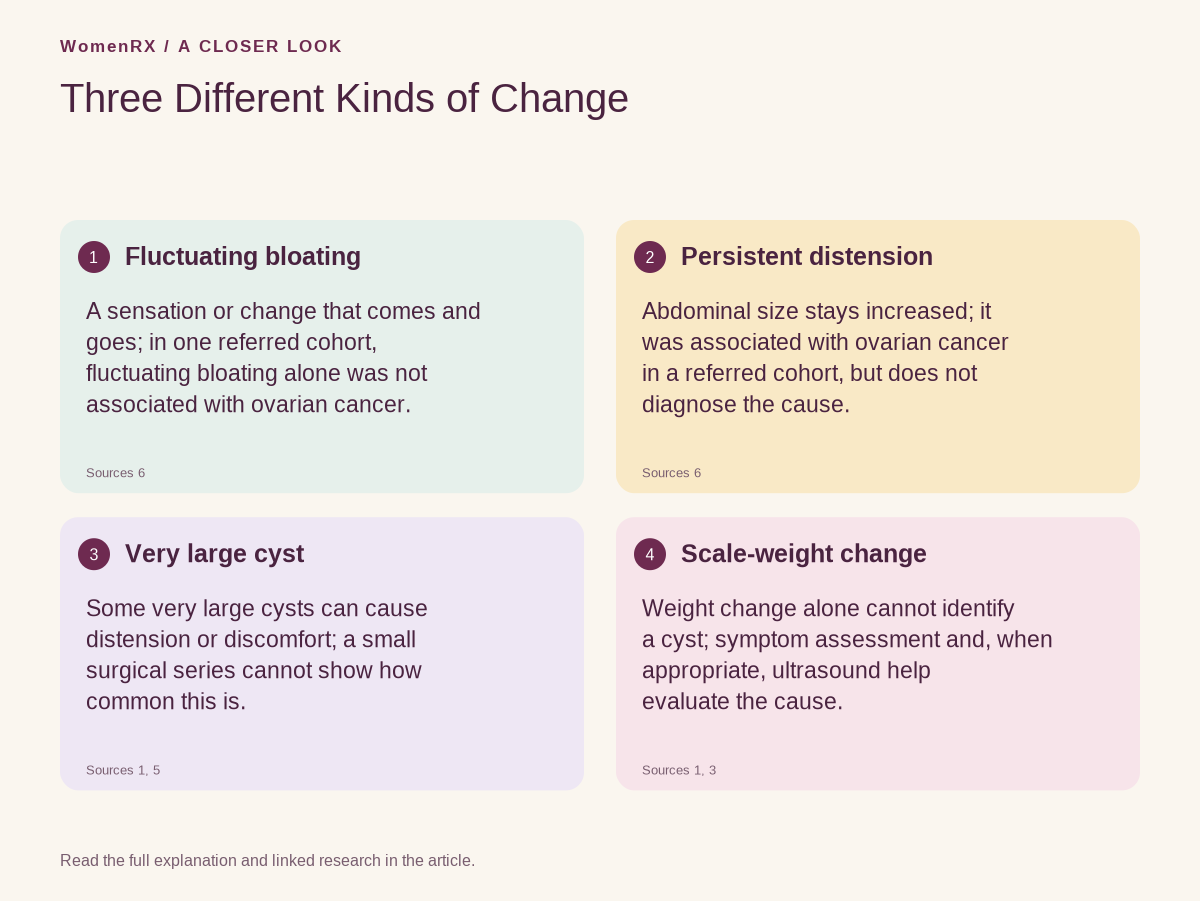
Three Different Kinds of Change
Fluctuating bloating: A sensation or change that comes and goes; in one referred cohort, fluctuating bloating alone was not associated with ovarian cancer.6
Persistent distension: Abdominal size stays increased; it was associated with ovarian cancer in a referred cohort, but does not diagnose the cause.6
Very large cyst: Some very large cysts can cause distension or discomfort; a small surgical series cannot show how common this is.15
Scale-weight change: Weight change alone cannot identify a cyst; symptom assessment and, when appropriate, ultrasound help evaluate the cause.13
Read the figure as text
Bloating, a lasting increase in abdominal size, and a scale-weight change describe different observations. None alone identifies an ovarian cyst.- Fluctuating bloating: A sensation or change that comes and goes; in one referred cohort, fluctuating bloating alone was not associated with ovarian cancer.6
- Persistent distension: Abdominal size stays increased; it was associated with ovarian cancer in a referred cohort, but does not diagnose the cause.6
- Very large cyst: Some very large cysts can cause distension or discomfort; a small surgical series cannot show how common this is.15
- Scale-weight change: Weight change alone cannot identify a cyst; symptom assessment and, when appropriate, ultrasound help evaluate the cause.13
Sources you can check
- Ovarian cyst - NHSAccessed 2026-09-25Return to first citation
- Ovarian cyst - Treatment - NHSAccessed 2026-09-25Return to first citation
- Ovarian cancer - Symptoms - NHSAccessed 2026-09-25Return to first citation
- Detecting ovarian disorders in primary care.Oliver A, Overton C. · The Practitioner · 2014Return to first citation
- Laparoscopic management of large ovarian cysts at a rural hospital.Shindholimath VV, Jyoti SG, Patil KV, Ammanagi AS. · Journal of gynecological endoscopy and surgery · 2009Return to first citation
- Identifying symptoms of ovarian cancer: a qualitative and quantitative study.Bankhead CR, Collins C, Stokes-Lampard H, Rose P, Wilson S, Clements A, Mant D, Kehoe ST, Austoker J. · BJOG : an international journal of obstetrics and gynaecology · 2008Return to first citation