Can an Ovarian Cyst Go Away on Its Own?
Many cysts that form during the menstrual cycle disappear without treatment, but the ultrasound findings and your symptoms determine what happens next.
Yes, many ovarian cysts, especially functional cysts that form during the menstrual cycle, go away within a few months. An ultrasound can help distinguish a cyst likely to resolve from one that needs monitoring or further assessment. Watchful waiting may include another scan; symptoms, persistence, pregnancy, or menopause can change the plan. Don’t let a diet or supplement replace planned follow-up. 126
An ultrasound report may say “ovarian cyst,” but that label alone doesn’t tell you whether to wait, treat symptoms, or investigate further. The useful details are what the cyst looks like, whether it’s causing problems, and whether you’re cycling, pregnant, or past menopause. 126
Why some cysts disappear and others don’t
Functional cysts develop as part of the menstrual cycle. They’re the most common type and are usually short-lived. If the scan looks consistent with a functional cyst and you’re otherwise well, observation may be reasonable because many disappear within a few months. A repeat ultrasound can show whether yours has gone away. 12
That expectation doesn’t apply to every ovarian finding. An endometrioma, a cyst associated with endometriosis, may call for a discussion about managing the underlying condition and any pain, rather than simply expecting the cyst to follow the course of a functional cyst. Endometriosis treatment may involve painkillers, hormone medicine, or surgery, depending on the situation. 26
A dermoid cyst, also called a benign ovarian teratoma, is another distinct finding. Observation can still be an option for some people without symptoms: in a retrospective study of 408 women whose ultrasound findings suggested a benign teratoma and who were followed conservatively, most lesions remained unchanged, while 130 women eventually had surgery. That’s a reason to discuss the scan findings and follow-up plan, not to assume every persistent cyst needs immediate removal. 4
What helps while you’re waiting?
Watchful waiting is a plan, not a remedy. It means no immediate treatment, with a possible ultrasound weeks or months later to check whether the cyst has disappeared or changed. If it’s still there, has grown, looks concerning, or causes symptoms, the next discussion may be different. Large, persistent, or symptomatic cysts may need surgery. 12
If discomfort is affecting your day, bring up the pain itself rather than assuming you must put up with it until the next scan. What helps depends partly on what’s causing the pain. For example, painkillers are among the treatment options for endometriosis, while a cyst that continues to cause symptoms may need a conversation about removal. Pain relief and cyst removal are different goals: feeling better does not show that a cyst has shrunk. 2
If you try a change in diet or a supplement, don’t let it replace the planned follow-up scan. A functional cyst may resolve while you’re trying one; the scan can show whether it has disappeared. Birth control pills can help prevent new cysts; that is different from treating the one already visible on ultrasound. 125
If a cyst ruptures or causes bleeding, get medical help right away rather than waiting for a routine follow-up scan. For ongoing pressure, bloating, or one-sided lower abdominal pain, contact the clinician managing your cyst to discuss the symptoms and whether the follow-up plan should change. 5
Pregnancy and menopause change the picture
During pregnancy, an ovarian finding still needs to be assessed by its ultrasound appearance and your symptoms. Simple or physiological cysts were the most common type of adnexal mass in a systematic review of pregnancy studies, but the review also found limited high-quality evidence to guide decisions. Pregnancy can change how an endometrioma appears on ultrasound, making a familiar-looking diagnosis less certain. Your pregnancy care team may therefore need to review an unclear or concerning finding rather than applying a routine cyst follow-up plan unchanged. The review describes torsion, bleeding, or concern for malignancy as reasons surgery may be considered during pregnancy. 6
After menopause, a cyst deserves a more deliberate assessment because ovarian cancer risk rises with age. That does not mean every simple cyst is cancer or needs surgery. In a retrospective study of postmenopausal women, 175 of 378 simple cysts with follow-up ultrasound resolved and 166 remained unchanged; nearly half the original patients were lost to follow-up, which limits how broadly those figures apply. Ultrasound monitoring, sometimes alongside blood tests, can help guide what happens next. 13
The most useful next question after a scan is specific: Does this look like a cyst likely to resolve, and what change would alter the plan? The answer should account for the scan appearance, your symptoms, and your life stage, not just the word “cyst.” 126
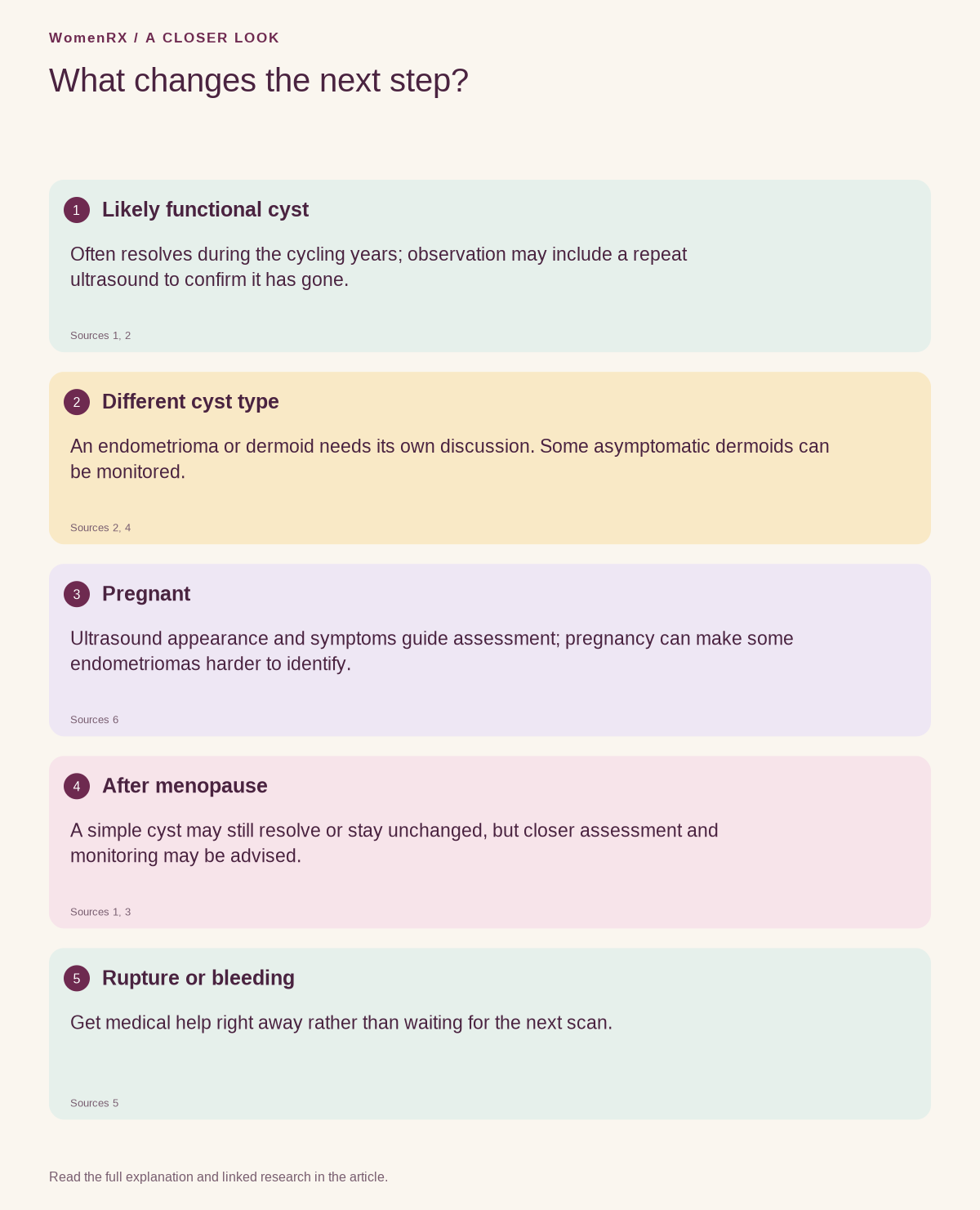
What changes the next step?
Likely functional cyst: Often resolves during the cycling years; observation may include a repeat ultrasound to confirm it has gone.12
Different cyst type: An endometrioma or dermoid needs its own discussion. Some asymptomatic dermoids can be monitored.24
Pregnant: Ultrasound appearance and symptoms guide assessment; pregnancy can make some endometriomas harder to identify.6
After menopause: A simple cyst may still resolve or stay unchanged, but closer assessment and monitoring may be advised.13
Rupture or bleeding: Get medical help right away rather than waiting for the next scan.5
Read the figure as text
Read the ultrasound finding alongside symptoms and life stage; these are decision branches, not a self-diagnosis tool.- Likely functional cyst: Often resolves during the cycling years; observation may include a repeat ultrasound to confirm it has gone.12
- Different cyst type: An endometrioma or dermoid needs its own discussion. Some asymptomatic dermoids can be monitored.24
- Pregnant: Ultrasound appearance and symptoms guide assessment; pregnancy can make some endometriomas harder to identify.6
- After menopause: A simple cyst may still resolve or stay unchanged, but closer assessment and monitoring may be advised.13
- Rupture or bleeding: Get medical help right away rather than waiting for the next scan.5
More questions, answered
Will birth control pills make my current cyst go away?
They can help prevent new ovarian cysts, but preventing a new cyst is not the same as shrinking one that’s already there. Ask how the cyst seen on your scan will be reassessed. 25
Does an ovarian cyst mean I’ll have trouble getting pregnant?
Usually not. If surgery is being considered and future pregnancy matters to you, ask what the procedure could mean for your ovary and fertility. Surgeons may be able to remove a cyst while leaving the ovary intact. 12
Sources you can check
- Ovarian cyst - NHSAccessed 2026-09-25Return to first citation
- Ovarian cyst - Treatment - NHSAccessed 2026-09-25Return to first citation
- Simple ovarian cysts in postmenopausal women: scope of conservative management.Sarkar M, Wolf MG. · European journal of obstetrics, gynecology, and reproductive biology · 2012Return to first citation
- Long-term Results for Expectant Management of Ultrasonographically Diagnosed Benign Ovarian Teratomas.Pascual MA, Graupera B, Pedrero C, Rodriguez I, Ajossa S, Guerriero S, Alcázar JL. · Obstetrics and gynecology · 2017Return to first citation
- Ovarian Cysts | Polycystic Ovary Syndrome | MedlinePlusAccessed 2026-09-25Return to first citation
- Is Ultrasound a Reliable and Reproducible Method for Assessing Adnexal Masses in Pregnancy? A Systematic Review.Gaughran JE, Naji O, Al Sabbagh MQ, Sayasneh A. · Cureus · 2021Return to first citation