Ovarian Cyst Claims: What’s True and What’s Next
An ovarian cyst doesn’t automatically mean surgery or cancer; its ultrasound appearance, symptoms, and whether you’ve gone through menopause help guide follow-up.
Many ovarian cysts go away without treatment, but not all cysts behave alike. Follow-up depends on the ultrasound description, whether the cyst persists or causes symptoms, and menopausal status. Pelvic pain or unusual fullness deserves assessment; sudden severe pelvic pain, or pain with nausea or vomiting, needs urgent evaluation. 12
A cyst finding isn’t a diagnosis of danger
An ovarian cyst is a fluid-filled sac, and cysts are common. Many develop naturally and disappear over a few months. That’s why finding one doesn’t automatically mean you need surgery. But “all cysts go away” isn’t true either: some remain, and a cyst’s size and appearance help determine whether it should be watched or evaluated further. 12
Symptoms can’t tell you what kind of cyst you have. Pelvic pain has many possible causes, and an ultrasound is commonly used to examine a suspected cyst. The written imaging description matters more than guessing from how the pain feels. 13
Which symptoms should you act on?
Make an appointment to discuss pelvic pain, pain during sex, or feeling unusually full after eating only a little, especially if these symptoms are new or continuing. They can occur with an ovarian cyst, but they don’t prove that a cyst is the cause. 13
Sudden, severe pelvic pain needs urgent medical assessment. Get urgent help as well if abdominal pain comes with nausea or vomiting. These symptoms can occur when a cyst ruptures or twists, but other conditions can also cause pelvic pain; don’t try to identify the cause by symptoms alone. 13
Why the ultrasound description changes the plan
A follow-up recommendation isn’t based on the word “cyst” alone. The size and appearance reported on ultrasound matter, as does whether you have symptoms. Some cysts are monitored with another ultrasound after a period of time; a persistent, large, symptomatic, or concerning cyst may lead to discussion of surgery or additional evaluation. 12
One useful distinction is whether the report describes a simple cyst. In a study of women older than 55 in a large cancer-screening trial, simple cysts were common and usually stayed stable or disappeared by the next annual exam. Among ovaries with one simple cyst at the first screen, 54% still had one a year later, while 32% had no cyst at that follow-up. The study found no increased risk of later invasive ovarian cancer associated with simple cysts. Those findings are reassuring for simple cysts in that population, not a guarantee about every ovarian mass. 4
If your report uses terms you don’t understand, ask what the description means for your particular follow-up plan. The NHS guidance also identifies cyst size and appearance as factors in whether monitoring or treatment is considered. 12
Menopause matters, but it isn’t a diagnosis
Whether you’ve gone through menopause is part of the assessment because ovarian cancer risk is somewhat higher after menopause. That fact alone does not mean a cyst is cancer. The ultrasound appearance and your overall clinical picture still matter. 1
The study of women older than 55 offers helpful context: simple cysts were seen in 14% of women the first time their ovaries were visualized, and the researchers found no increased risk of subsequent invasive ovarian cancer from these cysts. It supports a less alarming view of a simple cyst, while leaving room for follow-up based on its features and the person’s situation. 4
A useful way to read your report
Look for the description of the cyst, its size, and what follow-up the report recommends. Then connect that information with any symptoms you’re having and whether you’re premenopausal or postmenopausal. If surgery is discussed, ask what finding makes it preferable to monitoring and whether an approach that preserves ovarian tissue is possible. When surgery is needed, surgeons may be able to remove the cyst while leaving an ovary intact. 12
The most accurate takeaway is neither “every cyst is dangerous” nor “every cyst disappears.” Many cysts can be watched; others need more evaluation. The imaging details and symptoms help explain which situation applies to you.
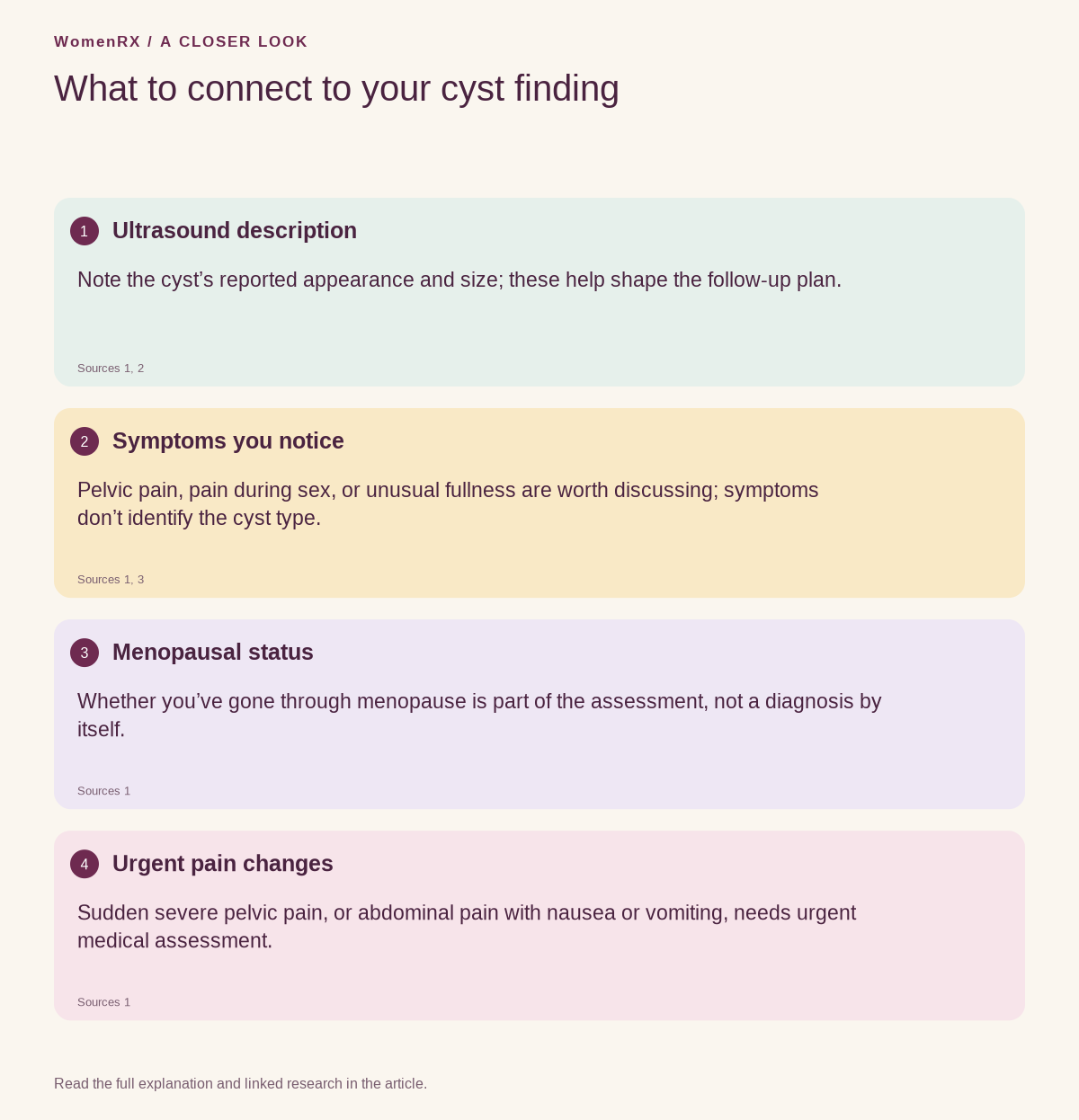
What to connect to your cyst finding
Ultrasound description: Note the cyst’s reported appearance and size; these help shape the follow-up plan.12
Symptoms you notice: Pelvic pain, pain during sex, or unusual fullness are worth discussing; symptoms don’t identify the cyst type.13
Menopausal status: Whether you’ve gone through menopause is part of the assessment, not a diagnosis by itself.1
Urgent pain changes: Sudden severe pelvic pain, or abdominal pain with nausea or vomiting, needs urgent medical assessment.1
Read the figure as text
Use these details to understand why a report may recommend monitoring, further evaluation, or urgent assessment.- Ultrasound description: Note the cyst’s reported appearance and size; these help shape the follow-up plan.12
- Symptoms you notice: Pelvic pain, pain during sex, or unusual fullness are worth discussing; symptoms don’t identify the cyst type.13
- Menopausal status: Whether you’ve gone through menopause is part of the assessment, not a diagnosis by itself.1
- Urgent pain changes: Sudden severe pelvic pain, or abdominal pain with nausea or vomiting, needs urgent medical assessment.1
More questions, answered
Does a cyst automatically mean I need surgery?
No. Monitoring with a later ultrasound is used for some cysts. Surgery may be considered when a cyst is large, persists, causes symptoms, or raises concern based on its features. 2
Does pelvic pain prove an ovarian cyst is the cause?
No. Pelvic pain can have many causes, and symptoms alone don’t identify the source. Ultrasound can help assess whether a cyst is present. 13
Sources you can check
- Ovarian cyst - NHSAccessed 2026-09-25Return to first citation
- Ovarian cyst - Treatment - NHSAccessed 2026-09-25Return to first citation
- Pelvic pain - NHSAccessed 2026-09-25Return to first citation
- Prevalence, incidence, and natural history of simple ovarian cysts among women >55 years old in a large cancer screening trial.Greenlee RT, Kessel B, Williams CR, Riley TL, Ragard LR, Hartge P, Buys SS, Partridge EE, Reding DJ. · American journal of obstetrics and gynecology · 2010Return to first citation