How an Ovarian Cyst Is Assessed Around Perimenopause
The word “cyst” doesn’t determine what happens next: menstrual status, symptoms, and the ultrasound description all help shape the plan.
A cyst found during perimenopause isn’t automatically treated as either a premenopausal or postmenopausal finding. If you’re still having menstrual cycles, a cycle-related functional cyst is possible; after menopause, clinicians may weigh the finding differently. They also consider symptoms, cyst size and persistence, and whether ultrasound describes a simple or more complex appearance. Those details together guide whether to watch, repeat imaging, or investigate further. 1 2 3
Why perimenopause doesn’t give one answer
Perimenopause is a transition, not a single ultrasound category. Menstrual cycles may still be happening, and functional cysts can form as part of the menstrual cycle. After menopause, that cycle-related explanation no longer fits, and ovarian cysts may prompt closer consideration. Menopause status matters, but it doesn’t decide the plan by itself. 1
The useful question isn’t simply, “Is this a cyst?” It’s “What kind of cyst does the report describe, what symptoms are present, and what follow-up fits my situation?” Cysts are common, and many disappear over time. 1 2
What the ultrasound description adds
Ultrasound helps describe a cyst’s size and appearance. A report may call it simple or describe features such as septa, nodules, or blood flow. These details help classify the finding, but ultrasound appearance is one part of assessment. A study reviewing ultrasound reports found that cyst type, size, and menopause status were all relevant to whether radiologists’ follow-up recommendations matched the guidelines it assessed. It also found examples of both overmanagement and undermanagement, a reminder that the whole picture matters. 3
Ask for the actual wording of the report, not just the summary “you have a cyst.” You can ask: Is it described as simple or complex? How large is it? Is there anything that makes the radiologist recommend repeat imaging or specialist review? These questions clarify what the finding means without assuming that every cyst needs treatment.
How symptoms and follow-up change the plan
If a cyst appears benign and isn’t causing symptoms, monitoring may be considered instead of immediate treatment. The appropriate timing of any repeat scan depends on the details and the care plan; there isn’t one interval that applies to every cyst. A cyst that persists, is large, causes symptoms, or raises concern on imaging may call for further assessment or surgery. 1 2
After menopause, a simple-looking cyst does not automatically mean cancer or surgery. In one retrospective US study of postmenopausal women, 378 simple cysts had follow-up ultrasound: 175 resolved and 166 stayed unchanged. One patient developed ovarian cancer three years after her last surveillance ultrasound, but the study did not establish that the cancer arose from or was caused by the cyst. Nearly half of the original patients were lost to follow-up, so the study is reassuring but limited and cannot settle an individual case. 4
A postmenopausal finding may lead to closer monitoring or additional assessment than a similar finding during cycling years, but the ultrasound details and symptoms still matter. If the plan is observation, ask what would lead to another scan, a referral, or treatment. 1 2
A useful way to discuss your result
Bring the report’s exact description into the conversation. Ask how your current menstrual status affects the interpretation, whether the cyst looks simple or has other features, and what the recommended next step is. If monitoring is proposed, clarify when follow-up is planned and what the team will be looking for. These questions turn an unsettling label into a specific plan.
Cysts can cause symptoms if they rupture, are very large, or twist and block the ovary’s blood supply. Mention symptoms when discussing what assessment and follow-up fit your situation. 1
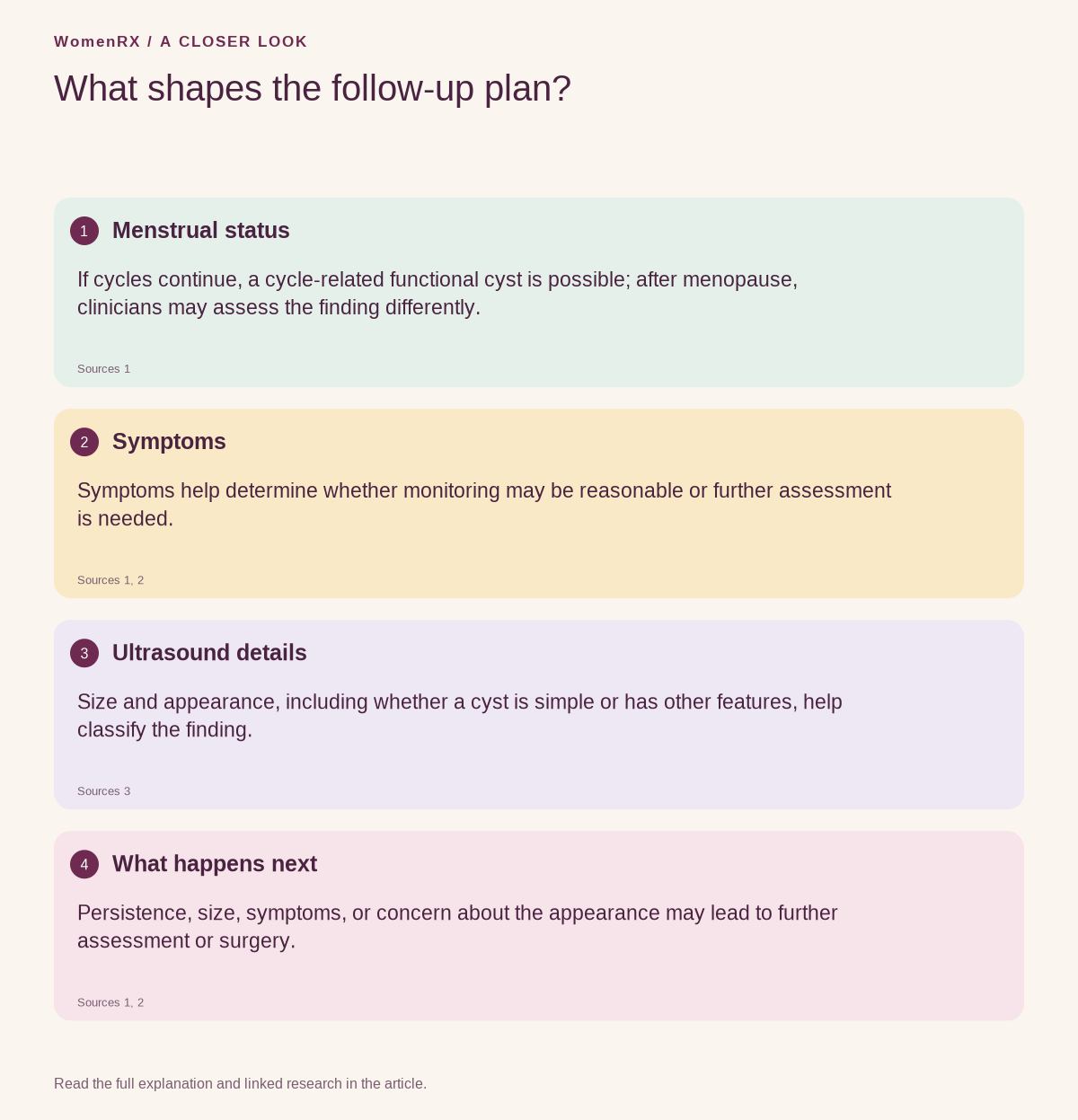
What shapes the follow-up plan?
Menstrual status: If cycles continue, a cycle-related functional cyst is possible; after menopause, clinicians may assess the finding differently.1
Symptoms: Symptoms help determine whether monitoring may be reasonable or further assessment is needed.12
Ultrasound details: Size and appearance, including whether a cyst is simple or has other features, help classify the finding.3
What happens next: Persistence, size, symptoms, or concern about the appearance may lead to further assessment or surgery.12
Read the figure as text
These connected questions help explain why two cysts, or two people at different stages of the menopause transition, may have different next steps.- Menstrual status: If cycles continue, a cycle-related functional cyst is possible; after menopause, clinicians may assess the finding differently.1
- Symptoms: Symptoms help determine whether monitoring may be reasonable or further assessment is needed.12
- Ultrasound details: Size and appearance, including whether a cyst is simple or has other features, help classify the finding.3
- What happens next: Persistence, size, symptoms, or concern about the appearance may lead to further assessment or surgery.12
More questions, answered
Does finding a cyst during perimenopause mean it is cancer?
No. Cysts are common, and many go away without treatment. Menopause status can affect how a finding is assessed, but symptoms and the cyst’s ultrasound appearance also matter. 1 2
Does every postmenopausal cyst need surgery?
No. A simple cyst may be monitored, depending on its features and the individual situation. In a retrospective study, most of the simple cysts with follow-up either resolved or stayed unchanged, though substantial loss to follow-up limits how confidently the results can be applied. 4
Sources you can check
- Ovarian cyst - NHSAccessed 2026-09-25Return to first citation
- Ovarian cyst - Treatment - NHSAccessed 2026-09-25Return to first citation
- Assessment of the Adherence of Radiologists in Reporting the Ovarian Cysts to the 2010 Society of Radiologists in Ultrasound Guidelines.Zarei F, Khatamizadeh N, Zeinali-Rafsanjani B. · Journal of medical ultrasound · 2023Return to first citation
- Simple ovarian cysts in postmenopausal women: scope of conservative management.Sarkar M, Wolf MG. · European journal of obstetrics, gynecology, and reproductive biology · 2012Return to first citation