Ovarian Cysts and Supplements: What to Know
A supplement claim only makes sense once you know whether the finding is a functional cyst, another ovarian mass, or PCOS.
A supplement isn’t a substitute for finding out what kind of ovarian finding you have. Cyst care depends on its size and appearance, symptoms, whether it persists, and menopause status. Many functional cysts resolve on their own. PCOS is a hormonal syndrome, not simply one ovarian cyst, so a supplement promoted for PCOS shouldn’t be assumed to treat a cyst. 1 2 3
First, what does “cyst” mean here?
A functional ovarian cyst forms as part of the menstrual cycle. These are common and often go away on their own within a few months. Other ovarian masses can have different causes and appearances, so the word “cyst” alone doesn’t tell you what follow-up is appropriate. Ultrasound findings, symptoms, and whether the mass changes over time help guide that decision. 1 3
PCOS is different. It’s a hormonal condition that can involve irregular or absent periods, higher androgen levels, and ovaries with clusters of follicles that may look like small cysts. Some people with PCOS don’t have those ovarian growths at all. The name can be confusing, but PCOS isn’t the same thing as having one functional cyst. 2
Why a general supplement recommendation doesn’t fit
A product marketed for “ovarian cysts” may blur together different conditions. Cyst management is based on the cyst’s appearance and size, symptoms, persistence, and menopause status. Cyst-care guidance describes monitoring and surgery when needed; it does not establish whether a supplement can make a cyst disappear. A general supplement claim isn’t a sound basis for deciding what to do about a specific finding. 3 4
PCOS-focused supplement claims are a separate question. A supplement discussed in relation to PCOS shouldn’t be assumed to shrink a functional cyst or treat another ovarian mass. Those are different findings, and PCOS care addresses the hormonal condition and its symptoms. 2
What usually guides cyst care
For many cysts, the approach is watchful waiting: no immediate procedure, with follow-up imaging when needed to see whether the cyst has changed or gone away. If a cyst persists, is large, causes symptoms, or has concerning features, a clinician may discuss additional evaluation or surgery. The decision is based on the individual finding, not on a general supplement plan. 3 4
Watchful waiting isn’t the response to every change. If a cyst bursts or causes bleeding, get medical help right away. 1
Birth control pills may help prevent new cysts. That is different from treating an existing cyst, which may resolve on its own. 1
Life stage matters, too
After menopause, cyst evaluation deserves particular attention because the chance that an ovarian cyst is cancerous increases with age. Menopause status is one of the factors used when deciding whether to monitor or treat a cyst. 1 3 4
Pregnancy also changes the context. In a UK specialist-center study of women with an adnexal mass found during pregnancy, assessment used ultrasound features and expert interpretation; follow-up was tailored to the individual finding. That study was about evaluation during pregnancy, not supplements, and its results shouldn’t be treated as a universal prediction for every pregnancy. If you’re pregnant or might be pregnant and an ovarian mass has been found, make sure the clinician assessing it knows. 5
A useful next step
If a scan report says “ovarian cyst,” ask what type or appearance was seen, whether follow-up imaging is planned, and what change would prompt another step. If you’re considering a supplement, bring its exact name and ingredients to the conversation. The key question is whether there’s evidence for that product for your specific finding, not just for “ovarian health” or PCOS generally.
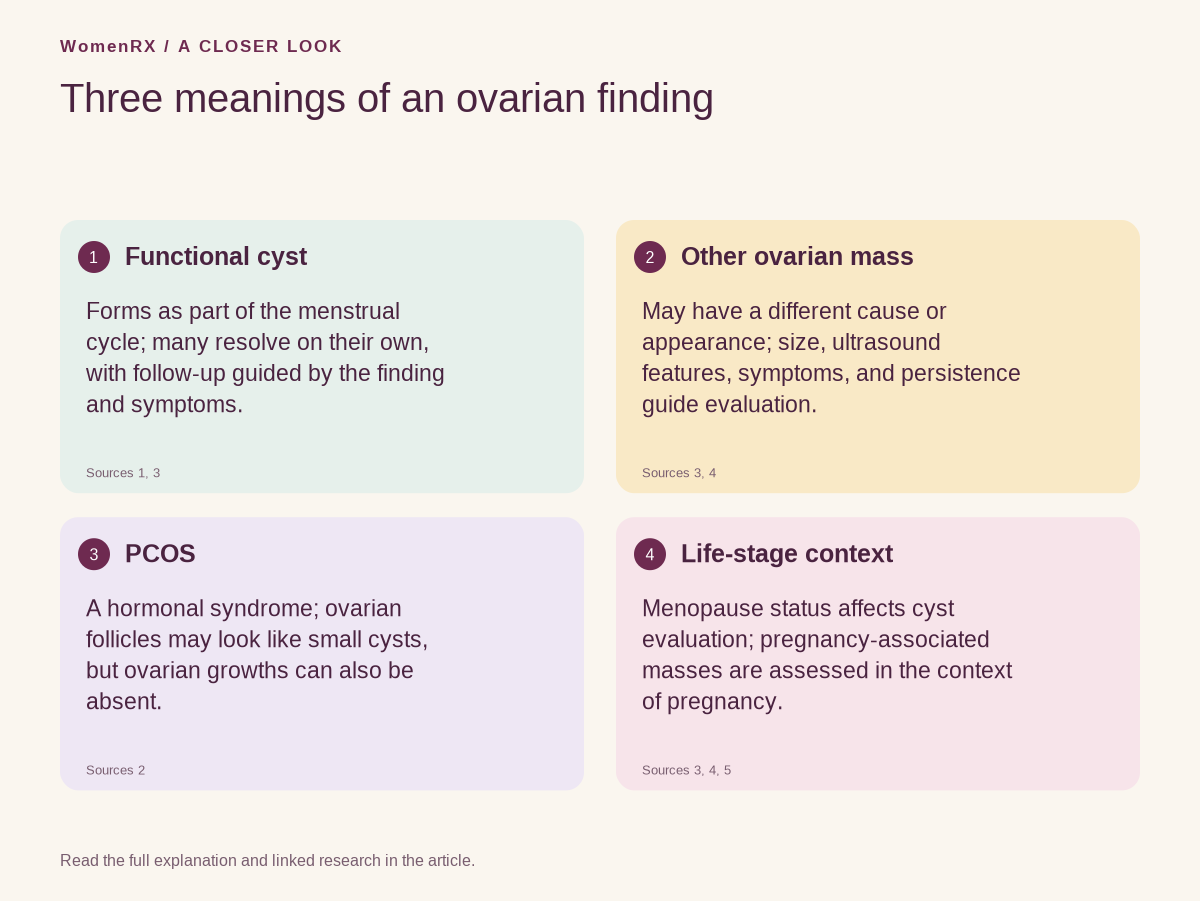
Three meanings of an ovarian finding
Functional cyst: Forms as part of the menstrual cycle; many resolve on their own, with follow-up guided by the finding and symptoms.13
Other ovarian mass: May have a different cause or appearance; size, ultrasound features, symptoms, and persistence guide evaluation.34
PCOS: A hormonal syndrome; ovarian follicles may look like small cysts, but ovarian growths can also be absent.2
Life-stage context: Menopause status affects cyst evaluation; pregnancy-associated masses are assessed in the context of pregnancy.345
Read the figure as text
The label alone doesn’t determine treatment. These distinctions show why the scan finding and life stage matter more than a general supplement claim.- Functional cyst: Forms as part of the menstrual cycle; many resolve on their own, with follow-up guided by the finding and symptoms.13
- Other ovarian mass: May have a different cause or appearance; size, ultrasound features, symptoms, and persistence guide evaluation.34
- PCOS: A hormonal syndrome; ovarian follicles may look like small cysts, but ovarian growths can also be absent.2
- Life-stage context: Menopause status affects cyst evaluation; pregnancy-associated masses are assessed in the context of pregnancy.345
More questions, answered
Can birth control pills make an existing ovarian cyst go away?
Birth control pills may help prevent new cysts, but don’t assume they’ll make one that’s already there go away. Many functional cysts resolve on their own, and follow-up depends on the cyst’s features and symptoms. 1 3
Does having PCOS mean I have an ovarian cyst?
No. PCOS can involve clusters of follicles that look like small cysts, but some people with PCOS don’t have ovarian growths. PCOS is a hormonal syndrome, not a diagnosis of one simple cyst. 2
Sources you can check
- Ovarian Cysts | Polycystic Ovary Syndrome | MedlinePlusAccessed 2026-09-25Return to first citation
- PCOS | Polycystic Ovary Syndrome | MedlinePlusAccessed 2026-09-25Return to first citation
- Ovarian cyst - NHSAccessed 2026-09-25Return to first citation
- Ovarian cyst - Treatment - NHSAccessed 2026-09-25Return to first citation
- Evaluating use of two-step International Ovarian Tumor Analysis strategy to classify adnexal masses identified in pregnancy: pilot study.Barcroft J, Pandrich M, Del Forno S, Cooper N, Linton-Reid K, Landolfo C, Timmerman D, Saso S, Bourne T. · Ultrasound in obstetrics & gynecology : the official journal of the International Society of Ultrasound in Obstetrics and Gynecology · 2024Return to first citation