Ovarian Cysts: Reading O-RADS and Follow-Up Recommendations
A cyst’s appearance, size, your symptoms, and whether you’ve been through menopause all help shape what happens next.
An ultrasound report can describe a cyst and sometimes assign an O-RADS category to help estimate concern. It cannot, by itself, tell you whether you need surgery. Many cysts are monitored rather than treated right away; the next step depends on the cyst’s appearance and size, your symptoms, and whether you’ve been through menopause. Sudden, severe pelvic pain needs urgent assessment. 125
Finding “ovarian cyst” on a report can be unsettling, especially if the scan was done for an unrelated reason. Look for any O-RADS category and the recommended next step, alongside the cyst’s description. Ultrasound findings matter, but so do your symptoms and whether you’re still having menstrual cycles. 12
What O-RADS and the recommendation mean
An ovarian cyst is a fluid-filled sac on an ovary. If the report calls it functional, that means it developed as part of the menstrual cycle. Functional cysts are the most common type and are usually short-lived. Many ovarian cysts cause no symptoms and go away without treatment. 1
A report may also use an O-RADS number. O-RADS is a standardized ultrasound system that uses features of an ovarian or nearby mass to place it in one of five estimated malignancy-risk categories and guide management. It’s a risk category, not a diagnosis of cancer. The 2022 update describes O-RADS 3 as lower risk and says these lesions can be followed with ultrasound if they aren’t removed. It identifies O-RADS 4 as a cutoff for greater malignancy concern. Neither category, on its own, is a decision to operate. 45
The description helps explain the category. A “solid component” means the report has identified solid tissue within a cyst, a feature that may prompt further characterization with MRI. If the finding is called “indeterminate,” the scan hasn’t settled what it is. Check the impression for the radiologist’s overall assessment and recommendation, then ask: Would another ultrasound help show whether this changes, or would MRI better characterize it? MRI can serve as a problem-solving test when ultrasound assessment is limited or more detail could change management. 45
Why the measurement isn’t the whole answer
Note the cyst’s size, but don’t treat a measurement as a stand-alone verdict. Size and appearance are considered alongside symptoms and menopausal status when deciding whether treatment is needed. Watchful waiting means no immediate treatment, though it may include a repeat ultrasound weeks or months later to see whether the cyst has gone. A persistent cyst is one that’s still there on follow-up; large, persistent, symptomatic, or potentially cancerous cysts may lead to a discussion about surgery. That does not mean every cyst that appears on a scan needs removal. 2
For example, if a report recommends a repeat scan, ask what the repeat scan is meant to check: disappearance, change in size, or a feature that wasn’t clear the first time. If it recommends a specialist evaluation, ask which finding prompted that recommendation. Those questions are more useful than trying to choose a follow-up date from the measurement alone. 125
The same finding can mean a different plan after menopause
During the cycling years, functional cysts can arise as part of the menstrual cycle. After menopause, a cyst deserves a different assessment because ovarian cancer is more common among women who have been through menopause. That higher concern doesn’t mean a postmenopausal cyst is cancer: monitoring with ultrasound and sometimes blood tests may be advised, depending on the finding. Ask whether the report’s recommendation accounts for your menopausal status and what would change the plan from monitoring to further evaluation. 12
If you’re pregnant, bring a cyst finding to the clinician managing your pregnancy rather than applying a nonpregnant follow-up plan. Ultrasound is used to assess ovarian and nearby masses in pregnancy, but a systematic review found that the studies available to guide assessment were mostly case reports and series. The imaging finding and your symptoms need individual interpretation in that setting. 3
When symptoms matter more than the report
Get urgent medical assessment for sudden, severe pelvic pain, even if an earlier report sounded reassuring. A cyst can cause symptoms if it ruptures or twists and blocks blood flow to the ovary. An imaging recommendation for routine follow-up isn’t a reason to wait through new, severe pain. 1
For symptoms that aren’t sudden or severe, tell the clinician reviewing the report what you’re feeling rather than assuming the cyst explains it. The useful decision is whether the scan finding fits your symptoms and whether observation, repeat imaging, or a specialist assessment is the right next step. 12
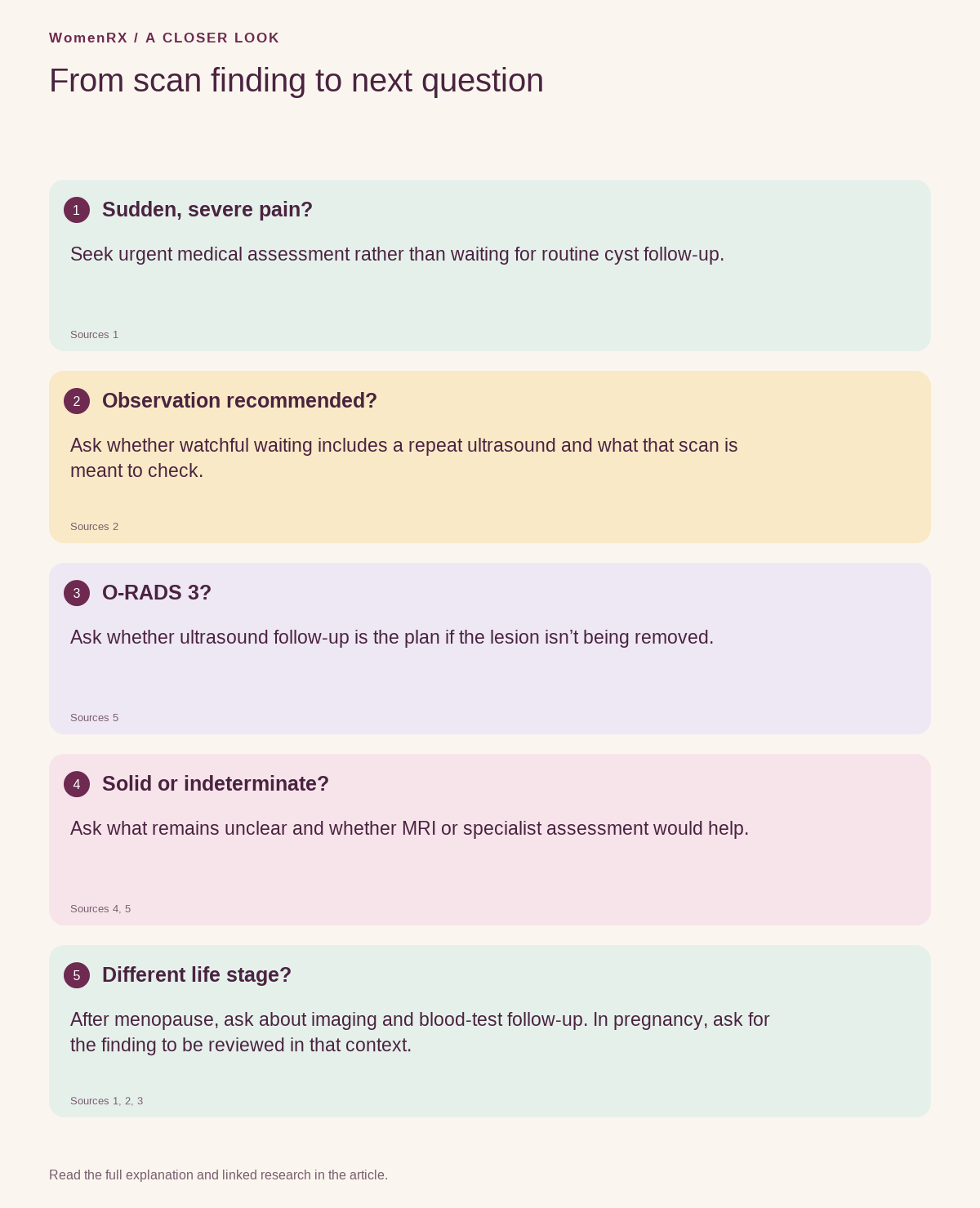
From scan finding to next question
Sudden, severe pain?: Seek urgent medical assessment rather than waiting for routine cyst follow-up.1
Observation recommended?: Ask whether watchful waiting includes a repeat ultrasound and what that scan is meant to check.2
O-RADS 3?: Ask whether ultrasound follow-up is the plan if the lesion isn’t being removed.5
Solid or indeterminate?: Ask what remains unclear and whether MRI or specialist assessment would help.45
Different life stage?: After menopause, ask about imaging and blood-test follow-up. In pregnancy, ask for the finding to be reviewed in that context.123
Read the figure as text
Start with symptoms. If there’s no sudden, severe pain, use the report’s description and recommendation to find the relevant follow-up question.- Sudden, severe pain?: Seek urgent medical assessment rather than waiting for routine cyst follow-up.1
- Observation recommended?: Ask whether watchful waiting includes a repeat ultrasound and what that scan is meant to check.2
- O-RADS 3?: Ask whether ultrasound follow-up is the plan if the lesion isn’t being removed.5
- Solid or indeterminate?: Ask what remains unclear and whether MRI or specialist assessment would help.45
- Different life stage?: After menopause, ask about imaging and blood-test follow-up. In pregnancy, ask for the finding to be reviewed in that context.123
More questions, answered
Does an O-RADS number tell me my personal chance of cancer?
It gives an estimated risk category based on imaging features, not a precise personal probability or a diagnosis. Ask what features led to the category and what follow-up the report recommends. 45
If a cyst disappears on a repeat scan, will I still need treatment?
Usually not. Repeat ultrasound can check whether a cyst has disappeared, and further tests or treatment are generally unnecessary when it has. Your clinician can explain whether anything else in your situation needs follow-up. 12
Sources you can check
- Ovarian cyst - NHSAccessed 2026-09-25Return to first citation
- Ovarian cyst - Treatment - NHSAccessed 2026-09-25Return to first citation
- Is Ultrasound a Reliable and Reproducible Method for Assessing Adnexal Masses in Pregnancy? A Systematic Review.Gaughran JE, Naji O, Al Sabbagh MQ, Sayasneh A. · Cureus · 2021Return to first citation
- O-RADS for assessment of adnexal lesions: current status, challenges and future directions.Guo Y, Strachowski LM, Shinagare AB, Maturen KE, Patel MD, Sadowski EA, Andreotti RF. · Cancer imaging : the official publication of the International Cancer Imaging Society · 2026Return to first citation
- O-RADS US v2022: An Update from the American College of Radiology's Ovarian-Adnexal Reporting and Data System US Committee.Strachowski LM, Jha P, Phillips CH, Blanchette Porter MM, Froyman W, Glanc P, Guo Y, Patel MD, Reinhold C, Suh-Burgmann EJ, Timmerman D, Andreotti RF. · Radiology · 2023Return to first citation