Ovarian Cysts and Fertility: Why the Type Matters
Many ovarian cysts are temporary and don’t usually stop pregnancy, but an endometrioma or a decision to operate can change the fertility discussion.
A cyst finding doesn’t automatically mean you’ll have trouble getting pregnant. Functional cysts, which form during the menstrual cycle, commonly go away on their own and usually don’t affect fertility. An endometrioma is different: it’s linked to endometriosis, which can affect fertility, and surgery to remove the cyst may also affect ovarian reserve. The cyst’s type, persistence, and your plans matter. 1 2 5
Start with the kind of cyst
“Ovarian cyst” describes a finding, not one single condition. Functional cysts develop as part of the menstrual cycle. They’re the most common type and often disappear within a few months. In most cases, they don’t prevent pregnancy. 1 2
An endometrioma is a cyst associated with endometriosis. In this case, the fertility question isn’t just whether a cyst is present: endometriosis itself is a potential contributor to infertility, and an endometrioma can be a sign of that condition. A cyst alone doesn’t tell you the full picture of whether or why conception might be difficult. 4 6
Other, less common cysts can form through abnormal cell growth. Whether a cyst needs follow-up or treatment can depend on what it looks like on imaging, whether it persists, its size, symptoms, and whether there’s concern about cancer. 1 2
Why endometrioma treatment involves a tradeoff
Removing an endometrioma isn’t automatically a way to improve the chance of pregnancy. Surgery may be considered for reasons such as symptoms or the details of the cyst and fertility plan, but removing ovarian tissue can affect ovarian reserve. A systematic review of studies on endometrioma treatment found that laparoscopic cyst removal was associated with changes in anti-Müllerian hormone (AMH), a measure used in assessing ovarian reserve. The review also found that results varied across surgical approaches and that more comparative research is needed. 5
That makes the decision a balance: leaving a cyst in place has its own considerations, while surgery may have consequences for ovarian tissue. The review doesn’t establish one best procedure for every person or show that surgery reliably improves fertility. 5
A retrospective study of women who had IVF after endometrioma surgery compared them with women whose infertility was attributed to tubal obstruction. Because it looked at selected groups after surgery and used a retrospective design, its results don’t show what would happen to every person with an endometrioma, or prove that surgery caused the difference in outcomes. 6
What to clarify from an ultrasound or diagnosis
If a scan finds a cyst while you’re trying to conceive, ask for the exact term used in the report and what the plan is to check whether it changes or goes away. Follow-up ultrasound may be used to see whether a cyst has resolved; persistent or concerning cysts may prompt further assessment or surgery. 1 2
It may also help to ask whether the finding is thought to be functional, an endometrioma, or another type of mass; whether it is on one ovary or both; and how any proposed treatment fits with your timing for pregnancy. These details matter because surgery, particularly when both ovaries are involved, can carry different ovarian-reserve considerations. 5
If endometrioma is suspected, ask how the possibility of endometriosis affects the fertility discussion. The cyst is one part of the picture, not a complete explanation of fertility. Age, how long you’ve been trying, and factors involving either partner can also matter. 3 4
When to widen the fertility conversation
A cyst doesn’t explain every delay in conception. In the United States, infertility is generally defined as not becoming pregnant after a year of frequent, unprotected sex, or after six months for someone age 35 or older. Evaluation can involve both partners, since fertility concerns may have more than one cause. 4
The most useful next question is often not “Will this cyst make me infertile?” but “What type is it, what are we watching for, and how would treatment affect my fertility plans?”
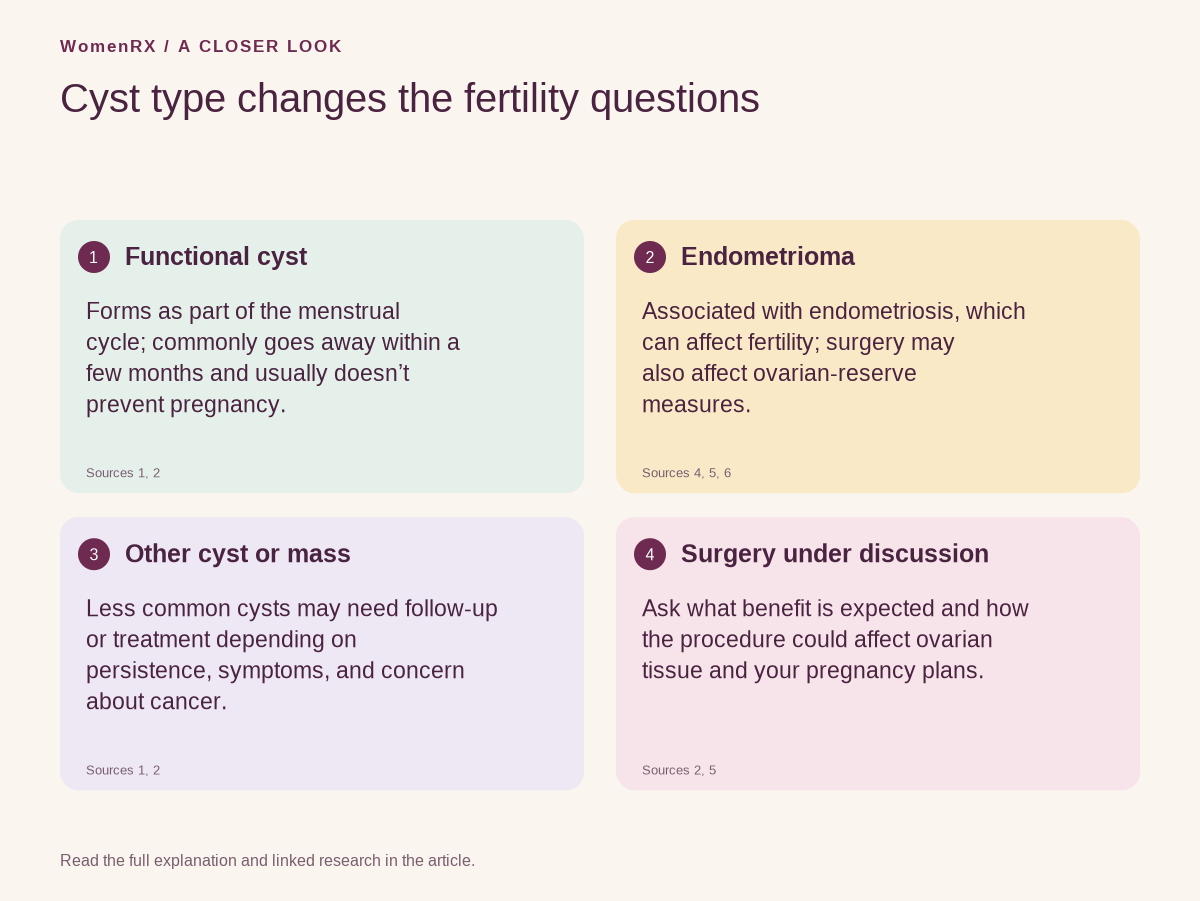
Cyst type changes the fertility questions
Functional cyst: Forms as part of the menstrual cycle; commonly goes away within a few months and usually doesn’t prevent pregnancy.12
Endometrioma: Associated with endometriosis, which can affect fertility; surgery may also affect ovarian-reserve measures.456
Other cyst or mass: Less common cysts may need follow-up or treatment depending on persistence, symptoms, and concern about cancer.12
Surgery under discussion: Ask what benefit is expected and how the procedure could affect ovarian tissue and your pregnancy plans.25
Read the figure as text
A cyst label alone doesn’t predict whether you’ll conceive. Its likely type and whether treatment is being considered help shape the discussion.- Functional cyst: Forms as part of the menstrual cycle; commonly goes away within a few months and usually doesn’t prevent pregnancy.12
- Endometrioma: Associated with endometriosis, which can affect fertility; surgery may also affect ovarian-reserve measures.456
- Other cyst or mass: Less common cysts may need follow-up or treatment depending on persistence, symptoms, and concern about cancer.12
- Surgery under discussion: Ask what benefit is expected and how the procedure could affect ovarian tissue and your pregnancy plans.25
More questions, answered
Does having a cyst mean I should take birth control while trying to conceive?
A cyst finding alone doesn’t establish that you need treatment. Whether monitoring or another approach makes sense depends on the suspected cyst type, whether it persists, symptoms, and your pregnancy plans. Ask what the scan suggests and what the aim of any proposed treatment would be. 1 2
Can surgery to remove a cyst affect fertility?
It can be relevant, especially with endometrioma surgery: studies reviewed found postoperative changes in AMH, and effects can vary with the person and procedure. That’s why the potential benefit of surgery is weighed against possible effects on ovarian reserve. 5
Sources you can check
- Ovarian cyst - NHSAccessed 2026-09-25Return to first citation
- Ovarian cyst - Treatment - NHSAccessed 2026-09-25Return to first citation
- Diagnosis of infertility - NHSAccessed 2026-09-25Return to first citation
- Infertility | Infertility Treatments | MedlinePlusAccessed 2026-09-25Return to first citation
- Comparison of Surgical Interventions for Endometrioma: A Systematic Review of Their Efficacy in Addressing Infertility.Ioannidou A, Machairiotis N, Stavros S, Potiris A, Karampitsakos T, Pantelis AG, Drakakis P. · Biomedicines · 2024Return to first citation
- Ovarian Stimulation for In Vitro Fertilization and Reproductive Outcome after Surgical Treatment of Endometriosis Compared with Tubal Factor Infertility.Nadă ES, Coroleucă CB, Coroleucă CA, Brătilă E. · Clinics and practice · 2023Return to first citation