Ovarian Cysts and Fertility: What the Type Can Tell You
Most ovarian cysts don’t stop pregnancy, but an endometrioma or a cyst that persists may call for a different fertility conversation.
Most ovarian cysts don’t prevent pregnancy. A short-lived cyst linked to the menstrual cycle is different from an endometrioma, a type associated with endometriosis and infertility. If surgery is considered for an endometrioma, the tradeoff matters too: removing the cyst can affect healthy ovarian tissue and ovarian-reserve measures. The ultrasound description, whether the cyst persists, and your age and fertility goals help frame the discussion. 1 3 4

An ovarian cyst on an ultrasound isn’t, by itself, a prediction that you’ll have trouble conceiving. The key question is what kind of cyst it is. Some arise as part of the menstrual cycle and are usually short-lived; an endometrioma is different because it occurs with endometriosis, a condition associated with infertility. 1 4
Two findings that mean different things
Functional cysts develop as part of the menstrual cycle. They’re the most common type, are usually harmless and often disappear within a few months. Ovarian cysts overall usually don’t prevent pregnancy, though they can sometimes make conception harder. 1
Endometriomas are ovarian cysts associated with endometriosis. In a retrospective study of 150 patients who were already being treated for infertility and had ovarian endometriosis cysts, researchers found that age and several other factors were associated with pregnancy outcomes after surgery followed by staged oral traditional Chinese medicine treatment. Because this was a selected group receiving a specific sequence of treatments, the study can’t tell you the chance of pregnancy for everyone with an endometrioma, or show that the cyst alone caused infertility. 4
For other cyst types, the cyst label alone isn’t enough to predict fertility. A persistent cyst, a large cyst, or one causing symptoms may prompt more evaluation or treatment, but that doesn’t automatically mean it is blocking conception. 2
What to look for in the ultrasound report
The report is useful because it helps identify what needs follow-up, not because one measurement can forecast fertility. Look for the cyst’s stated type or description, its size, whether it’s on one or both ovaries, and whether a repeat ultrasound is recommended. If the report doesn’t make the type clear, asking what the finding is thought to represent can be more useful than focusing on the word “cyst” alone. Ultrasound follow-up may be used to check whether a cyst has gone away; persistence, size, symptoms, and concern about cancer can affect whether treatment is considered. 1 2
Size can be part of the picture, but it shouldn’t be treated as a fertility verdict. In the study of patients with infertility and ovarian endometriosis who had surgery followed by staged oral traditional Chinese medicine treatment, cyst diameter was among several factors associated with pregnancy outcomes. Its results don’t establish a universal size cutoff for fertility problems or for surgery. 4
If surgery comes up, ask about the tradeoff
Removing a cyst isn’t automatically the best way to protect fertility. Endometrioma surgery can also affect ovarian tissue. A 2022 report describing a randomized comparison of endometrioma cyst removal and carbon-dioxide laser vaporization said the removal group had reductions in anti-Müllerian hormone (AMH) and antral follicle count, while the vaporization group did not; pregnancy rates were comparable. These findings describe particular procedures in a study, not a guarantee about your own outcome or a reason to choose one technique without considering the full clinical picture. 3
If surgery is proposed, ask what the goal is, what is known about preserving ovarian tissue, and whether the plan takes your pregnancy goals and age into account. In the selected retrospective infertility cohort that received surgery followed by staged oral traditional Chinese medicine treatment, age was associated with pregnancy outcome, but the study doesn’t provide a general age-based prediction for someone with an incidental cyst. 4
For many cysts, monitoring rather than immediate surgery is used, and some disappear within a few months. The practical next step is to understand the report’s description and follow-up plan, then consider those details alongside your fertility goals. 1 2
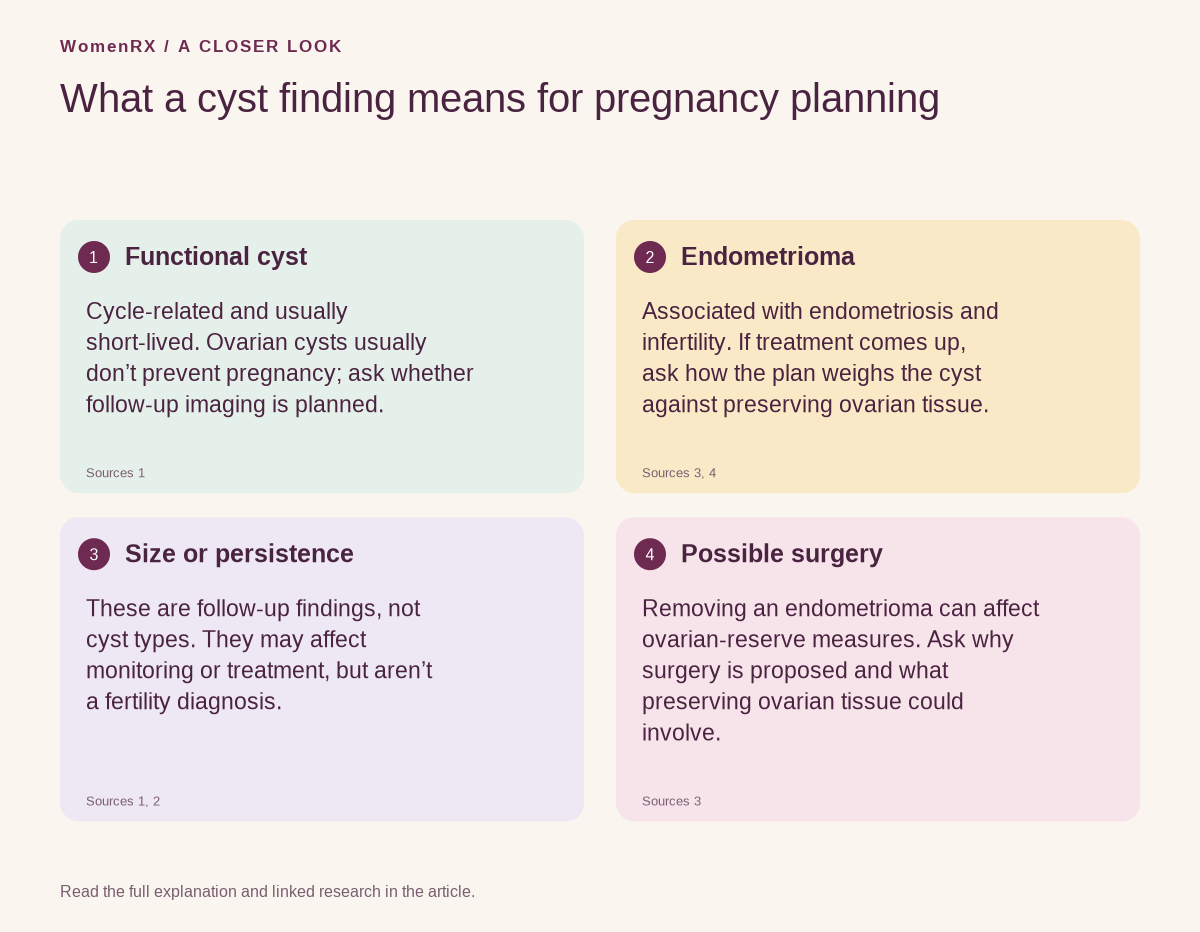
What a cyst finding means for pregnancy planning
Functional cyst: Cycle-related and usually short-lived. Ovarian cysts usually don’t prevent pregnancy; ask whether follow-up imaging is planned.1
Endometrioma: Associated with endometriosis and infertility. If treatment comes up, ask how the plan weighs the cyst against preserving ovarian tissue.34
Size or persistence: These are follow-up findings, not cyst types. They may affect monitoring or treatment, but aren’t a fertility diagnosis.12
Possible surgery: Removing an endometrioma can affect ovarian-reserve measures. Ask why surgery is proposed and what preserving ovarian tissue could involve.3
Read the figure as text
The first two rows compare cyst types. The others show how follow-up findings and a possible treatment decision can change the conversation.- Functional cyst: Cycle-related and usually short-lived. Ovarian cysts usually don’t prevent pregnancy; ask whether follow-up imaging is planned.1
- Endometrioma: Associated with endometriosis and infertility. If treatment comes up, ask how the plan weighs the cyst against preserving ovarian tissue.34
- Size or persistence: These are follow-up findings, not cyst types. They may affect monitoring or treatment, but aren’t a fertility diagnosis.12
- Possible surgery: Removing an endometrioma can affect ovarian-reserve measures. Ask why surgery is proposed and what preserving ovarian tissue could involve.3
More questions, answered
Does an ovarian cyst mean I can’t get pregnant?
No. Ovarian cysts usually don’t prevent pregnancy, although they can sometimes make conception harder. The type of cyst and the reason it formed matter. 1
Does a bigger cyst automatically mean lower fertility?
No. In a study of infertile patients with ovarian endometriosis who had surgery followed by staged oral traditional Chinese medicine treatment, cyst diameter was one of several factors associated with pregnancy outcomes. It doesn’t establish a size cutoff that predicts fertility for everyone with an ovarian cyst. 4
Sources you can check
- Ovarian cyst - NHSAccessed 2026-09-25Return to first citation
- Ovarian cyst - Treatment - NHSAccessed 2026-09-25Return to first citation
- Fertility Sparing Procedure using Carbon Dioxide Fiber Laser Vaporization of Ovarian Endometrioma.Candiani M, Ottolina J, Tandoi I, Bartiromo L, Schimberni M, Villanacci R, Ferrari S. · Journal of visualized experiments : JoVE · 2022Return to first citation
- Logistic regression analysis of pregnancy outcome and EFI score of infertile patients with ovarian endometriosis cyst after staged oral administration of traditional Chinese medicine.Bo Y, Peng S, Su J, Ye D. · Frontiers in endocrinology · 2025Return to first citation