Age, Fertility, and What Ovarian Reserve Tests Can Tell You
Age affects both the number of eggs available and their likelihood of developing normally, while reserve tests mainly estimate how the ovaries may respond to fertility treatment.
Fertility tends to decline with age as the pool of eggs shrinks and egg quality changes, including a greater chance of chromosome errors. The decline tends to become sharper from the mid-thirties, but that’s a population trend, not a personal cutoff. AMH and antral follicle count can help estimate response to IVF stimulation; they cannot measure egg quality or reliably predict your chance of natural pregnancy. 3 4 2
Age changes more than egg numbers
A useful way to think about reproductive aging is as two related changes, not one countdown. The number of eggs remaining declines over time. At the same time, the proportion of eggs with the capacity to develop normally can change. Fertility tends to decline more sharply from the mid-thirties, but that broad pattern doesn’t predict any one person’s timeline. These processes vary from person to person, and there isn’t one age at which fertility suddenly ends. 3 4
As eggs age, errors in chromosome separation become more common. Research reviews identify these errors as one factor in age-related changes in egg competence. 4 A broad review also describes ovarian aging as contributing to subfertility and miscarriage, but it does not provide an individual risk estimate. 3
That distinction matters: having fewer eggs and having eggs with a lower chance of developing normally are not the same thing. A test that offers information about the first can’t fully measure the second.
What AMH and antral follicle count add
Anti-Müllerian hormone (AMH) is measured in blood. Antral follicle count (AFC) is an ultrasound estimate of small follicles in the ovaries. Both are used as markers of ovarian reserve, or the remaining follicle pool. They can help estimate how the ovaries might respond to stimulation during IVF, including how many eggs might be retrieved. 3 2
They are not direct counts of all remaining eggs, and they do not assess whether an individual egg has the usual number of chromosomes. A reserve result also can’t reliably answer, “What are my chances of conceiving naturally?” 3
A 2026 retrospective study of 1,736 non-donor IVF cycles at one fertility center helps show the difference. AMH and AFC were strongly associated with egg retrieval and blastocyst formation, but less associated with live birth. Maternal age was the strongest factor associated with IVF success in that study. These findings describe people receiving IVF at one center; they aren’t a personal forecast or a study of natural conception. 2
So a low reserve result may be useful when planning a treatment approach, but it does not by itself establish that pregnancy is impossible. And a higher result is not a guarantee that age-related egg-quality changes are absent. The result is one piece of a broader assessment, not a verdict.
Reading age and test results together
Imagine two people with similar AMH results but different ages. The test may suggest a similar expected response to ovarian stimulation, while age still adds separate information about egg quality and the chance of IVF success. Conversely, a lower reserve marker doesn’t tell you that every egg is abnormal. These are examples of why test results and age answer different questions, rather than competing with each other. 2 3
If you’re weighing when to try, an ovarian reserve test can’t calculate a safe amount of time to wait. It may help make a fertility-treatment discussion more specific, but it can’t remove uncertainty about natural conception or an individual pregnancy outcome. The practical question is whether testing would change a decision you’re considering, such as whether to seek an evaluation now or discuss fertility preservation.
When to ask about an evaluation
In the United States, MedlinePlus says infertility can be diagnosed after a year of frequent, unprotected sex without pregnancy, or after six months for someone age 35 or older. If you’re ready to try to get pregnant, it also advises speaking with a provider if you’re over 40, have irregular periods, or have had fertility concerns in the past. 1
Those are reasons to discuss timing, not a prediction of what will happen. Age is one part of fertility assessment; a person’s health history and, when relevant, a partner’s fertility also matter. 1 If you’re deciding whether to test, ask what a result would and would not change for you. In particular: Is the goal to estimate response to IVF stimulation, investigate a fertility concern, or get a reliable forecast of natural pregnancy? The first two may be helped by reserve testing. The last can’t be answered by AMH or AFC alone. 3 2
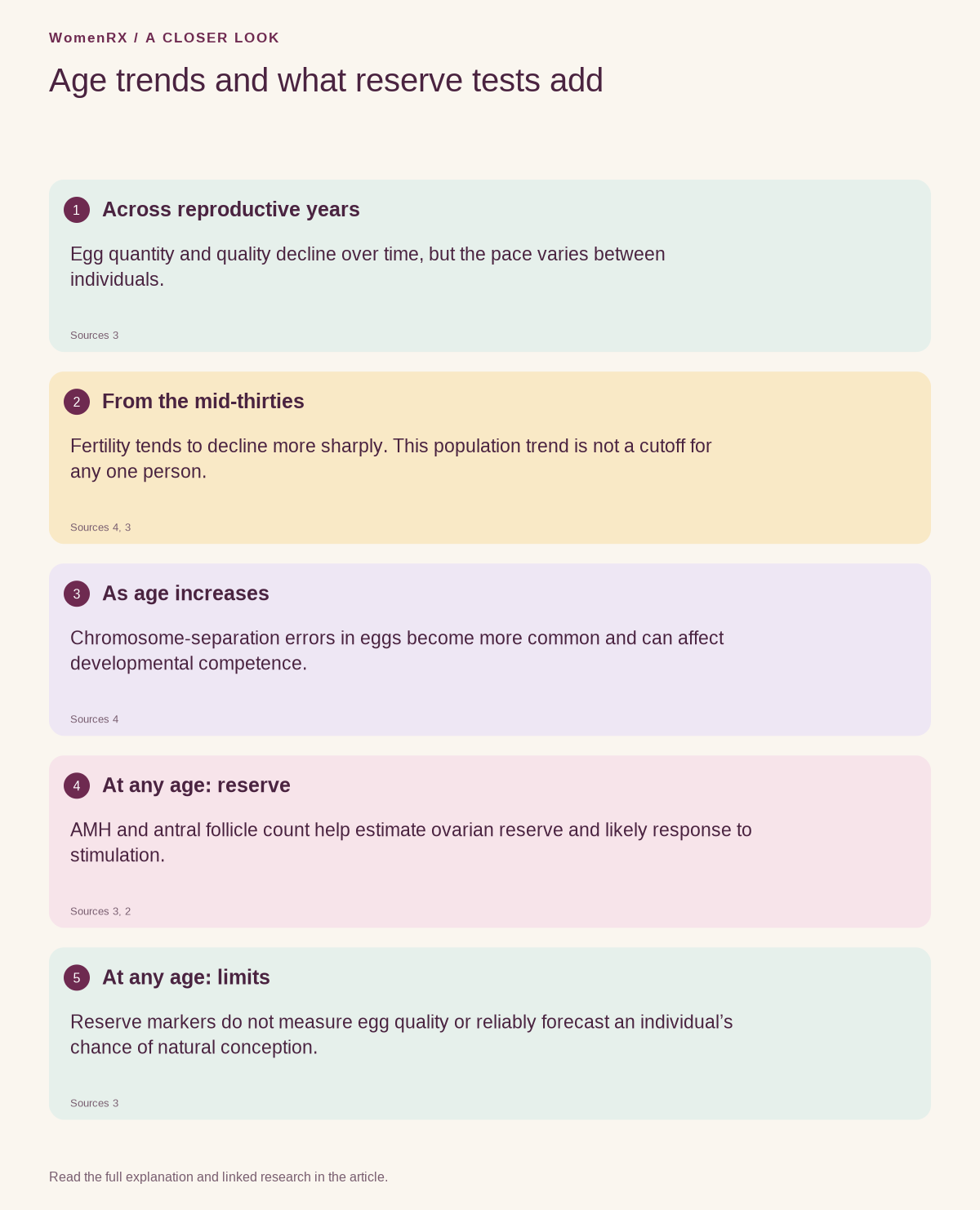
Age trends and what reserve tests add
Across reproductive years: Egg quantity and quality decline over time, but the pace varies between individuals.3
From the mid-thirties: Fertility tends to decline more sharply. This population trend is not a cutoff for any one person.43
As age increases: Chromosome-separation errors in eggs become more common and can affect developmental competence.4
At any age: reserve: AMH and antral follicle count help estimate ovarian reserve and likely response to stimulation.32
At any age: limits: Reserve markers do not measure egg quality or reliably forecast an individual’s chance of natural conception.3
Read the figure as text
Follow the broad age-related pattern, then see which part ovarian reserve tests can help assess. This is not a personal fertility timeline.- Across reproductive years: Egg quantity and quality decline over time, but the pace varies between individuals.3
- From the mid-thirties: Fertility tends to decline more sharply. This population trend is not a cutoff for any one person.43
- As age increases: Chromosome-separation errors in eggs become more common and can affect developmental competence.4
- At any age: reserve: AMH and antral follicle count help estimate ovarian reserve and likely response to stimulation.32
- At any age: limits: Reserve markers do not measure egg quality or reliably forecast an individual’s chance of natural conception.3
More questions, answered
Does a normal AMH result mean my eggs are good quality?
No. AMH is a marker of the follicle pool and can help estimate ovarian response to stimulation; it does not measure egg quality or chromosome status. 3
Can ovarian reserve tests tell me how long I can wait to try?
They can’t reliably predict an individual’s natural fertility or set a personal amount of time to wait. Their clearest use is estimating ovarian response in fertility treatment, so discuss whether that information would affect a decision you’re weighing. 3 2
Sources you can check
- Infertility | Infertility Treatments | MedlinePlusAccessed 2026-09-25Return to first citation
- A multifactorial analysis of in vitro fertilization outcomes.Afsari B, Gollapudi S, Portugal A, El Sharaiha R, Gornet M, Lebovic DI, Jimenez P, Omurtag K, Ahmady A, Darafsheh A. · Reproduction & fertility · 2026Return to first citation
- Ovarian ageing: from biological constraint to emerging therapeutic frontier.Mondal R, Nandi M. · Journal of assisted reproduction and genetics · 2026Return to first citation
- Causes and consequences of chromosomal cohesin loss: Novel insights for mechanisms of aging-related oocyte aneuploidy.Fu LL, Zhang JS, Zhang XY, Xu Y, Zhang FL, Zheng LW. · Mechanisms of ageing and development · 2026Return to first citation