Trying to Conceive After 35: What Changes and When to Seek Advice
Age affects fertility gradually, but your age and health history can help you decide when to ask for an evaluation.
Fertility tends to decline with age, but 35 isn’t a sudden cutoff and age alone can’t predict your individual chance of pregnancy. If you’re under 35 and have no known fertility concerns, evaluation is generally considered after 12 months of trying. At 35 or older, ask sooner rather than waiting a full year; one guideline recommends evaluation after six months at ages 35-37 and earlier after 37. Known reproductive conditions or irregular periods are reasons to discuss timing promptly. 4 5
What changes with age, and what doesn’t
Fertility doesn’t switch off on your 35th birthday. It changes over time, and people of the same age can have different reproductive histories and ovarian reserve. Still, age is a meaningful factor: as women get older, the number of eggs available declines, and the chance that an egg will lead to a chromosomally typical embryo also tends to fall. These changes contribute to lower chances of pregnancy and higher risks of pregnancy loss with increasing age. 4 7
That’s a population pattern, not a forecast for you. A study of 773 women having IVF and genetic testing of embryos, for example, looked at relationships between age, ovarian reserve markers, and embryo results. Its findings help describe relationships between age, ovarian reserve markers, and embryo results in that treatment setting; they can’t tell an individual what will happen when trying to conceive without treatment. 7
Ovarian reserve tests answer a narrower question
Tests such as anti-Müllerian hormone (AMH) and antral follicle count (AFC) are used to assess ovarian reserve. They can help clinicians understand the pool of developing follicles and, in fertility treatment, may inform expectations about ovarian response. But research describes the relationship between these measures and embryo chromosomal status as complex, with conflicting findings. A reserve result shouldn’t be treated as a stand-alone prediction of whether or when you’ll conceive naturally. 6 7
This distinction matters if you’re considering testing simply to find out how much time you have. A result is one part of an assessment, not a personal countdown. If you’ve been trying without conceiving, evaluation can consider your menstrual pattern, reproductive and medical history, and factors involving a sperm-producing partner, rather than relying on one blood test. 5 7
When to ask about an evaluation
Under 35: If you have no known fertility concerns, a common point to begin an evaluation is after 12 months of regular, unprotected sex without pregnancy. Earlier evaluation may be appropriate if a risk factor is already known. 5
Ages 35-37: Don’t assume you need to wait a full year. A 2023 US clinical review recommends evaluation earlier than 12 months when the female partner is 35 or older. A Canadian guideline published in 2012 specifies evaluation after six months for ages 35-37. That six-month point is a practical reference, not a requirement to wait if your history raises concern. 4 5
Older than 37: Discuss evaluation promptly rather than waiting through a long period of trying. The 2012 Canadian guideline recommends starting earlier than six months for women older than 37. The 2023 US clinical review recommends evaluation earlier than 12 months from age 35 but does not specify an exact interval. 4 5
An evaluation is a way to look for possible explanations and decide what makes sense next; it doesn’t commit you to fertility treatment. Depending on the situation, assessment may include a medical history, examination, evaluation of the uterus and fallopian tubes, and semen analysis for a partner who produces sperm. 5
Your history can change the timing at any age
Mention a history of pelvic inflammatory disease (PID), endometriosis, or irregular periods when you ask about timing. PID can cause scarring in reproductive organs and may lead to infertility. Endometriosis can affect the ovaries, fallopian tubes, or pelvic lining, and difficulty getting pregnant is one possible symptom. Irregular cycles can be associated with irregular ovulation, which can make conception more difficult. These histories don’t prove you’ll have trouble conceiving, but they’re relevant to an individualized evaluation. 1 2 3
For example, if you’re 33 with irregular cycles, or 36 with a history of PID, it’s reasonable to bring up evaluation before reaching a standard waiting period. The point isn’t to assume a problem; it’s to avoid treating age or time trying as the only information that matters. 1 2 5
A useful next step
When you reach out, share your age, how long you’ve been trying, whether your periods are regular, and any history of PID, endometriosis, or other reproductive evaluation. If you have a partner, ask whether the initial assessment can consider both partners; semen analysis is recommended as part of an initial assessment of the male partner. 5
If you’re 35 or older, you don’t need to wait until you’ve tried for a year to start that conversation. If you’re younger, a known risk factor or a change in your normal cycle may make earlier discussion useful. The appropriate timing depends on the whole picture, not a birthday alone. 2 5
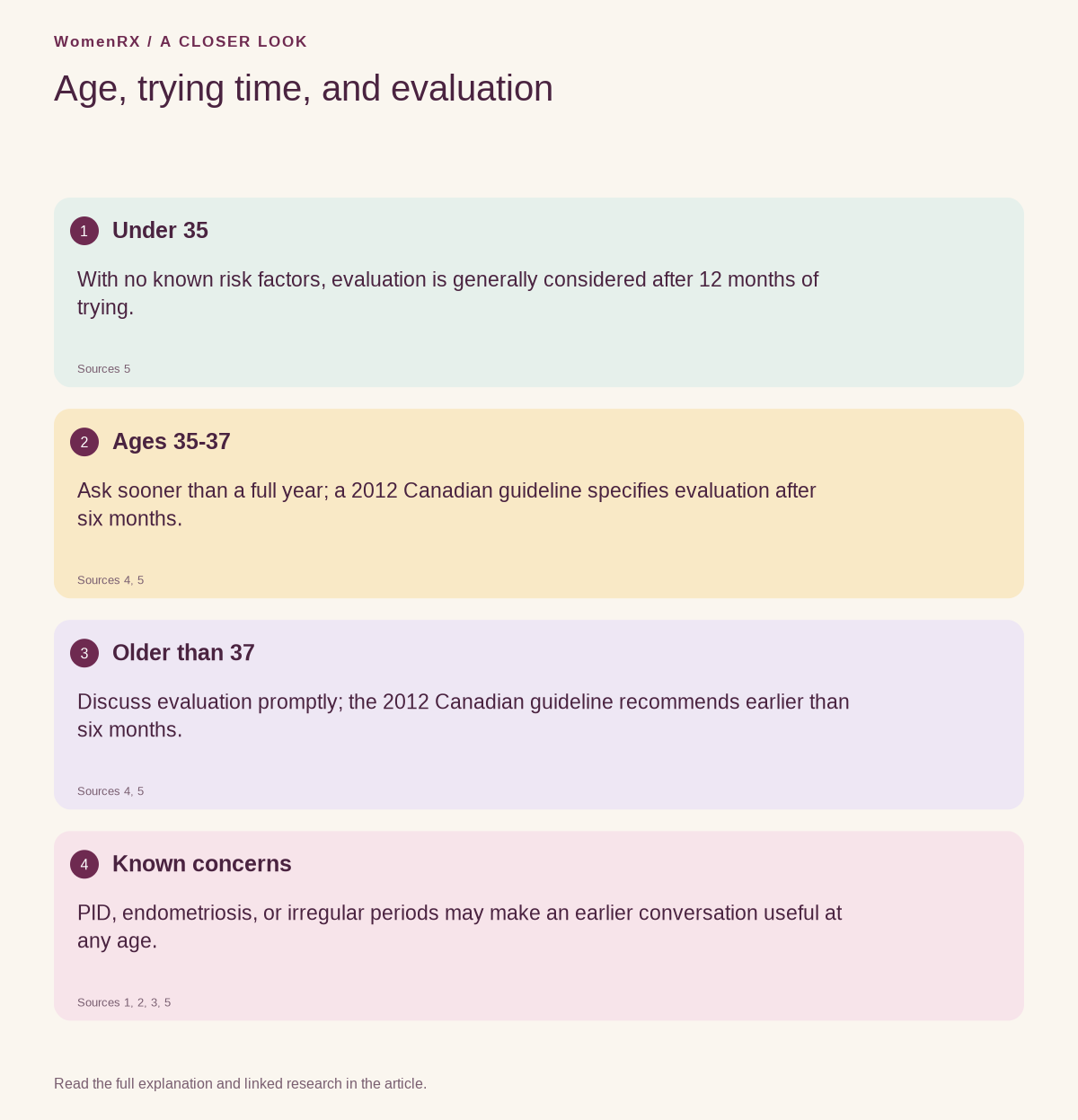
Age, trying time, and evaluation
Under 35: With no known risk factors, evaluation is generally considered after 12 months of trying.5
Ages 35-37: Ask sooner than a full year; a 2012 Canadian guideline specifies evaluation after six months.45
Older than 37: Discuss evaluation promptly; the 2012 Canadian guideline recommends earlier than six months.45
Known concerns: PID, endometriosis, or irregular periods may make an earlier conversation useful at any age.1235
Read the figure as text
These are general points for discussing an evaluation, not predictions of an individual outcome. Known reproductive concerns can change the timing at any age.- Under 35: With no known risk factors, evaluation is generally considered after 12 months of trying.5
- Ages 35-37: Ask sooner than a full year; a 2012 Canadian guideline specifies evaluation after six months.45
- Older than 37: Discuss evaluation promptly; the 2012 Canadian guideline recommends earlier than six months.45
- Known concerns: PID, endometriosis, or irregular periods may make an earlier conversation useful at any age.1235
More questions, answered
Does a low AMH result mean I can’t get pregnant?
No single ovarian reserve test gives a complete personal prediction. AMH and antral follicle count assess aspects of ovarian reserve, while their relationship to embryo chromosomal status and pregnancy outcomes is complex. Ask how a result fits with your age, history, and the reason for testing. 6 7
Does starting an evaluation mean I need IVF?
No. Evaluation is meant to assess possible causes and guide next steps. The options described in clinical guidance vary with the findings and may include different approaches; evaluation itself doesn’t commit you to a particular treatment. 5
Sources you can check
- Pelvic Inflammatory Disease | PID | MedlinePlusAccessed 2026-09-25Return to first citation
- Irregular periods - NHSAccessed 2026-09-25Return to first citation
- Endometriosis - NHSAccessed 2026-09-25Return to first citation
- Delayed child-bearing.Johnson JA, Tough S, SOGC GENETICS COMMITTEE. · Journal of obstetrics and gynaecology Canada : JOGC = Journal d'obstetrique et gynecologie du Canada : JOGC · 2012Return to first citation
- Infertility: Evaluation and Management.Phillips K, Olanrewaju RA, Omole F. · American family physician · 2023Return to first citation
- Ovarian reserve in patients with Sjögren's syndrome: a cross-sectional study.Mandosi C, Matys V, Deroma M, Del Negro V, Merlino L, Mariani M, Priori R, Ciminello E, Anastasi E, Porpora MG, Piccioni MG. · Clinical rheumatology · 2025Return to first citation
- Diminished ovarian reserve is associated to euploidy rate: a single center study.Carnesi E, Castellano S, Albani E, Busnelli A, Smeraldi A, Bulbul O, Morenghi E, Immediata V, Levi-Setti PE. · Frontiers in endocrinology · 2024Return to first citation