What Fertility Tests Measure, and What They Can Tell You
Fertility tests answer different questions: some estimate ovarian response, while others check ovulation or look for structural barriers to pregnancy.
AMH, antral follicle count, and FSH with estradiol are used to assess ovarian reserve and help estimate how the ovaries may respond to fertility treatment. Ovulation testing and imaging of the uterus and fallopian tubes address different questions. Your results make the most sense together, alongside your age, history, and reason for testing. 4 6
One evaluation, several different questions
A fertility evaluation isn’t one test with a single yes-or-no answer. It looks at several parts of reproduction: whether ovulation is happening, what the ovaries may do in response to treatment, and whether the uterus and fallopian tubes have structural issues. Medical history and, when relevant, a semen analysis may also be part of the initial workup. 4
That distinction matters because an ovarian reserve result answers only part of the fertility question. AMH, antral follicle count (AFC), and follicle-stimulating hormone (FSH) are used to assess ovarian reserve and help estimate ovarian response to fertility treatment. The results need to be interpreted alongside age and the reason for testing, rather than treated as the whole evaluation. 4 6
What the ovarian reserve tests look at
AMH: a blood marker related to the pool of developing follicles. Anti-Müllerian hormone is produced by cells around small developing follicles. Its level is relatively stable across the menstrual cycle compared with FSH, and it’s used as one marker of ovarian reserve and likely ovarian response. An AMH result does not assess whether you ovulate regularly or whether your fallopian tubes are open. 4 6
AFC: a scan-based count of small follicles. A clinician counts small follicles in the ovaries on ultrasound. AFC, like AMH, helps estimate ovarian reserve and response to stimulation. It measures what is visible in the ovaries at the time of the scan; it does not assess whether the fallopian tubes are open or whether ovulation is occurring regularly. 4 5 6
FSH and estradiol: early-cycle blood tests. FSH is a hormone involved in follicle development. FSH and basal estradiol are considered together in early-cycle ovarian reserve assessment, and FSH can vary both within and between cycles. A result needs to be considered with its cycle timing and the rest of the evaluation. Ask when your test is intended to be drawn and how its timing affects interpretation. 6
These tests are most useful for treatment planning, not as a simple ranking of fertility. In an observational study of 88 women receiving infertility care, hormone levels and AFC showed varied relationships with one another. The study illustrates why no single marker tells the whole story; its clinic-based sample does not establish how accurately a test predicts an individual’s chance of natural conception. 6
Ovulation is a separate question
Ovarian reserve and ovulation aren’t the same thing. A reserve test estimates aspects of the follicle pool or expected response to treatment; an ovulation assessment asks whether there is evidence that an egg is being released. ACOG’s summary of infertility evaluation lists evidence of ovulation as a distinct part of the basic workup when infertility remains unexplained. The choice of assessment depends on your history and the reason for testing. 4
If your periods are irregular, that history can help shape which questions the evaluation addresses. In some cases, the clinician may focus on ovulatory function rather than ordering every available reserve test. 1 4
Imaging checks the route and the space
Ultrasound and other reproductive imaging can look for pelvic or uterine findings and assess ovarian features. To check whether the fallopian tubes are open, a hysterosalpingogram (HSG) uses imaging to follow contrast through the reproductive tract. HSG can also show features of the uterine cavity and tubes, but an imaging finding may need interpretation in context because technical issues or normal variations can resemble abnormalities. 3 4
These tests answer a different question from AMH or FSH. A reassuring reserve marker cannot show that a tube is open, and a tubal study cannot tell you how many eggs may respond to ovarian stimulation. 3 4
Age, cycle timing, and hormonal contraception
Age belongs in the interpretation because it provides context that an ovarian reserve marker cannot replace. ACOG recommends an expedited evaluation for women older than 35, with treatment after six months of unsuccessful attempts or earlier when clinically indicated. For women older than 40, it recommends more immediate evaluation and treatment. 4
Cycle timing matters more for some tests than others. AMH is described as relatively stable during the cycle, while FSH varies; the ovarian testing study describes early-cycle FSH and estradiol testing and early-cycle AFC scans. That doesn’t mean the same schedule is right for every person or purpose, so find out which cycle day your clinic wants and why. 6
Hormonal contraception can also affect interpretation. A systematic review of 15 studies involving 3,280 women found no change in circulating AMH in short- or medium-term studies of cyclical combined hormonal contraception, while most studies of long-term or varied use reported lower AMH and AFC. Three long-term studies reported AMH recovery after contraception was discontinued. The findings don’t establish how much any one person’s result is affected; tell your clinician what method you use and for how long before interpreting a result. 2
A useful way to read your results
When a result comes back, ask what decision it is meant to inform. Is it about likely response to stimulation, evidence of ovulation, or the structure and openness of the reproductive tract? Then ask what the test cannot answer. Keeping those questions separate can make a complicated set of results more understandable and help you see why one normal result may not settle the whole fertility evaluation. 4 6
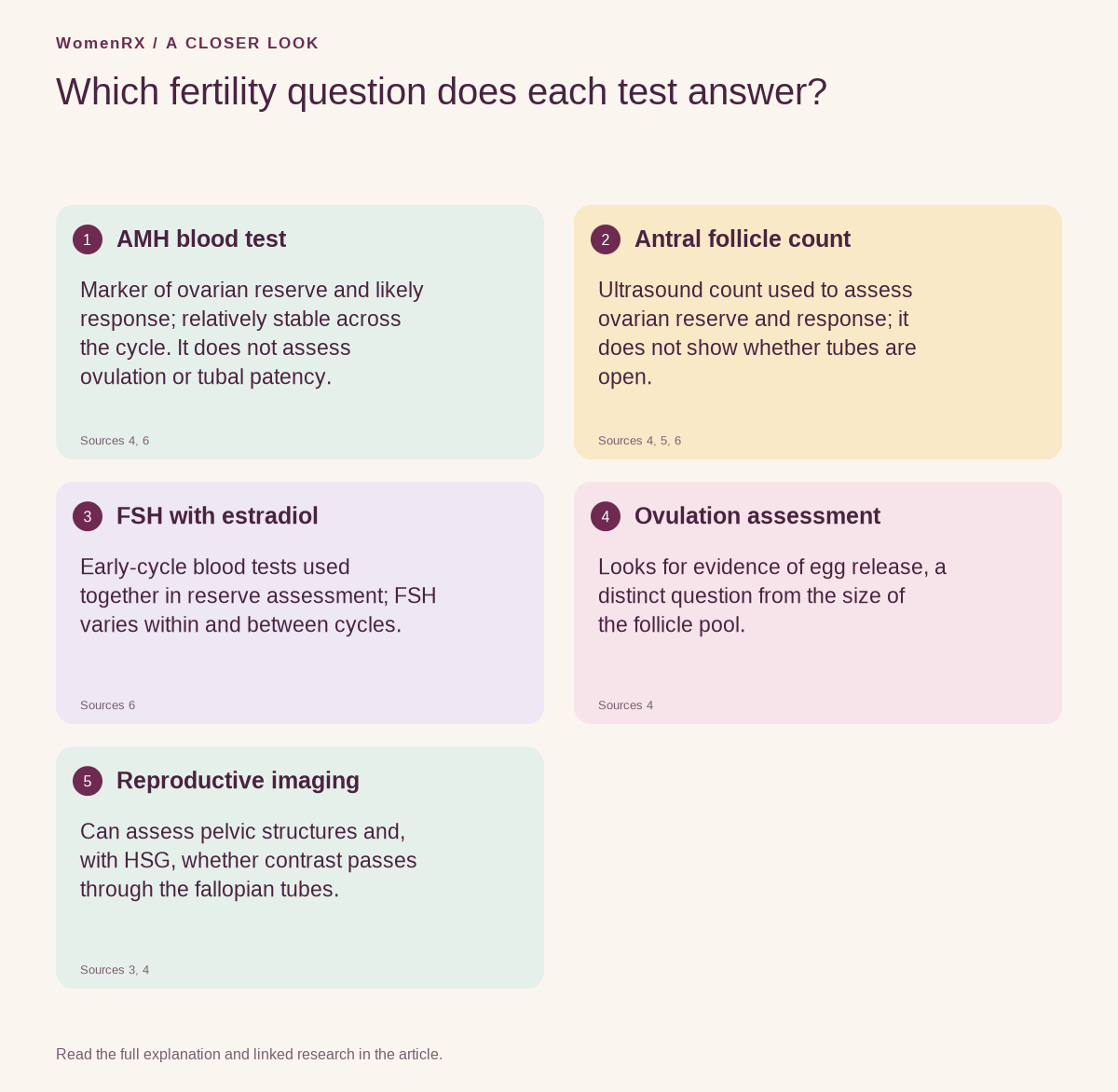
Which fertility question does each test answer?
AMH blood test: Marker of ovarian reserve and likely response; relatively stable across the cycle. It does not assess ovulation or tubal patency.46
Antral follicle count: Ultrasound count used to assess ovarian reserve and response; it does not show whether tubes are open.456
FSH with estradiol: Early-cycle blood tests used together in reserve assessment; FSH varies within and between cycles.6
Ovulation assessment: Looks for evidence of egg release, a distinct question from the size of the follicle pool.4
Reproductive imaging: Can assess pelvic structures and, with HSG, whether contrast passes through the fallopian tubes.34
Read the figure as text
These tests examine different parts of a fertility evaluation. Ovarian reserve markers are not substitutes for ovulation or structural assessment.- AMH blood test: Marker of ovarian reserve and likely response; relatively stable across the cycle. It does not assess ovulation or tubal patency.46
- Antral follicle count: Ultrasound count used to assess ovarian reserve and response; it does not show whether tubes are open.456
- FSH with estradiol: Early-cycle blood tests used together in reserve assessment; FSH varies within and between cycles.6
- Ovulation assessment: Looks for evidence of egg release, a distinct question from the size of the follicle pool.4
- Reproductive imaging: Can assess pelvic structures and, with HSG, whether contrast passes through the fallopian tubes.34
More questions, answered
What does a normal AMH result tell me?
It provides one piece of information about ovarian reserve and possible response to fertility treatment. It does not establish whether you’re ovulating regularly or whether your fallopian tubes are open; those are separate parts of an evaluation. 4 6
Does hormonal contraception affect an AMH result?
It can affect interpretation. Studies of long-term hormonal contraception often reported lower AMH and antral follicle counts, with AMH recovery reported in some studies after discontinuation. Your contraception method and how long you’ve used it provide context for the result. 2
Sources you can check
- Infertility | Infertility Treatments | MedlinePlusAccessed 2026-09-25Return to first citation
- Assessment of Circulating Anti-Müllerian Hormone in Women Using Hormonal Contraception: A Systematic Review.Amer SAKS, James C, Al-Hussaini TK, Mohamed AA. · Journal of women's health (2002) · 2020Return to first citation
- Beyond tubal patency: A pictorial review of the imaging spectrum of hysterosalpingography.Muthusamy L, Rasheed S, Woon TK, Win T. · Current problems in diagnostic radiology · 2026Return to first citation
- Infertility Workup for the Women's Health Specialist: ACOG Committee Opinion, Number 781.Obstetrics and gynecology · 2019Return to first citation
- Evaluation of Serum AMH, INHB Combined with Basic FSH on Ovarian Reserve Function after Laparoscopic Ovarian Endometriosis Cystectomy.Tang Y, Li Y. · Frontiers in surgery · 2022Return to first citation
- Correlation of Follicle-stimulating Hormone, Anti-Mullerian Hormone, and Antral Follicle Count with Age in Ovarian Reserve Testing.Das S, Bhattacharya N, Mahata R, Ghosh S, Bhar AS, Srivastava P. · International journal of applied & basic medical research · 2024Return to first citation