Leaky Gut Tests: What They Measure, and What They Don’t
Intestinal permeability is a real research concept, but a test result alone can’t explain a symptom or show that a supplement will help.
Intestinal permeability describes how substances pass through the gut lining, a selective barrier that normally absorbs nutrients while limiting other passage. Researchers can measure it with tracer tests, but results are difficult to interpret as a stand-alone diagnosis. Newer tests and biomarkers are being studied in specific settings, yet they haven’t established a general “leaky gut” diagnosis or shown that supplements treat nonspecific symptoms. 1 3 4
The gut lining is a barrier, not a sealed wall
Your intestinal lining has to do two things at once: let nutrients and water through, while helping keep other substances from crossing. “Intestinal permeability” is the research term for how readily substances cross that lining. It’s a property of a functioning barrier, not, by itself, the name of a disease. 1
The popular phrase “leaky gut” is often used to connect a wide range of symptoms to a single cause. But finding a change in permeability doesn’t automatically explain why someone has symptoms, identify what caused the change, or show that changing it will improve how they feel.
How researchers measure permeability
One established approach gives someone small, orally swallowed tracer molecules and measures how much later appears in urine. In the lactulose-to-mannitol test, the ratio between the two sugars’ urinary excretion is used as an indicator of permeability. The test measures a particular feature of the barrier; it doesn’t directly identify the cause of a change or diagnose every condition linked to gut symptoms. 3 4
That distinction matters because these tests can be time-consuming and have practical limits. Results can be difficult to compare across studies, and collecting urine can be challenging in some circumstances. A research measure can be useful for studying a specific disease without being a reliable, stand-alone test for a broad syndrome. 3 4
Researchers are also investigating blood and stool markers as easier alternatives. In one study of 51 non-obese healthy adults and 27 adults with obesity, blood lipopolysaccharide-binding protein was associated with the lactulose-to-mannitol ratio in both groups. Fecal zonulin was associated with the ratio in the overweight and obese group. Those associations make the markers candidates for further study, not proof that either one can diagnose “leaky gut” in an individual. 3
A newer technique uses an orally swallowed fluorescent dye and a sensor placed on the fingertip. An early study tested it in 11 healthy volunteers. A later cross-sectional study compared 38 people with Crohn’s disease with 20 healthy volunteers and found differences in test measures, with encouraging alignment between the new technique and the lactulose-to-mannitol test. These are promising research findings, not evidence that the technique is a general diagnostic test for unexplained symptoms. 2 4
What a result can, and can’t, tell you
Permeability changes have been studied in particular disease settings, including Crohn’s disease. Even there, the role of barrier changes in the disease process is not fully understood, and a permeability measure is only one part of evaluating gut function. 4
A result shouldn’t be treated as an explanation for fatigue, bloating, or other nonspecific concerns on its own. It also doesn’t establish that a particular food, supplement, or other treatment will help. The useful question is not simply “Is my gut leaky?” but whether there’s a well-defined condition that explains your symptoms and whether a test result would change how that condition is evaluated or treated.
Supplements and women’s health claims
These studies evaluate tests and biomarkers, not supplement treatments. They don’t demonstrate that a supplement repairs the barrier or improves nonspecific symptoms. A change in a biomarker, even if one is measured, would not by itself show that a person feels better or that a specific health outcome improves.
The human studies discussed here also don’t establish that a permeability test diagnoses hormone-related or reproductive conditions, or that a supplement improves them. One biomarker study included sex in its analyses, but did not report a women-specific interpretation. That leaves no basis in these findings for treating “leaky gut” as a proven explanation for menstrual, fertility, or menopause concerns. 3
If a test or supplement is being sold as an answer, look for evidence that it has been studied for the specific condition and outcome being claimed. A research signal about barrier function is not the same as a validated diagnosis or a demonstrated treatment benefit.
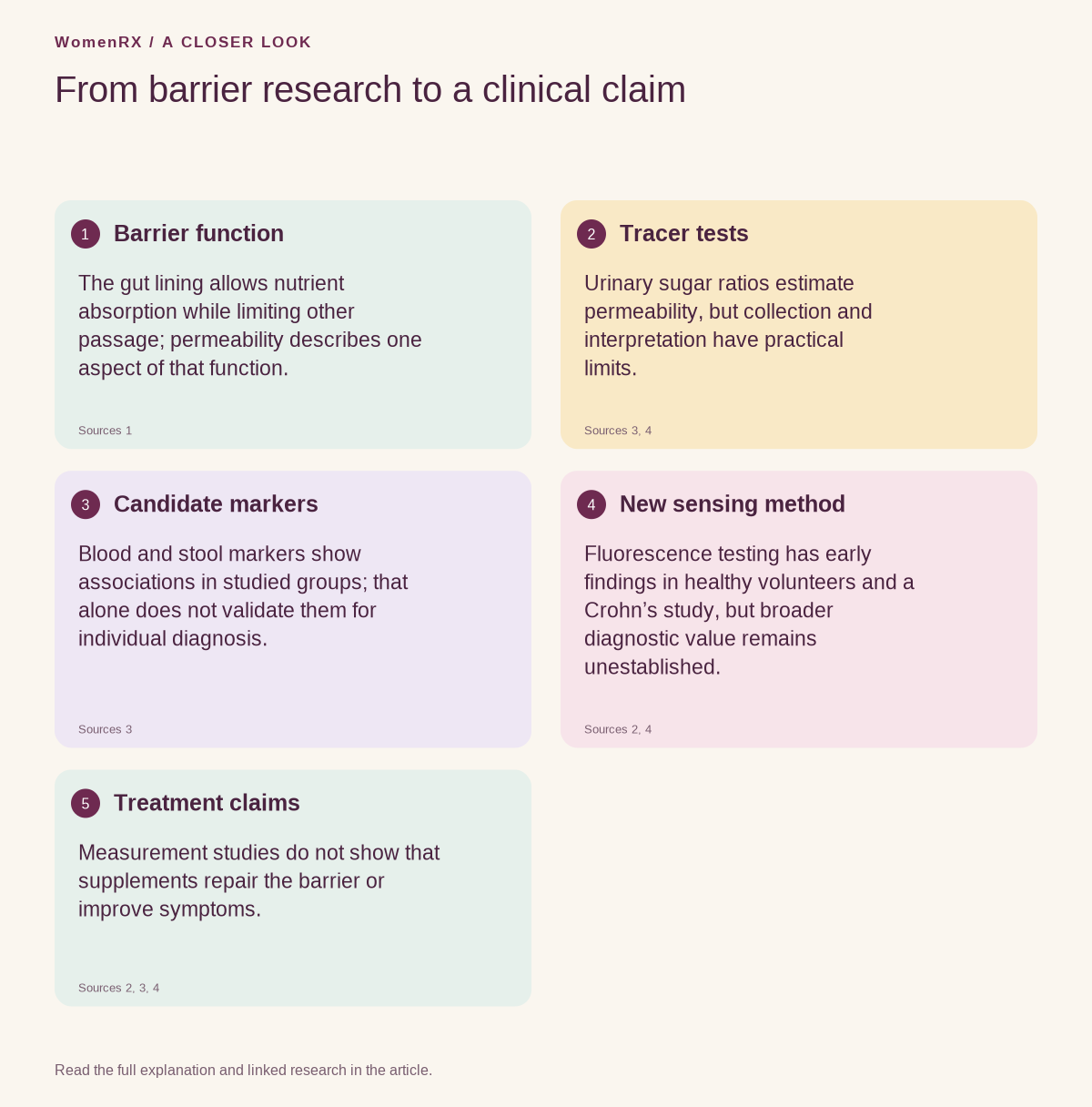
From barrier research to a clinical claim
Barrier function: The gut lining allows nutrient absorption while limiting other passage; permeability describes one aspect of that function.1
Tracer tests: Urinary sugar ratios estimate permeability, but collection and interpretation have practical limits.34
Candidate markers: Blood and stool markers show associations in studied groups; that alone does not validate them for individual diagnosis.3
New sensing method: Fluorescence testing has early findings in healthy volunteers and a Crohn’s study, but broader diagnostic value remains unestablished.24
Treatment claims: Measurement studies do not show that supplements repair the barrier or improve symptoms.234
Read the figure as text
These distinctions show why a measured permeability change is not automatically a diagnosis or a reason to expect a supplement to work.- Barrier function: The gut lining allows nutrient absorption while limiting other passage; permeability describes one aspect of that function.1
- Tracer tests: Urinary sugar ratios estimate permeability, but collection and interpretation have practical limits.34
- Candidate markers: Blood and stool markers show associations in studied groups; that alone does not validate them for individual diagnosis.3
- New sensing method: Fluorescence testing has early findings in healthy volunteers and a Crohn’s study, but broader diagnostic value remains unestablished.24
- Treatment claims: Measurement studies do not show that supplements repair the barrier or improve symptoms.234
More questions, answered
Does a permeability test diagnose Crohn’s disease?
No. A permeability measure can contribute to research on gut function, and one early study found differences between people with active Crohn’s disease and healthy volunteers. That does not establish the test as a stand-alone diagnostic tool; the study was cross-sectional and involved a limited number of participants. 4
Does a high zonulin result prove that I have “leaky gut”?
No. In one adult study, fecal zonulin was associated with the lactulose-to-mannitol ratio in the overweight and obese group, but that association doesn’t establish a diagnostic threshold or prove what caused an individual’s symptoms. 3
Sources you can check
- Interplay between volemic balance and the intestinal tract: insights on biomarkers and diagnostic tests used to assess intestinal morphofunctional barrier.Neto VLM, Araújo ICD, Rôla TBM, Magalhães PJC, Rodrigues FAP, Lima AAM, Santos AA. · Brazilian journal of medical and biological research = Revista brasileira de pesquisas medicas e biologicas · 2026Return to first citation
- Non-invasive assessment of intestinal permeability in healthy volunteers using transcutaneous fluorescence spectroscopy.Gan J, Monfort Sánchez E, Avery J, Barbouti O, Hoare J, Ashrafian H, Darzi A, Thompson AJ. · Methods and applications in fluorescence · 2022Return to first citation
- Biomarkers for assessment of intestinal permeability in clinical practice.Seethaler B, Basrai M, Neyrinck AM, Nazare JA, Walter J, Delzenne NM, Bischoff SC. · American journal of physiology. Gastrointestinal and liver physiology · 2021Return to first citation
- Non-invasive fluorescence sensing reveals changes in intestinal barrier function and gastric emptying rate in a first-in-human study of Crohn's disease.Gan J, Chen Q, Monfort Sanchez E, Mandal N, Xu J, Wang Z, Agarwal A, Oluwatunmise E, Ramkumar P, Salam A, Chekmeneva E, Gómez-Romero M, Maslen L, Balarajah S, Perry R, Yong KK, Hoa... · Therapeutic advances in gastroenterology · 2025Return to first citation