Taurine Doses in Human Studies: What They Do and Don’t Show
Human studies have used taurine in very different amounts and for different goals, so a studied dose isn’t a general-use recommendation.
Human studies have tested taurine from 500 mg to 6 g daily for heart failure over 2 to 48 weeks, and about 50 mg per kilogram before exercise in heat. Those studies address specific settings, not a universal dose. They don’t establish long-term safety for general use, pregnancy or breastfeeding, or a women-specific dose. 1 2
A taurine dose only makes sense in the context of what researchers were trying to study. A short exercise experiment and a study of people with heart failure don’t tell you the same thing about dose, benefit, or safety. Neither gives a universal amount to take.
The dose depends on the research question
In a systematic review of 11 human studies involving people with heart failure, taurine doses ranged from 500 milligrams to 6 grams a day. Studies lasted 2 to 48 weeks, and protocols varied in how often taurine was taken and how it was delivered. Only one study was rated high quality in the review. The researchers found no significant association in their pooled analysis for the heart measures they could combine, and concluded that a formal clinical trial was needed. These results don’t establish taurine as a heart-failure treatment or show that those study doses are suitable for someone else. 1
Exercise research asks a different question. A 2026 review describes small studies of taurine and exercise in hot conditions, including one randomized crossover trial using about 50 milligrams per kilogram of body weight before exercise. Another study used taurine daily for eight days. These experiments examined heat tolerance and sweating during exercise, not general health or long-term supplement use. 2
The comparison matters: don’t treat a dose tested for one specific outcome as a suggested dose for another goal. A larger amount or longer study period isn’t evidence that a supplement works better or is safe for routine use.
What the safety record can, and can’t, say
In the heart-failure review, no significant safety concerns were reported, but safety information was limited. The review describes one study of a drink containing multiple vitamins and minerals, so reported symptoms couldn’t be confidently attributed to taurine alone. The studies’ varied designs and durations also don’t settle what happens with longer-term use. 1
Products can add another layer of uncertainty. Taurine is sometimes included in preworkout blends or energy drinks with other active ingredients. In a review of preworkout products, labels often didn’t disclose every ingredient or its precise amount, and reported side effects from combination products couldn’t establish taurine as the cause. Check the full ingredient list and amounts rather than assuming that evidence about taurine alone applies to a blend. 3
The human evidence summarized here doesn’t establish safety during pregnancy or breastfeeding, and it doesn’t support a different dose for women. It also doesn’t provide a reliable list of taurine-medicine interactions. If you’re pregnant, breastfeeding, or take regular medicines, the product’s exact ingredients and your situation matter; a pharmacist or clinician can help check that specific combination rather than guessing from a study dose.
A practical way to judge a proposed dose
Before treating a number on a label as meaningful, ask what outcome it was studied for, who took it, and for how long. Then check whether the research tested taurine by itself or as part of a mixture. If the study population or goal doesn’t match yours, its dose doesn’t answer whether taurine is useful or appropriate for you.
For most people considering taurine, the clearest takeaway is not a number: research doses are context-specific, and the human evidence summarized here leaves important questions about long-term and pregnancy or breastfeeding safety unanswered.
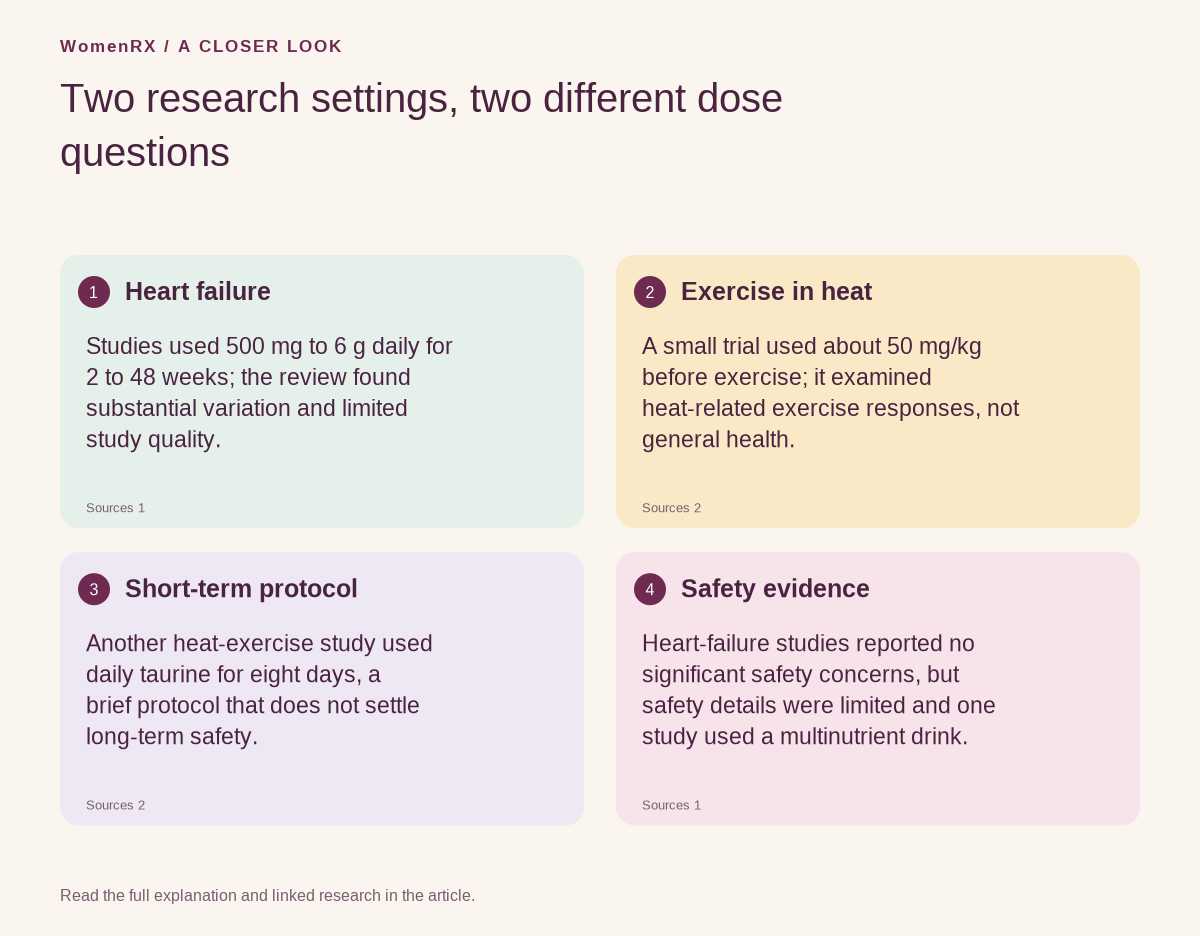
Two research settings, two different dose questions
Heart failure: Studies used 500 mg to 6 g daily for 2 to 48 weeks; the review found substantial variation and limited study quality.1
Exercise in heat: A small trial used about 50 mg/kg before exercise; it examined heat-related exercise responses, not general health.2
Short-term protocol: Another heat-exercise study used daily taurine for eight days, a brief protocol that does not settle long-term safety.2
Safety evidence: Heart-failure studies reported no significant safety concerns, but safety details were limited and one study used a multinutrient drink.1
Read the figure as text
These study examples differ in population, purpose, dose, and duration; neither establishes a general taurine dose.- Heart failure: Studies used 500 mg to 6 g daily for 2 to 48 weeks; the review found substantial variation and limited study quality.1
- Exercise in heat: A small trial used about 50 mg/kg before exercise; it examined heat-related exercise responses, not general health.2
- Short-term protocol: Another heat-exercise study used daily taurine for eight days, a brief protocol that does not settle long-term safety.2
- Safety evidence: Heart-failure studies reported no significant safety concerns, but safety details were limited and one study used a multinutrient drink.1
More questions, answered
Is there a taurine dose specifically for women?
The human studies summarized here don’t establish a women-specific dose. They also don’t show that women need a different amount. 1 2
Do taurine studies establish that it’s safe with my medication?
No. The human evidence summarized here doesn’t provide a dependable interaction list. Because some products combine taurine with other ingredients, check the exact product and your medicines with a pharmacist or clinician rather than assuming a study of taurine alone applies. 3
Sources you can check
- Effect of taurine administration on symptoms, severity, or clinical outcome of dilated cardiomyopathy and heart failure in humans: a systematic review.McGurk KA, Kasapi M, Ware JS. · Wellcome open research · 2022Return to first citation
- Taurine Supplementation and Human Heat Tolerance: Mechanisms, Evidence, and Integration with Heat Acclimation, Cooling, and Hydration.Naddafha S, Stout JR, Evans C. · Nutrients · 2026Return to first citation
- Efficacy and safety of ingredients found in preworkout supplements.Eudy AE, Gordon LL, Hockaday BC, Lee DA, Lee V, Luu D, Martinez CA, Ambrose PJ. · American journal of health-system pharmacy : AJHP : official journal of the American Society of Health-System Pharmacists · 2013Return to first citation