Taurine Supplements: What Human Studies Actually Show
Taurine has important roles in the body, but evidence that taking extra improves health is uneven and depends on the outcome.
The clearest human findings here are mixed: a small meta-analysis in people with diabetes found improvements in some blood-sugar measures, while trials of taurine alone for cognition found mostly no effect or small, inconsistent changes. Neither result establishes a benefit for women specifically, and neither tells you that taurine prevents disease or slows aging. 2 3
Taurine is a naturally occurring compound with roles in cellular processes such as calcium regulation and mitochondrial function. Those roles explain why researchers study it, but they don’t show that taking more will improve a particular health outcome. A useful way to assess a taurine supplement is to look at the outcome tested, who took part, and whether taurine was tested on its own. 1
Blood sugar: a promising but small evidence base
A meta-analysis of five randomized trials involving 209 people with diabetes found statistically significant differences favoring taurine for HbA1c, fasting blood sugar, and HOMA-IR, a measure related to insulin resistance. The analysis did not find statistically significant effects on blood lipids, blood pressure, or body composition. 3
That’s a signal worth studying, not proof that taurine is an established diabetes treatment. The trials were few, and the results were reported as standardized effects rather than changes in HbA1c units that are easy to translate into an individual’s likely benefit. The review summary also doesn’t establish a practical dose or show whether results differed for women. These findings don’t show that taurine can replace diabetes care.
Cognition and mood: little evidence of a reliable boost
A systematic review of eight randomized trials included 244 healthy participants. The studies tested a single dose, typically 1-3 grams, and found at best small, inconsistent cognitive effects; most measured outcomes showed no effect. Any reported mood or performance benefits were also minor or appeared under particular conditions. 2
Some trials combined taurine with caffeine. Because those studies can’t isolate taurine’s contribution, a result from a caffeinated product isn’t evidence that taurine alone improves focus or mood. The trials were acute, so they also don’t establish a lasting cognitive benefit from regular supplementation. 2
Aging and metabolism: mechanisms aren’t outcomes
Taurine’s effects on pathways involving inflammation, metabolism, and mitochondria are research interests, and a broad review describes promising possibilities. But a biological pathway or a review’s overall promise isn’t the same as evidence that a supplement prevents an age-related disease or slows aging in people. The review summary doesn’t provide a specific, established benefit for those goals. 1
What the evidence says about women
The summaries of the diabetes and cognition research don’t report results separately for women, or identify findings for pregnancy, postpartum, perimenopause, or postmenopause. That means the results can’t answer whether effects differ by sex or life stage. It also doesn’t prove that no relevant study exists; it means a women-specific benefit isn’t established by the results described here. 2 3
A practical way to weigh a taurine claim
Start with the exact goal. Blood-sugar findings come from a small group of trials in people with diabetes; cognition findings come mostly from single-dose tests in healthy participants. Those are different populations and outcomes, not evidence for a general wellness effect. Ask whether the study tested taurine by itself, whether it measured the result you care about, and whether its participants resemble you. If a claim jumps from taurine’s role in the body to a promised benefit for women, that leap isn’t supported by these human findings.
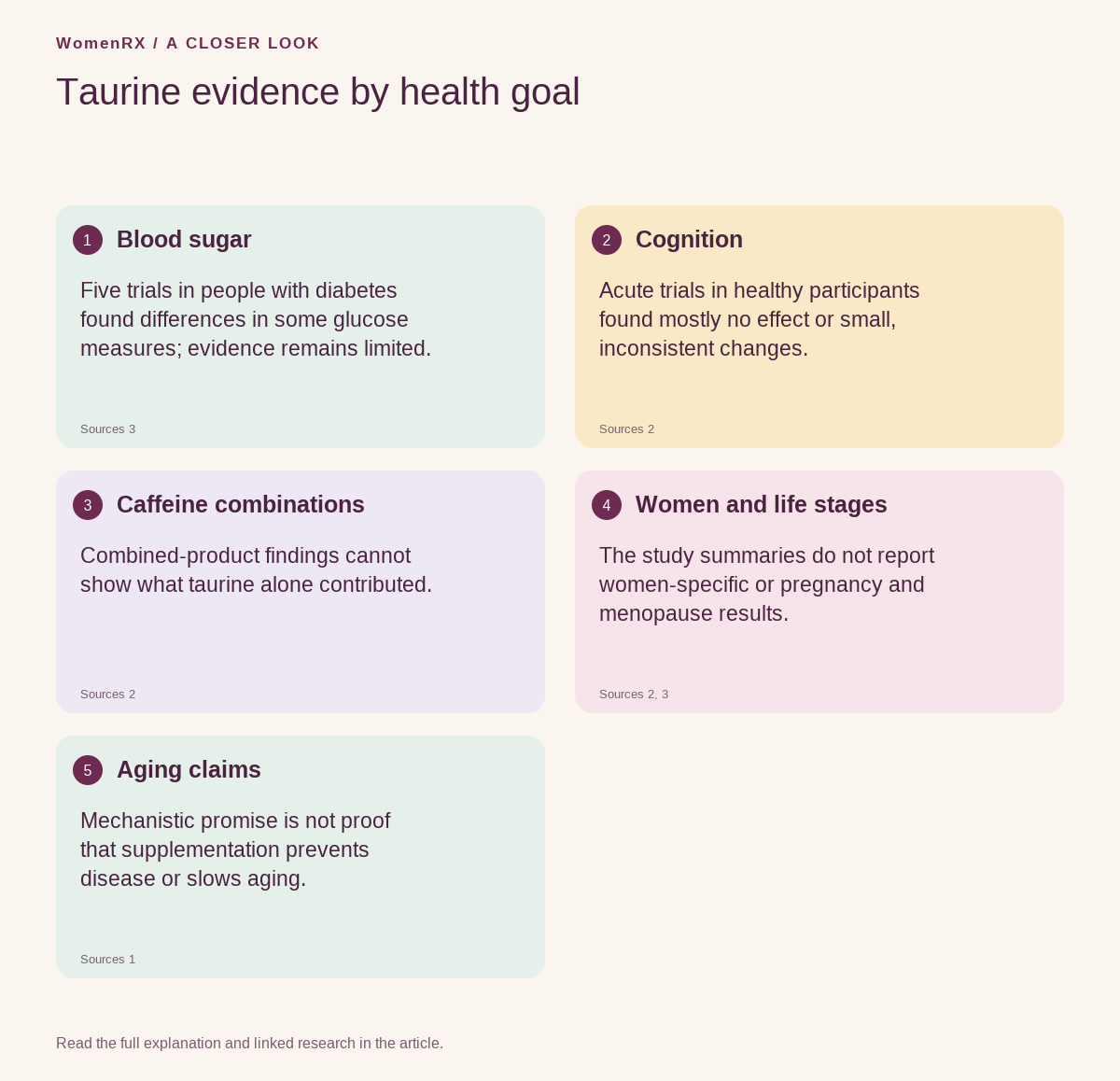
Taurine evidence by health goal
Blood sugar: Five trials in people with diabetes found differences in some glucose measures; evidence remains limited.3
Cognition: Acute trials in healthy participants found mostly no effect or small, inconsistent changes.2
Caffeine combinations: Combined-product findings cannot show what taurine alone contributed.2
Women and life stages: The study summaries do not report women-specific or pregnancy and menopause results.23
Aging claims: Mechanistic promise is not proof that supplementation prevents disease or slows aging.1
Read the figure as text
The findings differ by outcome, study population, and whether taurine was tested alone.- Blood sugar: Five trials in people with diabetes found differences in some glucose measures; evidence remains limited.3
- Cognition: Acute trials in healthy participants found mostly no effect or small, inconsistent changes.2
- Caffeine combinations: Combined-product findings cannot show what taurine alone contributed.2
- Women and life stages: The study summaries do not report women-specific or pregnancy and menopause results.23
- Aging claims: Mechanistic promise is not proof that supplementation prevents disease or slows aging.1
More questions, answered
Do taurine energy drinks show that taurine improves focus?
Not on their own. When taurine is combined with caffeine, the study can’t establish which ingredient contributed to any performance effect. Trials of taurine alone found mostly no effect or small, inconsistent cognitive changes. 2
Is there a proven taurine dose for women?
The findings described here don’t establish a dose for women. Cognitive trials tested acute doses, typically 1-3 grams, but those results don’t establish a regular-use dose or a women-specific benefit. The diabetes meta-analysis summary doesn’t identify a practical dose. 2 3
Sources you can check
- Taurine supplementation at the crossroads of metabolism, inflammation and aging: mechanistic and nutritional perspectives.Beine BJ, Castellano M, Fiamoncini J, Hiller K. · Food & function · 2026Return to first citation
- Cognitive Effects of Taurine and Related Sulphur-Containing Amino Acids: A Systematic Review of Human Trials and Considerations for Plant-Based Dietary Transitions.Moore JA, Cousins AL, Taylor RMJ, Griffiths AR, Young HA. · Foods (Basel, Switzerland) · 2026Return to first citation
- The effects of taurine supplementation on diabetes mellitus in humans: A systematic review and meta-analysis.Tao X, Zhang Z, Yang Z, Rao B. · Food chemistry. Molecular sciences · 2022Return to first citation