Period Pain: When Self-Care Isn’t Enough
Typical cramps often respond to anti-inflammatory medicine or hormonal contraception, but pain that starts later, changes, or disrupts daily life deserves attention.
Period cramps that begin around the start of bleeding and repeat in a similar pattern may be primary dysmenorrhea, often driven by prostaglandins that make the uterus contract. NSAIDs such as ibuprofen or naproxen are common options; hormonal contraception can also reduce pain. New, changing, persistent, or disabling pain can have another cause and merits evaluation, not just stronger self-care. 2 3 4
The pattern can help you choose a next step
Primary dysmenorrhea means menstrual pain without an underlying pelvic condition. It often feels like cramps low in the abdomen that may spread to the back or thighs, starts just before or around bleeding, and follows a similar pattern from cycle to cycle. Prostaglandins help explain why: they prompt the uterus to contract, and excess production can make those contractions painful. Nausea, diarrhea, fatigue, or back pain can accompany cramps, too. 2 4
Pain often begins after menstrual cycles become ovulatory, rather than with the very first period. Pain from the first period, or pain that is steadily getting worse, has a different pattern worth discussing. Later-onset pain, pain that persists beyond bleeding, and pain with abnormal bleeding can point to secondary dysmenorrhea, meaning pain associated with another condition. Endometriosis is a common cause; fibroids, adenomyosis, and pelvic infection are other possibilities. Pain alone can’t identify which cause, if any, is present. 2 4
If period pain begins after years without cramps, including around menopause while periods continue, or keeps you from usual activities, don’t assume it’s simply part of your cycle. A clinician can assess the pattern and decide whether examination or imaging, such as ultrasound, is appropriate. Changes from your usual pain and accompanying symptoms help guide that assessment. 2 4
Match pain relief to your needs
NSAIDs: Ibuprofen and naproxen are nonsteroidal anti-inflammatory drugs. They reduce inflammation-related pain, and randomized trials in primary dysmenorrhea found NSAIDs relieved pain better than placebo. The review did not establish that one NSAID works better than another. These medicines aren’t suitable for everyone and can cause side effects. Don’t combine different NSAIDs; if you take other medicines, or are pregnant or breastfeeding, check with a pharmacist or clinician about what’s appropriate. Follow the product label. 1 3
Hormonal contraception: Combined oral contraceptive pills can ease dysmenorrhea and may suit you if you also want contraception. Studies generally suggest a benefit, but their methods varied, so the evidence does not show that every pill formulation works equally well for every person. A clinician can help weigh this option against your health history and preferences. 3
Heat and movement: A warm bath or shower and gentle activity such as walking, swimming, or yoga may help ease pain. These are reasonable additions, but don’t treat them as a test of whether your pain is serious. TENS is another option sometimes used for severe cramps. 2
If one approach isn’t enough, that doesn’t mean you have to endure the pain or keep trying the same thing. A discussion can include how much the pain affects your day, what you’ve already tried, and whether a different treatment or evaluation for an underlying cause makes sense. 2 4
When to get assessed
Arrange an evaluation for pain that is new or worsening, continues beyond your period, repeatedly limits daily activities, or comes with abnormal bleeding. Those patterns can occur with secondary causes and may need more than pain relief alone. Evaluation starts with your history and symptoms; if a pelvic condition is suspected, a clinician may consider an examination or imaging. 2 4
Seek urgent medical care for severe pelvic or period pain that is worse than usual and not helped by pain medicine. Severe pelvic pain with bleeding when pregnancy is possible also needs urgent assessment, because ectopic pregnancy is one possible cause. 2 4
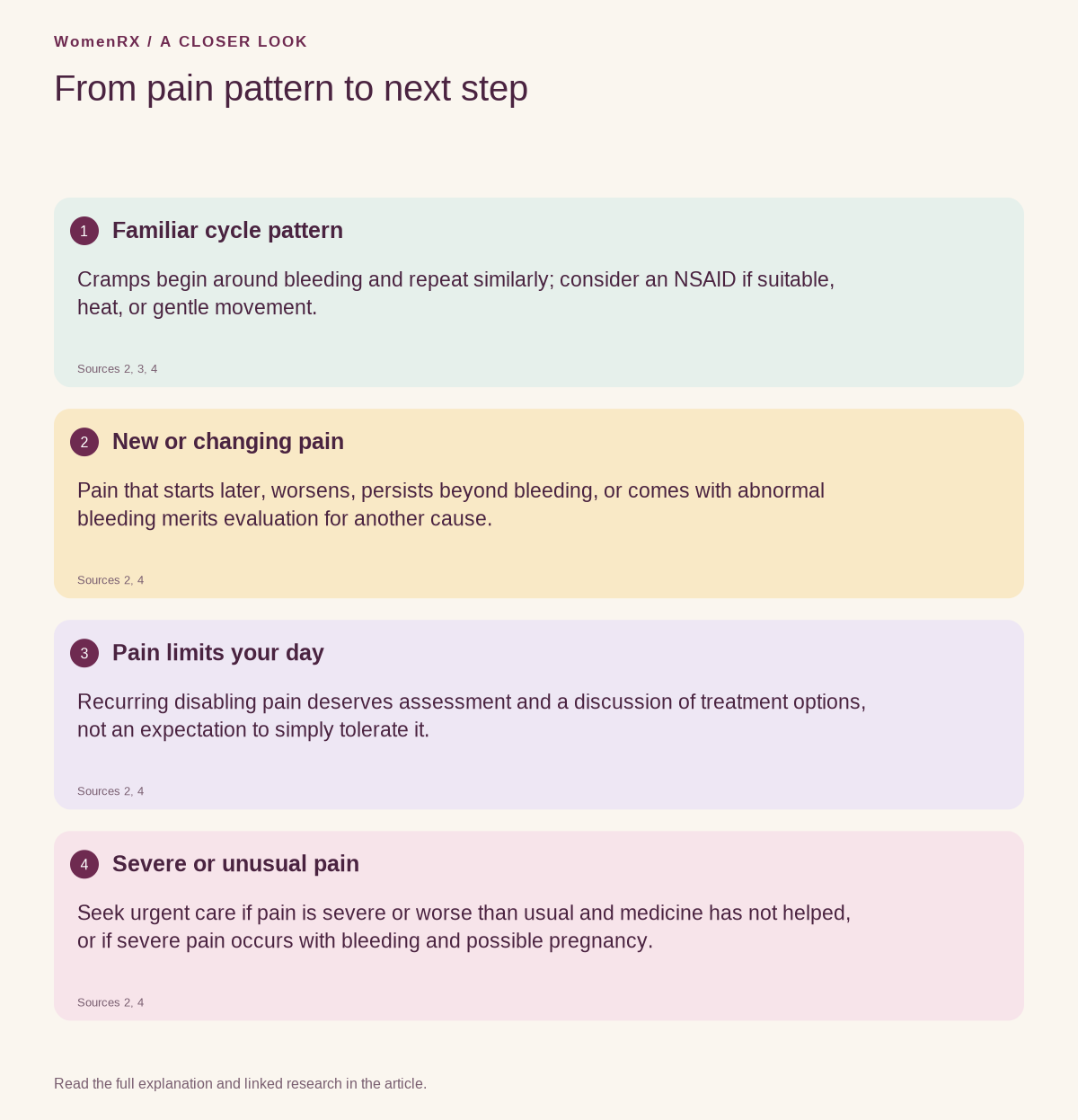
From pain pattern to next step
Familiar cycle pattern: Cramps begin around bleeding and repeat similarly; consider an NSAID if suitable, heat, or gentle movement.234
New or changing pain: Pain that starts later, worsens, persists beyond bleeding, or comes with abnormal bleeding merits evaluation for another cause.24
Pain limits your day: Recurring disabling pain deserves assessment and a discussion of treatment options, not an expectation to simply tolerate it.24
Severe or unusual pain: Seek urgent care if pain is severe or worse than usual and medicine has not helped, or if severe pain occurs with bleeding and possible pregnancy.24
Read the figure as text
Use the timing, change, and impact of pain to distinguish self-care from routine or urgent assessment.- Familiar cycle pattern: Cramps begin around bleeding and repeat similarly; consider an NSAID if suitable, heat, or gentle movement.234
- New or changing pain: Pain that starts later, worsens, persists beyond bleeding, or comes with abnormal bleeding merits evaluation for another cause.24
- Pain limits your day: Recurring disabling pain deserves assessment and a discussion of treatment options, not an expectation to simply tolerate it.24
- Severe or unusual pain: Seek urgent care if pain is severe or worse than usual and medicine has not helped, or if severe pain occurs with bleeding and possible pregnancy.24
More questions, answered
Does severe period pain mean I have endometriosis?
No. Endometriosis is a common cause of secondary dysmenorrhea, but severe pain can have other causes, and pain severity alone can’t identify the cause. A changing or persistent pattern is a reason to be assessed. 2 4
Can I take ibuprofen and naproxen together for stronger relief?
No. They are both NSAIDs, and taking more than one NSAID can cause problems. Check the medicine label, and ask a pharmacist or clinician if you’re unsure what you can take with your other medicines. 1
Sources you can check
- NSAIDs - NHSAccessed 2026-09-25Return to first citation
- Period pain - NHSAccessed 2026-09-25Return to first citation
- Nonsteroidal anti-inflammatory drugs and hormonal contraceptives for pain relief from dysmenorrhea: a review.Zahradnik HP, Hanjalic-Beck A, Groth K. · Contraception · 2010Return to first citation
- Primary Dysmenorrhea: Assessment and Treatment.Guimarães I, Póvoa AM. · Revista brasileira de ginecologia e obstetricia : revista da Federacao Brasileira das Sociedades de Ginecologia e Obstetricia · 2020Return to first citation