When Your Period Stops: What to Check First
A missed period has several possible explanations, and the next step depends on pregnancy possibility, your cycle history, and where you are in life.
If pregnancy is possible, make pregnancy testing your first check when a period is missing. Don’t wait for the three- or six-month evaluation thresholds to consider it. Periods can also stop during lactation or after menopause, or because something affects hormone signaling, ovarian function, or the reproductive tract. If cycles were regular, evaluation is generally warranted after three months without a period; if irregular, after six months. Adolescents have separate timing criteria. 4 5
First, consider pregnancy and life stage
If a period is missing and you could be pregnant, start with pregnancy testing rather than waiting for the evaluation thresholds below. Pregnancy is the first possibility clinicians generally rule out when evaluating absent periods. 4 5
Periods may also be absent during lactation or after menopause. Around perimenopause, cycles can become less predictable, but a longer gap by itself doesn’t tell you whether menopause is the reason. 4 5
Has a period never started, or has it stopped?
Clinicians distinguish primary amenorrhea, when someone has never had a period, from secondary amenorrhea, when periods stop after they have started. For someone who has menstruated before, evaluation is generally recommended after three months without a period if cycles were previously regular, or six months if they were irregular. 5
For adolescents, evaluation is generally warranted if a period has not started by age 15 or by three years after breast development began. No breast development by age 13 is also a reason to evaluate delayed puberty. 5
These are points to seek an evaluation, not proof that something is wrong. They help avoid dismissing a meaningful change as simply an irregular cycle, while recognizing that cycle patterns vary at different life stages. 5
The cycle depends on a connected hormone pathway
A menstrual cycle relies on signals between the hypothalamus and pituitary gland in the brain, the ovaries, and the uterine lining. A problem at more than one point in that pathway can stop bleeding, so the symptom alone doesn’t identify the cause. 4
Several common non-pregnancy causes fit into that pathway:
- Changes in energy, exercise, or stress: Significant stress, increased exercise, or weight loss can disrupt hormone signaling from the brain and reduce ovarian hormone production. These changes may happen together or one after another. 3
- Ovarian or other hormone conditions: Polycystic ovary syndrome, primary ovarian insufficiency, and high prolactin are among the causes clinicians may consider. Thyroid problems can also be part of the evaluation. 3 4
- Changes to the uterine lining or menstrual outflow: Intrauterine adhesions and other structural problems can affect bleeding. 4
- Medication effects: Medication-related causes are another category clinicians consider. Bring a current list of prescriptions, over-the-counter medicines, and supplements. If you’re pregnant, talk with your provider before stopping or starting a medicine. Some medicines can harm a developing fetus, and stopping a medicine you need may also carry risk. 5 1
- Life stage: Pregnancy, lactation, and menopause are physiologic causes of absent periods. 4
This isn’t a checklist for diagnosing yourself. For example, a period stopping after a major increase in training could fit a change in brain-hormone signaling, but pregnancy and other causes still need consideration. 3 4
What history makes the evaluation more useful?
A focused timeline can help a clinician decide which parts of the cycle pathway to assess. Before an appointment, note:
- When your last period began and whether your cycles were usually regular.
- Whether pregnancy is possible and whether you have taken a test.
- Whether you are breastfeeding or may be in perimenopause or menopause.
- Any recent changes in exercise, eating, weight, or stress.
- Medicines and supplements you take, including anything recently started or stopped.
- When the absence began and any other changes you’ve noticed.
You don’t need to arrive with a theory about the cause. A medical history and exam are part of evaluation; testing may include a pregnancy test, hormone tests, or pelvic imaging, with additional assessment depending on the situation. 5
Treat the reason, not just the missing bleed
Management depends on what is causing the periods to stop. For example, functional hypothalamic amenorrhea is evaluated by considering other causes as well as possible triggers such as low weight, excessive exercise, or stress. 3 4
A medication that causes bleeding does not, by itself, explain why periods stopped. Progesterone has been studied for producing withdrawal bleeding in some people with secondary amenorrhea, but bleeding after treatment is not the same as identifying the underlying cause. 2 4 Don’t try to induce a period before the reason for its absence has been assessed.
What to check when a period stops
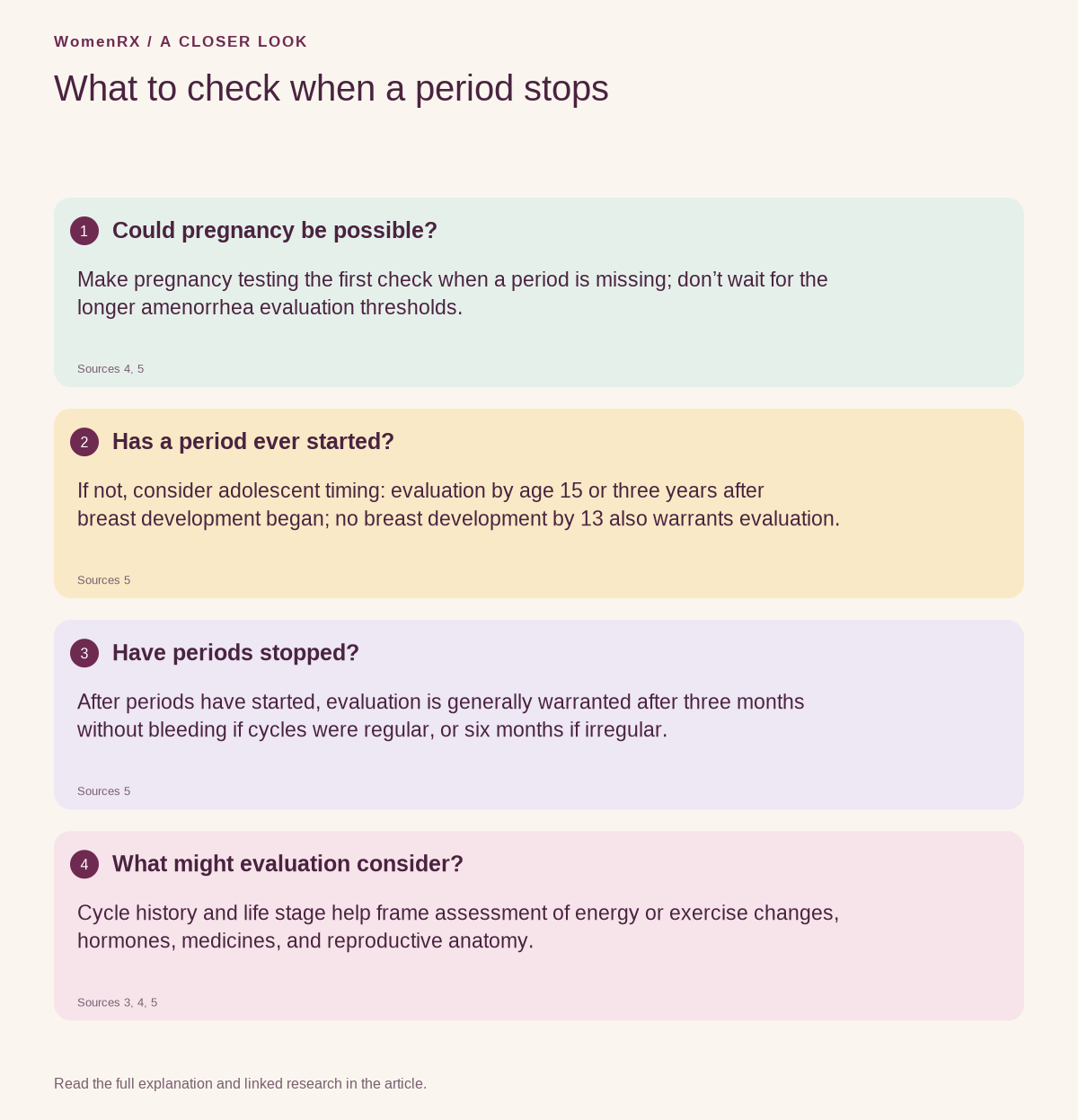
Could pregnancy be possible?: Make pregnancy testing the first check when a period is missing; don’t wait for the longer amenorrhea evaluation thresholds.45
Has a period ever started?: If not, consider adolescent timing: evaluation by age 15 or three years after breast development began; no breast development by 13 also warrants evaluation.5
Have periods stopped?: After periods have started, evaluation is generally warranted after three months without bleeding if cycles were regular, or six months if irregular.5
What might evaluation consider?: Cycle history and life stage help frame assessment of energy or exercise changes, hormones, medicines, and reproductive anatomy.345
Read the figure as text
Follow the questions in order: consider pregnancy, establish whether periods have ever started, check the relevant timing threshold, then consider the broader evaluation.- Could pregnancy be possible?: Make pregnancy testing the first check when a period is missing; don’t wait for the longer amenorrhea evaluation thresholds.45
- Has a period ever started?: If not, consider adolescent timing: evaluation by age 15 or three years after breast development began; no breast development by 13 also warrants evaluation.5
- Have periods stopped?: After periods have started, evaluation is generally warranted after three months without bleeding if cycles were regular, or six months if irregular.5
- What might evaluation consider?: Cycle history and life stage help frame assessment of energy or exercise changes, hormones, medicines, and reproductive anatomy.345
More questions, answered
Can exercise or stress stop a period?
Yes. Significant stress, increased exercise, or weight loss can interfere with hormone signaling from the brain and reduce ovarian hormone production. That pattern is one possible explanation, but pregnancy and other causes still need to be considered. 3 4
What if I’m a teenager and haven’t had a first period?
An evaluation is generally warranted if a period has not started by age 15 or by three years after breast development began. No breast development by age 13 is also a reason to evaluate delayed puberty. 5
Sources you can check
- Pregnancy and Medicines | MedlinePlusAccessed 2026-09-25Return to first citation
- PROMETRIUM (PROGESTERONE) CAPSULE [ACERTIS PHARMACEUTICALS, LLC] | US prescribing information and patient instructionsAccessed 2026-09-25Return to first citation
- Low-Dose Estrogens as Neuroendocrine Modulators in Functional Hypothalamic Amenorrhea (FHA): The Putative Triggering of the Positive Feedback Mechanism(s).Battipaglia C, Petrillo T, Semprini E, Ricciardiello F, Rusce ML, Prampolini G, Ambrosetti F, Sponzilli A, Genazzani AD. · Biomedicines · 2023Return to first citation
- Secondary AmenorrheaLord M, Jenkins SM, Sahni M. · 2024Return to first citation
- AmenorrheaNawaz G, Rogol AD, Jenkins SM. · 2024Return to first citation