Missed Periods: What to Check and What Happens Next
A pregnancy test is an early step when pregnancy is possible, but the next questions depend on your age, cycle history, contraception, and symptoms.
If pregnancy is possible, start by telling your clinician and taking a pregnancy test as part of the evaluation. If you’ve never had a period, evaluation is recommended by age 15 or three years after breast development begins. If previously regular periods stop for three months, or irregular periods stop for six months, evaluation is also recommended. Your history and symptoms help determine which tests come next. 3
First, clarify what “missing” means
A period that has never started is a different situation from periods stopping after they were established. Primary amenorrhea means periods have never begun; evaluation is recommended by age 15 or three years after breast development begins. Secondary amenorrhea means previously regular periods have stopped for three months, or irregular periods have stopped for six months. These are evaluation thresholds, not a diagnosis of the cause. 3
If pregnancy is possible, pregnancy testing is part of the initial evaluation. Share when your last period began and whether your cycles were usually regular. A missed period alone can’t tell you why your cycle changed. 3
Your age and life stage add context
If you’re an adolescent and periods have never begun, the timing of puberty matters as well as age. A clinician may ask when breast development started and assess pubertal development during an exam. 3
If you’re postpartum or breastfeeding, mention that, along with whether periods had returned after pregnancy. Lactation can suppress the hormonal activity involved in ovulation and may keep estrogen low, particularly while periods are absent. Postpartum symptoms can have other causes too, so don’t assume every change is from breastfeeding. 2
If you’re approaching or past menopause, include that context and describe any changes in your cycle. The reasons for missed periods and the appropriate evaluation depend on the person’s situation; a missed period by itself doesn’t establish that menopause is the cause.
Contraception and medicines are part of the story
Tell your clinician what contraception you use, when you started or stopped it, and whether you’ve had changes in bleeding. Amenorrhea can occur with the Depo-Provera injection: in its clinical studies, 55% of users reported no menstrual bleeding after one year and 68% after two years. Those figures describe users of this specific contraceptive, not everyone with missed periods. 1
Bring a list of prescription medicines, nonprescription medicines, and supplements. The point is to give your clinician a fuller picture, not to assume a medicine is responsible. Don’t change a treatment solely to make bleeding return without first discussing it with the prescriber.
Symptoms and history help focus testing
A clinician may ask about your previous cycle pattern, eating and exercise habits, stress, chronic illness, medicines, and symptoms involving puberty, the nervous system, or signs of higher androgen levels. They may also review changes in your body measurements and assess pubertal development. 3
For secondary amenorrhea, the routine laboratory evaluation described in a recent clinical review includes a pregnancy test and blood tests for estradiol, follicle-stimulating hormone (FSH), luteinizing hormone (LH), prolactin, and thyroid-stimulating hormone (TSH). Other tests, such as androgen testing, chromosome analysis, or pelvic or brain imaging, are selected based on the individual history and findings. 3
This is why details matter: a period that never started may call for a different evaluation from cycles that stopped after being regular. Symptoms and examination findings help determine whether additional testing is useful rather than making every test necessary for everyone. 3
Treatment depends on the cause
There isn’t one treatment for amenorrhea. The clinical approach depends on what the evaluation finds. For example, functional hypothalamic amenorrhea may call for attention to underlying disordered eating or low bone density. Premature ovarian insufficiency may be treated with hormone therapy until the average age of natural menopause. For polycystic ovary syndrome, care also needs to address longer-term metabolic health and endometrial cancer risk. These are different conditions with different care needs, not reasons to try to trigger bleeding on your own. 3
Make the appointment more useful
Before you go, write down when your last period began, your usual cycle pattern, and when the change started. Bring your contraception and medication list, and note whether you’re postpartum or breastfeeding, whether pregnancy is possible, and any new symptoms. If you’re an adolescent, include when breast development began if you know. These details map directly to the questions that shape the initial evaluation. 3
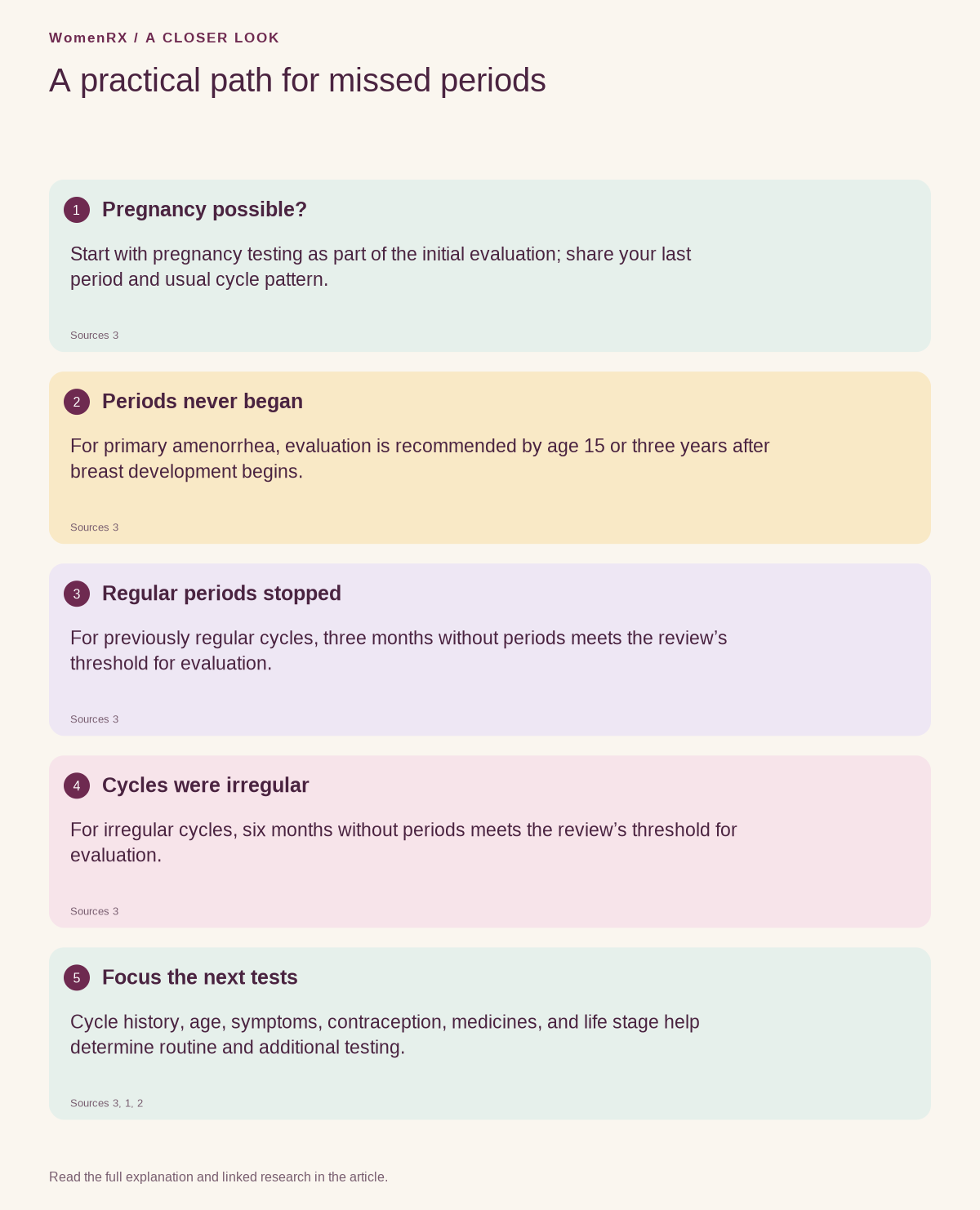
A practical path for missed periods
Pregnancy possible?: Start with pregnancy testing as part of the initial evaluation; share your last period and usual cycle pattern.3
Periods never began: For primary amenorrhea, evaluation is recommended by age 15 or three years after breast development begins.3
Regular periods stopped: For previously regular cycles, three months without periods meets the review’s threshold for evaluation.3
Cycles were irregular: For irregular cycles, six months without periods meets the review’s threshold for evaluation.3
Focus the next tests: Cycle history, age, symptoms, contraception, medicines, and life stage help determine routine and additional testing.312
Read the figure as text
The starting point is pregnancy possibility. Then distinguish periods that never began from periods that stopped, and use age, cycle history, contraception, and symptoms to guide further evaluation.- Pregnancy possible?: Start with pregnancy testing as part of the initial evaluation; share your last period and usual cycle pattern.3
- Periods never began: For primary amenorrhea, evaluation is recommended by age 15 or three years after breast development begins.3
- Regular periods stopped: For previously regular cycles, three months without periods meets the review’s threshold for evaluation.3
- Cycles were irregular: For irregular cycles, six months without periods meets the review’s threshold for evaluation.3
- Focus the next tests: Cycle history, age, symptoms, contraception, medicines, and life stage help determine routine and additional testing.312
More questions, answered
Should I take a pregnancy test after a missed period?
If pregnancy is possible, pregnancy testing is part of the initial evaluation for missed periods. A clinician can interpret the result alongside your cycle history and other information. 3
Can contraception stop periods?
Yes. Amenorrhea is reported with Depo-Provera use; its prescribing information reports that 55% of users had no menstrual bleeding after one year and 68% after two years in clinical studies. Mention your contraceptive method and timing when discussing a missed period. 1
Sources you can check
- DEPO-PROVERA (MEDROXYPROGESTERONE ACETATE) INJECTION, SUSPENSION [PHARMACIA & UPJOHN COMPANY LLC] | US prescribing information and patient instructionsAccessed 2026-09-25Return to first citation
- Genitourinary syndrome of lactation: An underrecognized postpartum condition affecting women's vulvovaginal, urinary and sexual health.Orozco Fernández R, Gil-Antuñano SP. · Women's health (London, England) · 2026Return to first citation
- Amenorrhea: A Practical Approach to Diagnosis and Management.Klein DA, Sylvester JE, Paradise SL. · American family physician · 2026Return to first citation