PCOS or Endometriosis? How to Compare Symptoms and Tests
Irregular ovulation and androgen-related changes can point toward PCOS, while recurring pelvic pain can raise suspicion for endometriosis, but symptoms alone can’t confirm either condition.
PCOS and endometriosis can both affect periods and fertility, but they tend to raise different clues. Irregular or absent ovulation, acne, and excess facial or body hair fit the PCOS pattern; severe period pain or other recurring pelvic pain can point toward endometriosis. Neither condition can be identified from symptoms alone, and the two aren’t an either-or choice. 1 2 3
The clues tend to fall into different patterns
PCOS is a hormone-related condition often associated with irregular ovulation and higher androgen levels. Androgens can contribute to acne or extra facial and body hair. Some people with PCOS also have a particular ovarian appearance on ultrasound, but ovarian follicles aren’t required for everyone with the condition. 1 3
Endometriosis is more likely to come up when pain is a prominent part of the picture. Severe period pain that disrupts everyday activities, heavy periods, and difficulty getting pregnant can occur with endometriosis. Symptoms can resemble those of other conditions, so pain alone doesn’t establish the diagnosis. 2
There’s overlap: both conditions can affect periods and fertility. Those effects don’t make them the same condition, and fertility concerns don’t mean you have either one. Many women with PCOS can still get pregnant. 1 2
What an evaluation may involve
For PCOS, there isn’t one test that settles the question. Assessment can bring together menstrual and ovulation history, signs of androgen excess, blood tests, and sometimes ultrasound findings. A commonly used diagnostic framework considers three features: irregular or absent ovulation, clinical or blood-test evidence of androgen excess, and polycystic ovarian appearance. The framework uses a combination of features rather than ultrasound alone. 1 3
For possible endometriosis, a clinician may ask about pain, bleeding, and family history, and may consider an examination, ultrasound, or MRI. Laparoscopy, a procedure using a camera inserted through a small abdominal cut, can confirm endometriosis. The right assessment depends on the symptoms and findings; there isn’t a single symptom that makes the diagnosis. 2
An ultrasound can have a role in assessing either condition, but it answers different questions in each evaluation. For PCOS, ovarian appearance is one feature among several. For endometriosis, ultrasound is one of several possible investigations, alongside MRI and, in some cases, laparoscopy. A scan should be interpreted in the context of your symptoms and the rest of the assessment. 1 2 3
How to make the next conversation more useful
Before an appointment, note the pattern rather than trying to label it. For example, record whether your periods are unpredictable or absent, whether pain follows a cycle, and whether acne or unwanted hair growth is also present. Include how much pain affects daily activities and whether pregnancy is a current concern. These details help connect the symptoms to the different assessment paths.
If you have both pelvic pain and signs such as irregular periods or excess hair, say so plainly. A PCOS diagnosis wouldn’t by itself explain every pelvic-pain symptom, and suspected endometriosis wouldn’t by itself account for androgen-related changes or irregular ovulation. You can ask whether the evaluation should consider both patterns rather than treating them as competing explanations. 1 2 3
The age and stage of life matter, too. PCOS can develop later than the first years of menstruation, while endometriosis is commonly diagnosed from when periods begin through menopause. If your symptoms change over time, describe what changed and when. 1 2
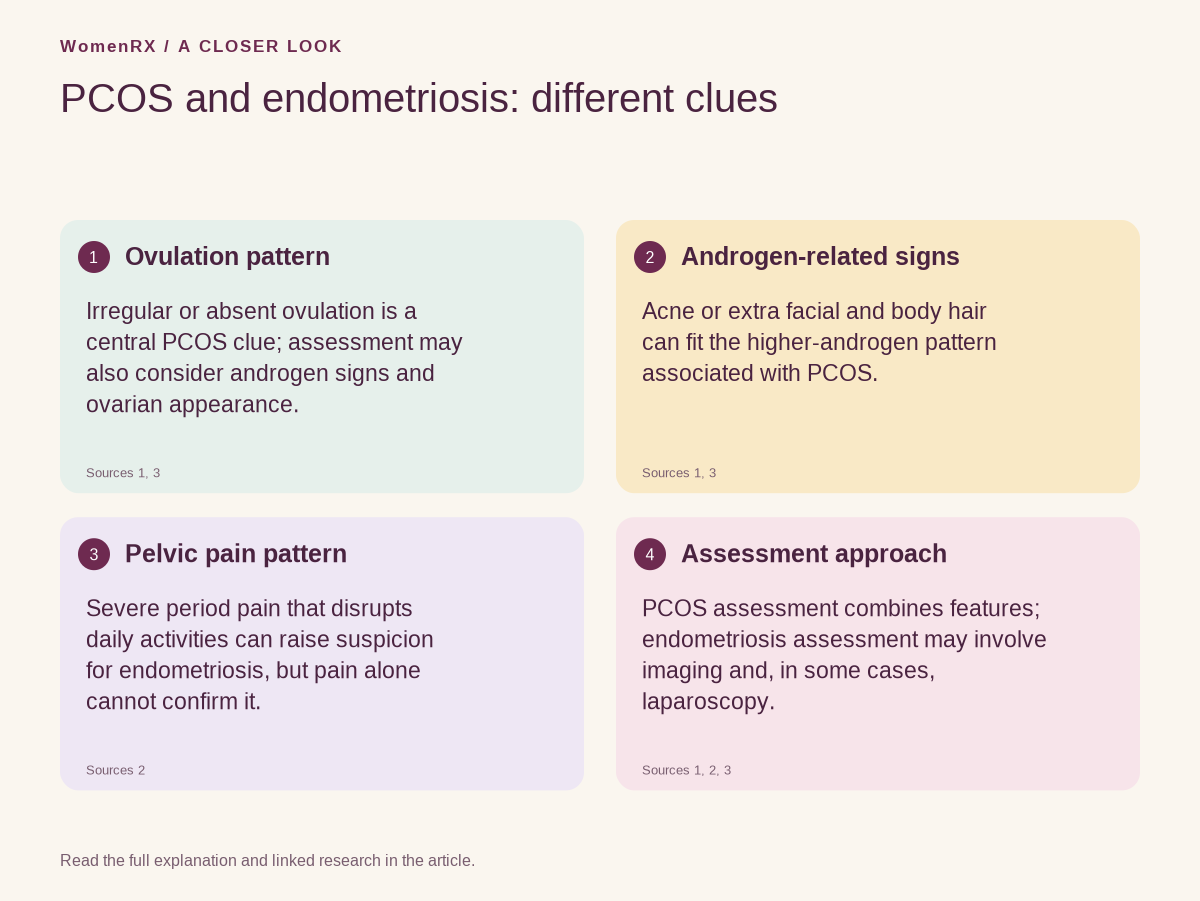
PCOS and endometriosis: different clues
Ovulation pattern: Irregular or absent ovulation is a central PCOS clue; assessment may also consider androgen signs and ovarian appearance.13
Androgen-related signs: Acne or extra facial and body hair can fit the higher-androgen pattern associated with PCOS.13
Pelvic pain pattern: Severe period pain that disrupts daily activities can raise suspicion for endometriosis, but pain alone cannot confirm it.2
Assessment approach: PCOS assessment combines features; endometriosis assessment may involve imaging and, in some cases, laparoscopy.123
Read the figure as text
Compare the symptom patterns and assessment approaches without treating a symptom list or scan as a diagnosis.- Ovulation pattern: Irregular or absent ovulation is a central PCOS clue; assessment may also consider androgen signs and ovarian appearance.13
- Androgen-related signs: Acne or extra facial and body hair can fit the higher-androgen pattern associated with PCOS.13
- Pelvic pain pattern: Severe period pain that disrupts daily activities can raise suspicion for endometriosis, but pain alone cannot confirm it.2
- Assessment approach: PCOS assessment combines features; endometriosis assessment may involve imaging and, in some cases, laparoscopy.123
More questions, answered
Does a PCOS diagnosis rule out endometriosis?
No. The conditions involve different patterns, and one diagnosis doesn’t automatically account for symptoms that fit the other. If you have both irregular ovulation or androgen-related signs and recurring pelvic pain, ask whether both deserve consideration. 1 2 3
Can an ultrasound diagnose PCOS or endometriosis by itself?
Not by itself for PCOS: ovarian appearance is one part of a broader assessment. For endometriosis, ultrasound is one possible investigation; other tests, including MRI or laparoscopy, may be considered. 1 2 3
Sources you can check
- PCOS | Polycystic Ovary Syndrome | MedlinePlusAccessed 2026-09-25Return to first citation
- Endometriosis - NHSAccessed 2026-09-25Return to first citation
- Reproductive Endocrine Disorders: A Comprehensive Guide to the Diagnosis and Management of Infertility, Polycystic Ovary Syndrome, and Endometriosis.Saleem Azam S, Vasudevan S, Saqib Bukhari W, Thadhani J, Tasneem H, Singh S, Chijioke I, Mendes de Freitas B, Bhagyani Weerasinghe Thammitage M, Motwani J. · Cureus · 2025Return to first citation