How to Compare Online PCOS Care
The right service should explain how it assesses PCOS, handles testing, supports your goals, and follows up.
Compare online PCOS services by what happens beyond the video visit: how a clinician assesses possible PCOS, who arranges and reviews tests, which of your concerns the service can address, and how follow-up works. PCOS has no single diagnostic test, and care may involve symptoms, fertility, and metabolic health in different combinations. Ask each service to explain its process before you enroll. 1 4
Start with the reason you’re seeking care
An online service that helps with irregular periods may not offer the same care as one that evaluates fertility concerns or follows metabolic health. Before comparing them, decide what you need first. For example, are you trying to understand new cycle changes, get help with acne or unwanted hair, discuss pregnancy goals, or make sure the health checks associated with PCOS aren’t overlooked? Those are different starting points, and you don’t have to have every symptom for your concern to deserve attention. PCOS can affect ovulation, androgen-related symptoms, and metabolic health, but it doesn’t look the same in everyone. 1 2 4
Use the four checks below as a scorecard. Record each service’s actual answer, not just whether its website says it treats PCOS.
Check 1: How will they assess possible PCOS?
There’s no single test that settles a PCOS diagnosis. In adults, clinicians consider combinations of ovulatory dysfunction or irregular cycles, signs or blood-test evidence of higher androgen levels, and ovarian features assessed by ultrasound or, in an appropriate adult assessment, anti-Müllerian hormone (AMH). An AMH result alone isn’t a PCOS diagnosis. 1 4 5
Ask: What will the clinician ask about, and how will they explain what my results do or don’t show? A service promising a diagnosis from one symptom, one ultrasound finding, or one AMH result isn’t describing the full assessment. 4
If you’re seeking care for an adolescent, ask how the clinician accounts for age and time since the first period. Some findings that raise questions about PCOS can overlap with normal adolescent development, making an automatic adult approach a poor fit. 3
Check 2: What happens when care moves off-screen?
A video appointment can begin a conversation, but it can’t collect a blood sample or perform imaging. Hormone blood tests may be part of a PCOS assessment; ultrasound or AMH may be considered in some adult assessments rather than being required for everyone. 1 4
Ask who orders any tests, how you’ll arrange them, who explains the results, and what happens if an in-person evaluation is needed. Look for a clear handoff rather than a vague promise that testing is “available.” If metabolic health is part of your concern, ask whether the plan addresses it: a review summarizing PCOS guidelines describes blood pressure, lipid, and glucose assessment at diagnosis. 4
Check 3: Does the treatment scope fit your goal?
“PCOS treatment” can mean different things. A service may help with cycle or androgen-related symptoms yet refer fertility care elsewhere. Another may discuss metabolic health but not provide a way to follow up on test results. PCOS treatment can include symptom management and, for someone having trouble getting pregnant, fertility treatment. Neither pregnancy nor any particular symptom should be assumed to be your priority. 1
Ask: Which of my concerns can you assess and manage, and which would need another clinician? If pregnancy is your goal, clarify whether the service offers fertility-related care or helps coordinate it. If it isn’t, look for an answer centered on the concerns you actually brought in. A list of treatments on a website tells you less than an explanation of how the clinician chooses a plan with you.
Check 4: Who stays responsible after the visit?
Find out who reviews outstanding results, how you can ask a question about the plan, and whether you can return when your priorities change. That matters with a condition that can involve both reproductive and metabolic health; current guideline recommendations summarized in a clinical review include cardiometabolic assessment, not just an initial discussion of symptoms. 4
For example, if you begin with cycle concerns and later want to discuss fertility, can the service address that change or make a clear handoff? If a test is ordered, will the clinician who requested it explain the result and next step? Compare those answers alongside the price and convenience of a visit, rather than assuming that an easy first appointment includes continuing care.
Put the answers side by side
For each service, write down four things: its assessment approach, its testing and in-person-care pathway, the concerns it can manage, and who handles follow-up. This article doesn’t rank providers. Comparing each service’s stated scope and process will help you choose one that fits what you need now, while showing you where you may need care elsewhere.
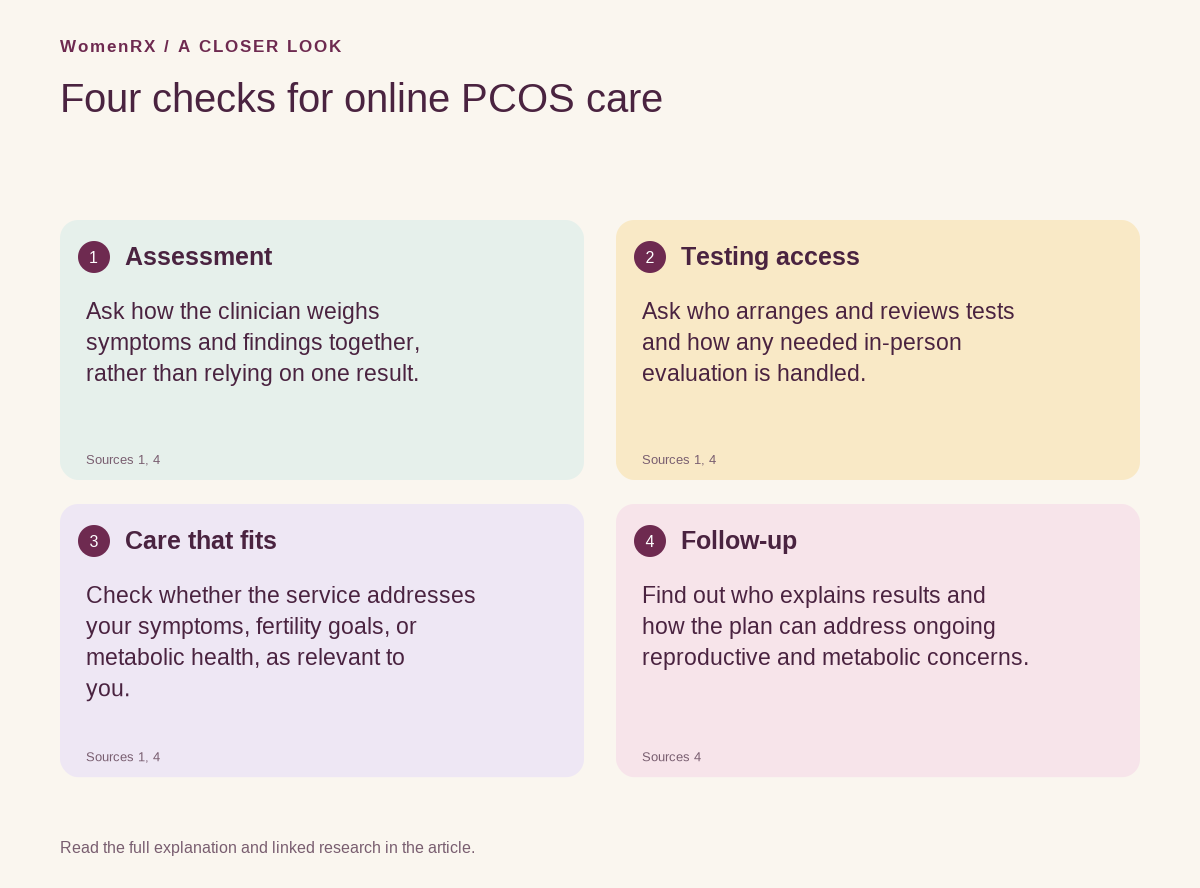
Four checks for online PCOS care
Assessment: Ask how the clinician weighs symptoms and findings together, rather than relying on one result.14
Testing access: Ask who arranges and reviews tests and how any needed in-person evaluation is handled.14
Care that fits: Check whether the service addresses your symptoms, fertility goals, or metabolic health, as relevant to you.14
Follow-up: Find out who explains results and how the plan can address ongoing reproductive and metabolic concerns.4
Read the figure as text
Compare each service’s answer in these four areas; a promise to treat PCOS doesn’t explain its full scope.- Assessment: Ask how the clinician weighs symptoms and findings together, rather than relying on one result.14
- Testing access: Ask who arranges and reviews tests and how any needed in-person evaluation is handled.14
- Care that fits: Check whether the service addresses your symptoms, fertility goals, or metabolic health, as relevant to you.14
- Follow-up: Find out who explains results and how the plan can address ongoing reproductive and metabolic concerns.4
More questions, answered
Do I need an ultrasound to be assessed for PCOS?
Not necessarily. Adult assessment considers a combination of features, and ultrasound is one way ovarian features may be evaluated. Ask why it would be useful in your situation rather than assuming every assessment requires one. 4 5
Sources you can check
- PCOS | Polycystic Ovary Syndrome | MedlinePlusAccessed 2026-09-25Return to first citation
- Polycystic ovary syndrome: An update on diagnosis and management.Sung N, Amir J, Alwahab UA, Falcone T. · Cleveland Clinic journal of medicine · 2026Return to first citation
- Women's Perspectives Regarding Polycystic Ovary Syndrome (PCOS) After Their Diagnosis: A Qualitative Study in Pakistan.Jehangir M, Qu S, Ul Haq I, Huwaikem M, Akhtar S, Zakki SA, Khan GA, Chen XS. · Health science reports · 2026Return to first citation
- Polyendocrine metabolic ovarian syndrome (PMOS)/polycystic ovary syndrome (PCOS): current and future trends.Chan JL, Masini I, Pisarska MD. · The Journal of clinical investigation · 2026Return to first citation
- From polycystic ovary syndrome to polyendocrine metabolic ovarian syndrome: what obstetricians and gynecologists need to know.Bahri-Khomami M, Hoeger KM, Huddleston H, Mahalingaiah S, Teede HJ, Dokras A. · American journal of obstetrics and gynecology · 2026Return to first citation