How to Compare Online Weight-Loss Programs Offering GLP-1 Care
Compare the care behind the prescription, including who assesses you, what follow-up looks like, and what happens if treatment changes.
Look beyond advertised weight-loss results. Before enrolling, find out who reviews your health history and makes prescribing decisions, which medication and dispensing source are involved, how follow-up works, and what the full cost includes. Ask how the program supports you if access changes or you stop treatment, and how it addresses pregnancy, breastfeeding, or reproductive plans when relevant.
Start with the care, not the promise
An online program may make it easy to request weight-loss medication, but convenience doesn’t tell you what assessment or ongoing care comes with it. Compare the clinical relationship first: who reviews your health history, who makes prescribing decisions, and how you can reach the care team if a concern comes up.
A weight-care assessment can include your health and weight history, previous weight-loss efforts, a physical exam, and realistic goals. Ask what the program actually reviews, how a clinician is involved, and what happens if medication isn’t considered appropriate. Weight treatment can include nutrition support, counseling, medication, or other approaches, depending on a person’s circumstances. 1
A study of one German direct-to-consumer telemedicine service offers a useful distinction between screening and follow-up. Patients completed an online questionnaire followed by physician review. But the study’s 50-day outcomes came from a later self-report survey, without objective weight verification or medical supervision of that outcome assessment. It examined liraglutide through one service, not every medication or US program. 3
Compare the parts that shape your care
| What to compare | Questions to ask | What a clear answer gives you |
|---|---|---|
| Eligibility and assessment | What health and weight history do you review? Does a clinician assess my answers and decide whether treatment is suitable? What other options are discussed if it isn’t? | You understand what the decision is based on, who makes it, and what care may be available beyond medication. |
| Prescriber and follow-up | Who is responsible for prescribing and ongoing care? How do check-ins work? How can I reach someone if side effects or treatment needs change? | You know who is following your care and how to get help between planned visits. For example, Wegovy’s prescribing information identifies persistent or severe abdominal pain, sometimes radiating to the back, as a possible pancreatitis symptom. Ask how the program handles concerning symptoms; this is a product-specific example, not a complete list of risks for all medicines. 2 |
| Medication and dispensing | What exact medication is offered? Which pharmacy or other dispensing source supplies it? Can I get those details in writing? | You can tell what product the program proposes and who supplies it, rather than relying on a general “GLP-1 care” description. |
| Total cost | What will I pay for the medication, clinical service, and follow-up? Which services are included? Could the amount change if access or coverage changes? | You can compare like with like instead of judging by a monthly headline price that may not include the same services. |
| Continuity and support | If I pause, stop, or can’t obtain medication, what follow-up or other support is available? Who will help plan next steps? | You know what the program offers if treatment is interrupted, rather than having to guess after the fact. |
Treat cost and dispensing as questions to verify with each program. The medication’s product information can explain a specific drug’s risks and use, but it doesn’t tell you what a telehealth service charges or which pharmacy it uses. 2
Keep results claims in perspective
In the German study, 354 of 966 people who received liraglutide prescriptions completed the 50-day follow-up survey. Among those respondents, 85.6% reported losing more than 2 kg. That’s a short-term, self-reported result from people who answered the survey, not a prediction for you or proof that another program will produce the same outcome. 3
Ask how a program measures progress and what support it provides beyond the prescription. Then compare those answers separately from promotional claims about typical or dramatic results.
Ask about plans that may affect treatment
If pregnancy, breastfeeding, or plans to become pregnant are relevant to you, ask the prescriber for clear, product-specific guidance before starting and if your plans change. Ask whom to contact if you need to revisit that guidance. A program should be able to explain how those questions are handled, rather than offering a vague reassurance.
Ask what stopping treatment could look like
There isn’t one discontinuation result that predicts what will happen for everyone. In a one-year telemedicine intervention involving 50 employees with metabolic disease, the researchers reported that weight loss continued or was maintained among participants who discontinued GLP-1 medication. The program also included nutrition changes, coaching, education, and remote monitoring, so the result doesn’t isolate the effect of stopping medication or show what another program would do. 4
A separate retrospective matched-cohort study involved people with type 2 diabetes receiving carbohydrate-restricted nutrition therapy through telemedicine. More than 70% of the group who discontinued GLP-1 treatment maintained at least 5% weight loss at 12 months. That finding belongs to this specific care setting and population; it isn’t a general forecast for people stopping treatment. 5
These studies make continuity worth asking about, but they don’t establish a standard plan that every online program provides. Before enrolling, get a direct answer about follow-up, other support, and how the program will help if treatment becomes unavailable or no longer suits you.
A useful comparison comes down to four concrete answers: who assesses and prescribes, what medication and dispensing source are involved, what follow-up and support are included, and what the total cost covers. If a program is specific about results but vague about those basics, keep comparing.
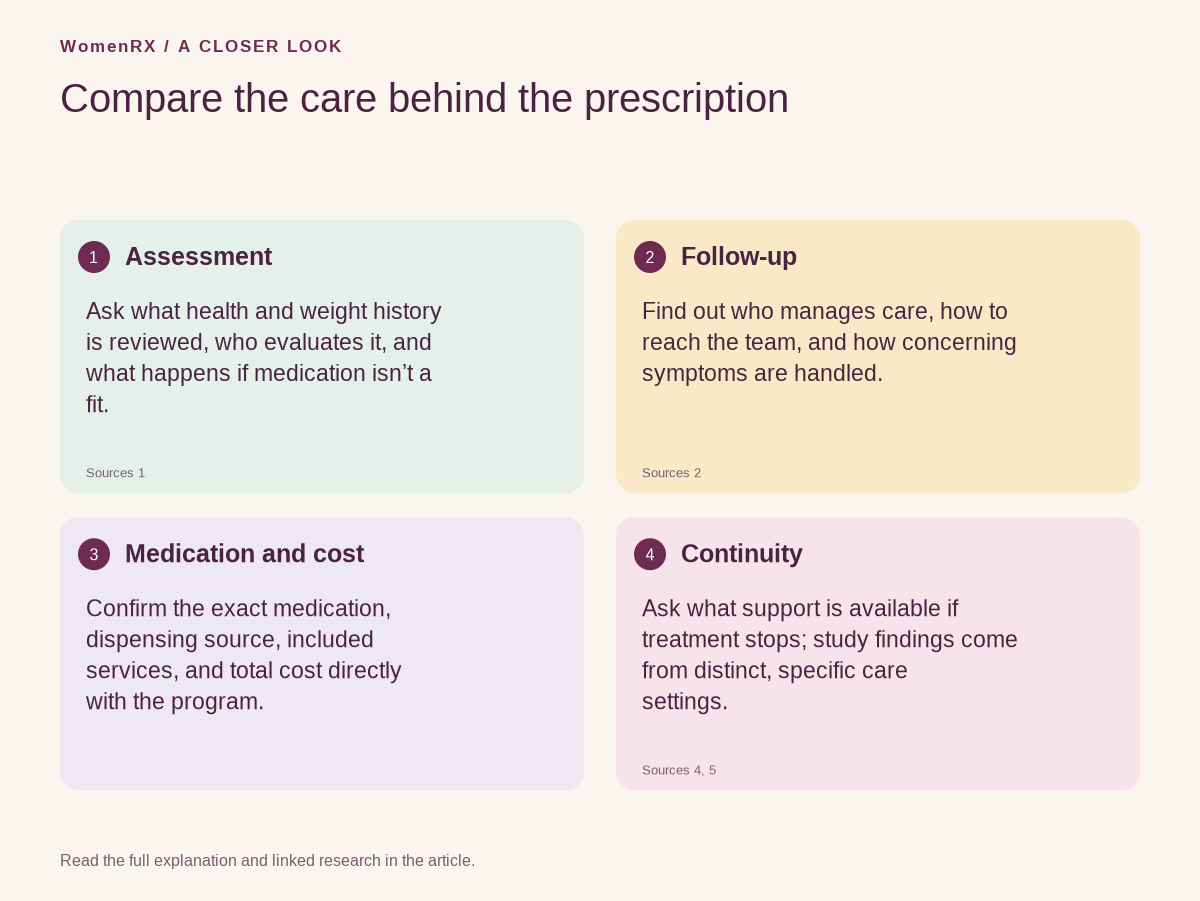
Compare the care behind the prescription
Assessment: Ask what health and weight history is reviewed, who evaluates it, and what happens if medication isn’t a fit.1
Follow-up: Find out who manages care, how to reach the team, and how concerning symptoms are handled.2
Medication and cost: Confirm the exact medication, dispensing source, included services, and total cost directly with the program.
Continuity: Ask what support is available if treatment stops; study findings come from distinct, specific care settings.45
Read the figure as text
Use these checks to compare clinical responsibility and service details separately from advertised results.- Assessment: Ask what health and weight history is reviewed, who evaluates it, and what happens if medication isn’t a fit.1
- Follow-up: Find out who manages care, how to reach the team, and how concerning symptoms are handled.2
- Medication and cost: Confirm the exact medication, dispensing source, included services, and total cost directly with the program.
- Continuity: Ask what support is available if treatment stops; study findings come from distinct, specific care settings.45
Sources you can check
- Obesity: MedlinePlusAccessed 2026-09-25Return to first citation
- WEGOVY (SEMAGLUTIDE) INJECTION, SOLUTION WEGOVY (SEMAGLUTIDE) TABLET [NOVO NORDISK PHARMACEUTICAL INDUSTRIES, LP] | US prescribing information and patient instructionsAccessed 2026-09-25Return to first citation
- GLP-1 receptor agonist therapy for obesity via direct-to-consumer telemedicine: Clinical characteristics and treatment outcomes.Gratzke M, von Bueren J, Garrahy E, Calewaert B, Abeck F, Wuelfing C. · Digital health · 2025Return to first citation
- TOWARD, a metabolic health intervention, demonstrates robust 1-year weight loss and cost-savings through deprescription.Buchanan L, Calkins M, Kalayjian T, Norwitz NG, Teicholz N, Unwin D, Soto-Mota A. · Frontiers in nutrition · 2025Return to first citation
- Impact of Glucagon-Like Peptide 1 Agonist Deprescription in Type 2 Diabetes in a Real-World Setting: A Propensity Score Matched Cohort Study.McKenzie AL, Athinarayanan SJ. · Diabetes therapy : research, treatment and education of diabetes and related disorders · 2024Return to first citation