What to Check Before Choosing Online GLP-1 Care
A trustworthy remote program should explain why treatment fits your health, what else you could choose, and who will help if problems arise.
Before starting online weight-loss care, check that a clinician reviews your health history and explains why a specific treatment is appropriate, including non-medication options. Ask what exact medicine you would receive, how side effects are handled, and how follow-up and refills work. If pregnancy, plans to become pregnant, or breastfeeding are relevant, raise them during screening and ask for guidance specific to the proposed medicine.
Online care can make weight-management support easier to reach, but a questionnaire and prescription aren’t a complete care plan. Compare programs by the decisions they help you make and the support available after treatment starts, not by promised results.
Start with a real assessment, not a checkout form
Ask what happens after you submit your information. A meaningful assessment should give a clinician a chance to review your health history, weight history, previous efforts, activity, other conditions, and medicines that could affect weight. MedlinePlus describes diagnosis as potentially including a physical exam, vital signs, and waist measurement, alongside health history. A remote program should explain what it can assess online, what information it needs from you, and when it would recommend an in-person assessment. 1
Ask how the program decides whether a medicine is a reasonable option for you. You should be able to hear the reason in terms of your health and circumstances, not just receive a generic “you qualify.” Also ask what would make the clinician recommend a different approach or more evaluation. The answer may depend on your overall health and weight, as well as other conditions and treatment preferences. 1
Compare more than medication
Medication is one possible part of weight management, not the only kind of care. Options can include support or counseling, help with nutrition and physical activity, referrals to specialists, and, for people with severe obesity or serious related health problems who haven’t been able to lose enough weight, weight-loss procedures or surgery. Ask which options the program can provide directly, which it refers out, and how those services fit with any medication discussion. 1
A program should be able to discuss benefits and tradeoffs without guaranteeing a particular amount of weight loss. Ask what progress it will review besides the number on the scale, and what the next step would be if a treatment doesn’t suit you.
Get the exact medicine and a specific safety plan
“GLP-1” is a drug class, not enough information to understand what you’re being offered. Ask for the medicine’s full name, form, and written instructions, and ask how to reach the prescribing clinician with questions. Don’t assume different medicines or forms have identical directions or warnings. For example, Wegovy’s US prescribing information says not to use it with another semaglutide-containing product or another GLP-1 receptor agonist. 2
Ask what side effects to watch for and what to do if they occur. Wegovy’s prescribing information describes gastrointestinal reactions that can sometimes be severe. It also tells clinicians to watch for possible pancreatitis, which can involve persistent or severe abdominal pain, sometimes radiating to the back, with or without nausea or vomiting. If Wegovy is the medicine being discussed, ask how the program wants you to report symptoms like these and who will respond. These are product-specific details, not a complete list of risks for every weight-loss medicine. 2
Ask how medication is obtained, who handles prescription questions, and what happens if a refill is delayed. These are practical questions to clarify before enrolling; don’t settle for a program that won’t tell you what medicine it plans to prescribe or how you’ll get help with it.
If pregnancy, trying to become pregnant, or breastfeeding is relevant to you, bring it up during screening. Ask the prescriber to explain guidance for the exact medicine under consideration.
Make follow-up part of the offer
Before paying or starting treatment, find out when and how follow-up happens, who reviews side effects, and whether you can reach a clinician between scheduled check-ins. Ask what the program does if you need to pause or stop medication, change treatment, or move your care elsewhere. A useful plan makes responsibilities clear rather than leaving you to figure out a handoff on your own.
Evidence about one direct-to-consumer telemedicine program shows why it’s worth asking how follow-up works. In a retrospective study of a German platform prescribing liraglutide, an online questionnaire was followed by physician review. The study’s 50-day outcomes came from a follow-up survey completed by 354 of the 966 people who received prescriptions. The reported outcomes were self-reported, not objectively verified, and the researchers said there was no medical supervision of that outcome assessment. That short, platform-specific study doesn’t establish how well other programs monitor patients or how remote care works over the long term. 3
A solid enrollment conversation should leave you knowing who made the treatment decision, what alternatives were considered, what medicine is proposed, and how follow-up works. If those basics are hard to get before you start, ask for clear answers before committing.
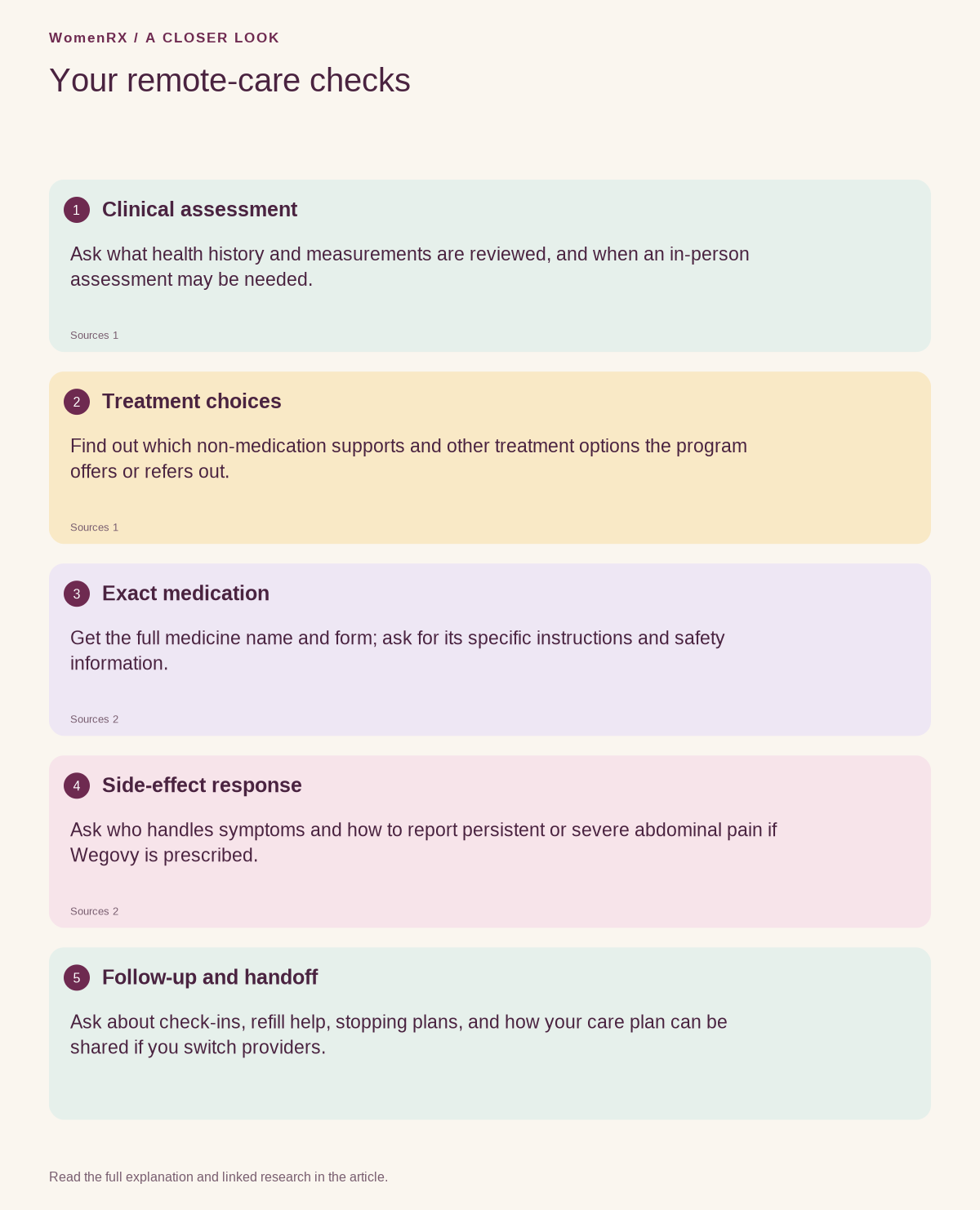
Your remote-care checks
Clinical assessment: Ask what health history and measurements are reviewed, and when an in-person assessment may be needed.1
Treatment choices: Find out which non-medication supports and other treatment options the program offers or refers out.1
Exact medication: Get the full medicine name and form; ask for its specific instructions and safety information.2
Side-effect response: Ask who handles symptoms and how to report persistent or severe abdominal pain if Wegovy is prescribed.2
Follow-up and handoff: Ask about check-ins, refill help, stopping plans, and how your care plan can be shared if you switch providers.
Read the figure as text
Use these questions to compare what a program assesses, offers, and supports after treatment begins.- Clinical assessment: Ask what health history and measurements are reviewed, and when an in-person assessment may be needed.1
- Treatment choices: Find out which non-medication supports and other treatment options the program offers or refers out.1
- Exact medication: Get the full medicine name and form; ask for its specific instructions and safety information.2
- Side-effect response: Ask who handles symptoms and how to report persistent or severe abdominal pain if Wegovy is prescribed.2
- Follow-up and handoff: Ask about check-ins, refill help, stopping plans, and how your care plan can be shared if you switch providers.
More questions, answered
What if a program says I qualify after an online questionnaire?
Ask whether a clinician reviews your answers and what health information they consider before recommending treatment. In one study of a direct-to-consumer platform, an online questionnaire was followed by physician review, but the short-term outcome survey was self-reported and did not objectively verify weight change. 3
Should I ask about non-medication support?
Yes. Weight-management care may include counseling or support, nutrition and activity guidance, specialist referrals, and other treatment options. Ask what the program provides and what it would refer elsewhere. 1
Sources you can check
- Obesity: MedlinePlusAccessed 2026-09-25Return to first citation
- WEGOVY (SEMAGLUTIDE) INJECTION, SOLUTION WEGOVY (SEMAGLUTIDE) TABLET [NOVO NORDISK PHARMACEUTICAL INDUSTRIES, LP] | US prescribing information and patient instructionsAccessed 2026-09-25Return to first citation
- GLP-1 receptor agonist therapy for obesity via direct-to-consumer telemedicine: Clinical characteristics and treatment outcomes.Gratzke M, von Bueren J, Garrahy E, Calewaert B, Abeck F, Wuelfing C. · Digital health · 2025Return to first citation