Why Periods Stop and When to Get Checked
A missed period can reflect pregnancy, a life-stage change, medication, or a health condition; what matters next depends on whether periods ever started and how long they’ve been absent.
If pregnancy is possible, a pregnancy test is an early step in assessing a stopped period. If periods have never started, evaluation is recommended by age 15 or three years after breast development began, and earlier if there’s no breast development by 13. If periods used to come regularly, three months without one warrants assessment; for previously irregular periods, the threshold is six months. Severe pain deserves attention sooner. 124
One late period doesn’t automatically mean something is wrong. Cycles can vary, especially around puberty and perimenopause, and bleeding may change after childbirth or while breastfeeding. But a period that never starts and periods that stop after becoming established raise different questions. Clinicians call these primary and secondary amenorrhea. 124
If periods have never started
A first period usually arrives within a few years of breast development, though the timing varies. An assessment is recommended if you haven’t had a period by age 15, or if three years have passed since breast development began. If there’s no breast development by age 13, an assessment for delayed puberty is recommended then, rather than waiting until 15. These are points to look for a reason, not diagnoses on their own. 15
The possible explanations reach beyond a late-running menstrual cycle. They include differences in reproductive anatomy or development, ovarian function, the hormone signals from the brain and pituitary gland, and other endocrine conditions. History, an examination, hormone tests and, when appropriate, pelvic imaging help distinguish among them. 1
If periods started and then stopped
Start with pregnancy possibility, even if another explanation seems plausible. A urine pregnancy test is part of the usual initial evaluation for amenorrhea. After pregnancy is considered, the length of the gap matters: three months without a period if your cycles were previously regular, or six months if they were not, meets commonly used criteria for secondary amenorrhea and warrants assessment. You don’t have to wait for those thresholds if the change concerns you or you have severe pain. 124
Why might bleeding stop? A period depends on hormone signals between the brain, pituitary gland and ovaries, as well as a uterus and an open path for bleeding. Problems in different parts of that process can look similar from the outside. Clinicians consider ovarian insufficiency; hypothalamic or pituitary conditions; other endocrine conditions; changes involving the reproductive tract; and medication effects. That’s why an explanation such as “it’s probably stress” can be premature without considering the rest of the picture. 2
Prolactin shows how context changes the meaning of a hormone finding. It rises naturally during pregnancy and lactation. Elevated prolactin from other causes can suppress the hormone signals involved in ovulation and lead to absent periods. A prolactin result therefore needs to be understood alongside pregnancy and breastfeeding status, rather than treated as an answer by itself. 3
An evaluation usually begins with your menstrual and health history, an examination, a pregnancy test, hormone testing and sometimes pelvic imaging. Which additional tests make sense depends on the clinical picture. These steps are meant to locate the reason periods stopped, not to assume that any one cause is most likely for you. 12
How life stage changes the question
After childbirth and during breastfeeding, a change in periods may reflect a change in hormones. That context belongs in the assessment, but it doesn’t replace considering pregnancy when pregnancy is possible. Near menopause, longer gaps between periods can occur during the transition; menopause itself most often happens between ages 45 and 55. Age and cycle history help put a gap in context, rather than making every missed period abnormal. 24
Accompanying symptoms can change when to speak up, even before an amenorrhea threshold is reached. Severe pain is a reason to contact a healthcare provider about a menstrual change. For an adolescent who has never had a period, the absence of breast development by 13 likewise changes the timing of assessment. Otherwise, you don’t need an additional symptom to justify evaluation once periods have been absent for the intervals above. 124
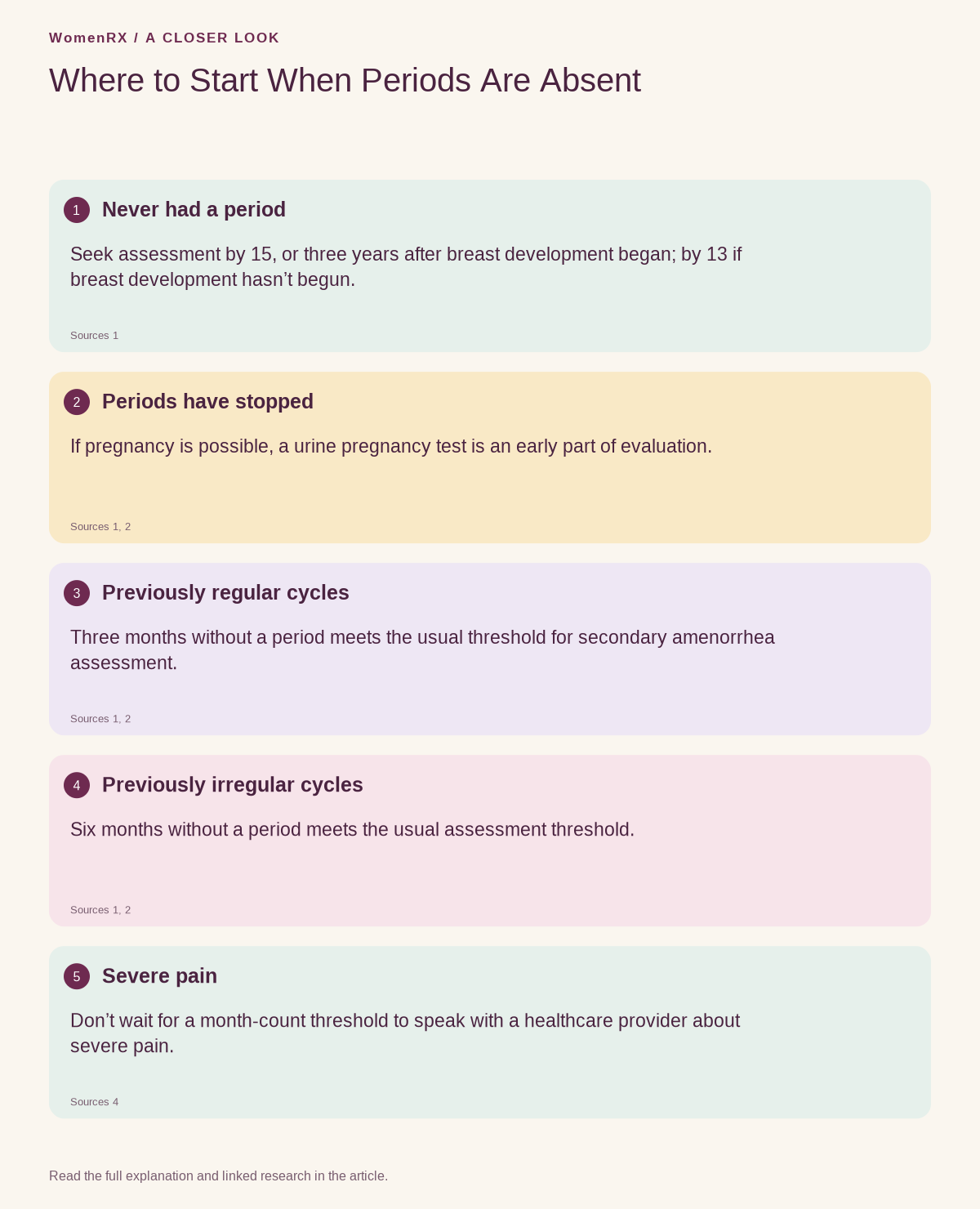
Where to Start When Periods Are Absent
Never had a period: Seek assessment by 15, or three years after breast development began; by 13 if breast development hasn’t begun.1
Periods have stopped: If pregnancy is possible, a urine pregnancy test is an early part of evaluation.12
Previously regular cycles: Three months without a period meets the usual threshold for secondary amenorrhea assessment.12
Previously irregular cycles: Six months without a period meets the usual assessment threshold.12
Severe pain: Don’t wait for a month-count threshold to speak with a healthcare provider about severe pain.4
Read the figure as text
The first distinction is whether periods have ever started; pregnancy possibility and age or cycle history then help determine the next question.- Never had a period: Seek assessment by 15, or three years after breast development began; by 13 if breast development hasn’t begun.1
- Periods have stopped: If pregnancy is possible, a urine pregnancy test is an early part of evaluation.12
- Previously regular cycles: Three months without a period meets the usual threshold for secondary amenorrhea assessment.12
- Previously irregular cycles: Six months without a period meets the usual assessment threshold.12
- Severe pain: Don’t wait for a month-count threshold to speak with a healthcare provider about severe pain.4
Sources you can check
- Primary AmenorrheaGasner A, Rehman A. · 2023Return to first citation
- AmenorrheaNawaz G, Rogol AD, Jenkins SM. · 2024Return to first citation
- [Hyperprolactinemia and pregnancy].Ionescu O, Vulpoi C, Cristea C, Ionescu D, Zbranca E. · Revista medico-chirurgicala a Societatii de Medici si Naturalisti din Iasi · 2002Return to first citation
- Menstruation | Period | MedlinePlusAccessed 2026-09-25Return to first citation
- Starting your periods - NHSAccessed 2026-09-25Return to first citation