Breastfeeding in Your 40s: Periods, Supply, and Hot Flashes
Breastfeeding can delay periods while perimenopause may bring cycle changes, so the timing of a symptom matters more than any one sign.
If you’re breastfeeding in your 40s, a missing period alone can’t tell you whether you’re in perimenopause: breastfeeding can delay periods, and ovulation may return before the first one. New hot flashes and cycle changes may point toward perimenopause, but they don’t explain every change in milk supply. Consider periods, symptoms, and feeding concerns separately rather than assigning them one cause. 753
Start with what your periods can’t tell you
Breastfeeding can delay the return of periods after birth. That makes a stretch without bleeding hard to interpret, especially if you’re also at an age when perimenopause may begin. A period that hasn’t returned is not, by itself, evidence of menopause. It isn’t proof that pregnancy is impossible, either: ovulation often happens before the first postpartum period. 7
The distinction is different once periods have returned. In general menopause guidance, newly occurring hot flashes alongside menstrual-cycle changes can point toward perimenopause. If your cycles had resumed and then became irregular, that history gives those symptoms more context than an absence of periods throughout breastfeeding would. It still doesn’t identify the cause with certainty. 56
You may hear that menopause means 12 months without a period. That definition is used when periods have stopped, but it cannot, on its own, explain 12 months without bleeding during breastfeeding, which can also delay periods. 67
Treat a supply concern as its own question
A change in pumping output or a feeling that supply has dropped may be worrying. Neither establishes that perimenopause is the cause. Low milk supply can involve several factors, including how often milk is removed and endocrine conditions. Research on assessing supply also finds that a person’s impression and any single measurement have limitations. 43
That means a useful assessment looks beyond one pumping session. Depending on the concern, a lactation specialist or clinician may discuss feeding and milk-removal patterns and consider the baby’s weight trajectory alongside what you’re noticing. Those pieces answer a more immediate question, whether milk intake or production needs attention, without assuming that a reproductive hormone change explains it. If breastfeeding is becoming difficult, a lactation consultant is a practical place to get help. 341
Where hot flashes fit
Hot flashes, sweats, sleep problems, and changing periods are recognized perimenopause symptoms. Menopause commonly occurs between ages 45 and 55, though it can happen earlier. If you’re breastfeeding in your early 40s and these symptoms are new, it’s reasonable to bring them up rather than dismissing them as part of breastfeeding. 6
A clinician can consider your age, when periods returned or changed, and when symptoms began. General guidance does not rely on a routine single test to identify perimenopause; it considers age and symptoms. Breastfeeding makes the period history less straightforward, so describe what happened before pregnancy and since birth, including whether bleeding ever resumed. 67
If hot flashes are disrupting your sleep or day, treatment is worth discussing. General menopause guidance includes menopause-specific cognitive behavioral therapy and hormone therapy as options for hot flashes, but it does not establish which hormone treatment is suitable while breastfeeding. Tell the clinician you’re breastfeeding before choosing a medicine, since some medicines can pass into breast milk. 51
Decide which question needs attention now
If pregnancy is possible, contact your usual care team about checking for pregnancy now rather than waiting for a period to return: ovulation can precede that first bleed. If your concern is milk supply, seek breastfeeding help, particularly when you’re worried about your baby’s intake or weight. If new hot flashes or changing cycles are affecting you, arrange an assessment of those symptoms too. These can be separate conversations. You don’t need to prove that perimenopause is behind all three changes before asking for help. 7135
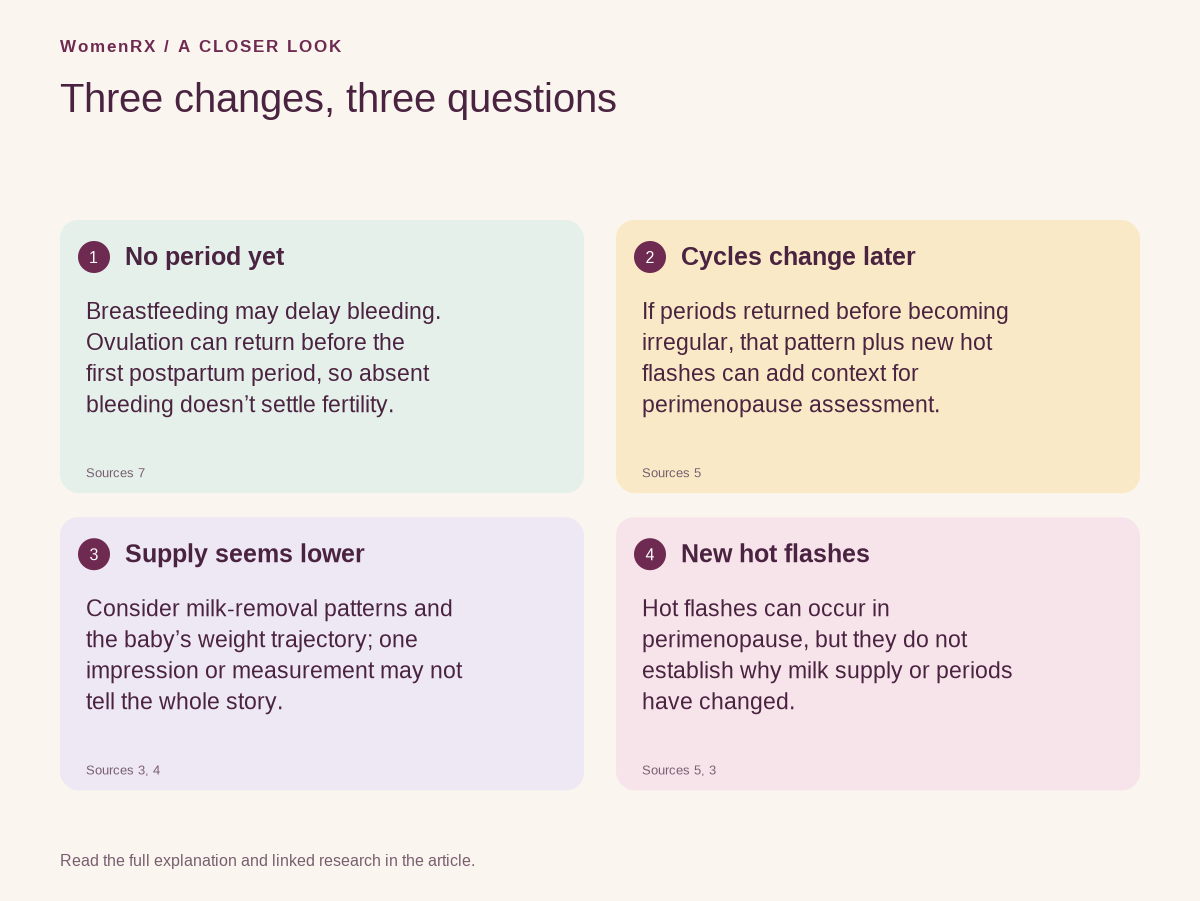
Three changes, three questions
No period yet: Breastfeeding may delay bleeding. Ovulation can return before the first postpartum period, so absent bleeding doesn’t settle fertility.7
Cycles change later: If periods returned before becoming irregular, that pattern plus new hot flashes can add context for perimenopause assessment.5
Supply seems lower: Consider milk-removal patterns and the baby’s weight trajectory; one impression or measurement may not tell the whole story.34
New hot flashes: Hot flashes can occur in perimenopause, but they do not establish why milk supply or periods have changed.53
Read the figure as text
This comparison separates what each change can suggest from what it cannot establish while breastfeeding.- No period yet: Breastfeeding may delay bleeding. Ovulation can return before the first postpartum period, so absent bleeding doesn’t settle fertility.7
- Cycles change later: If periods returned before becoming irregular, that pattern plus new hot flashes can add context for perimenopause assessment.5
- Supply seems lower: Consider milk-removal patterns and the baby’s weight trajectory; one impression or measurement may not tell the whole story.34
- New hot flashes: Hot flashes can occur in perimenopause, but they do not establish why milk supply or periods have changed.53
More questions, answered
Can a prolactin or estradiol result settle whether this is perimenopause?
Not on its own. General menopause guidance does not recommend a routine single test to identify perimenopause, and interpretation of hormones involved in lactation can depend on how and when a sample was collected. Your symptom and period history remains relevant. 62
Sources you can check
- Breastfeeding | Benefits of Breastfeeding | MedlinePlusAccessed 2026-09-25Return to first citation
- Analytical considerations and general diagnostic and therapeutic ramifications of milk hormones during lactation.Wagner CL, Baatz JE, Newton D, Hollis BW. · Best practice & research. Clinical endocrinology & metabolism · 2018Return to first citation
- Measuring Low Milk Supply: Methods and Implications for Lactation Research and Clinical Practice.Kivlighan KT, Demirci JR. · Journal of human lactation : official journal of International Lactation Consultant Association · 2026Return to first citation
- Milk Composition Is Predictive of Low Milk Supply Using Machine Learning Approaches.Jin X, Lai CT, Perrella SL, Zhou X, Hassan GM, McEachran JL, Gridneva Z, Taylor NL, Wlodek ME, Geddes DT. · Diagnostics (Basel, Switzerland) · 2025Return to first citation
- Recommendations | Menopause: identification and management | Guidance | NICEAccessed 2026-09-25Return to first citation
- What are menopause and perimenopause? - NHSAccessed 2026-09-25Return to first citation
- Efficacy of a new postpartum transition protocol for avoiding pregnancy.Bouchard T, Fehring RJ, Schneider M. · Journal of the American Board of Family Medicine : JABFM · 2013Return to first citation