How Hypothyroidism Can Affect Periods and Prolactin
When thyroid hormone is low, menstrual changes and higher prolactin can sometimes be part of the same hormonal ripple.
Overt hypothyroidism can be associated with irregular or infrequent periods and, in some women, elevated prolactin. One possible link is increased signaling from the brain that stimulates both thyroid activity and prolactin release. In a small study of premenopausal women with overt hypothyroidism, thyroid replacement lowered prolactin and raised estradiol, but it did not change LH or FSH. That doesn’t mean every cycle or fertility concern is caused by the thyroid. 2 4
The thyroid can influence reproductive signaling
Thyroid hormone does more than regulate energy use. It also interacts with reproductive signaling, including prolactin, gonadotropin-releasing hormone, and sex hormone levels. Reviews describe these pathways as one reason thyroid disorders can be associated with menstrual changes. The effect isn’t a simple switch, though: a thyroid-related change may contribute to a cycle problem without being its only cause. 2 5
One possible connection runs through the brain. When thyroid hormone is deficient, increased thyrotropin-releasing hormone (TRH) may also stimulate prolactin release. Higher prolactin can interfere with the signals involved in ovulation. This is a plausible pathway, not proof that a raised prolactin level in any individual woman comes from hypothyroidism. 2 3
What changes might show up?
Hypothyroidism has been associated with infrequent or irregular periods, including oligomenorrhea. Changes in ovulation may also matter if you’re trying to conceive. But menstrual patterns and fertility are influenced by more than thyroid function, and studies of women with infertility can’t show that thyroid dysfunction was the sole reason for their difficulties. 3 5
Prolactin is one piece of the picture, not a diagnosis by itself. In a hospital-based study of women being evaluated for infertility, elevated prolactin was more common in the infertility group than in fertile controls, and women in the infertility group who had hypothyroidism had higher prolactin than those who were euthyroid or hyperthyroid. Because this was an infertility-clinic study, those findings shouldn’t be treated as rates for all women with hypothyroidism. 3
What treatment may change, and what it may not
A small study followed 40 premenopausal women with overt hypothyroidism before and after thyroid hormone replacement. After thyroid function was restored, prolactin fell and estradiol rose. LH and FSH did not significantly change. This suggests that some hormone changes can improve with treatment, but the study measured hormone levels, not whether every participant’s periods or fertility improved. Treatment shouldn’t be understood as a guaranteed fix for cycle or conception problems. 4
The distinction between overt hypothyroidism and subtler thyroid test changes also matters. The study above involved women with overt disease; its results don’t establish what will happen for every woman with a mildly abnormal test or symptoms despite normal results. 4
Making sense of a cycle or fertility concern
If you have known hypothyroidism and a new menstrual change, fertility concern, or symptoms that raise the question of high prolactin, a useful discussion is whether thyroid status and prolactin need assessment. TSH and free T4 describe thyroid status; prolactin may be considered when the symptoms and clinical context make it relevant. A prolactin result alone doesn’t establish why it’s high. 3 4
Pregnancy adds another reason to review thyroid management: US prescribing information says levothyroxine dosing is individualized and takes pregnancy into account. The available study of reproductive hormones was in premenopausal women, not a pregnancy study, so its hormone findings shouldn’t be used to predict pregnancy outcomes. 1 4
The practical takeaway is to treat thyroid status as a potentially relevant part of the picture, not the whole explanation. If thyroid tests are back in range but menstrual or fertility concerns continue, that’s a reason to keep considering other explanations rather than assuming more thyroid treatment will solve them.
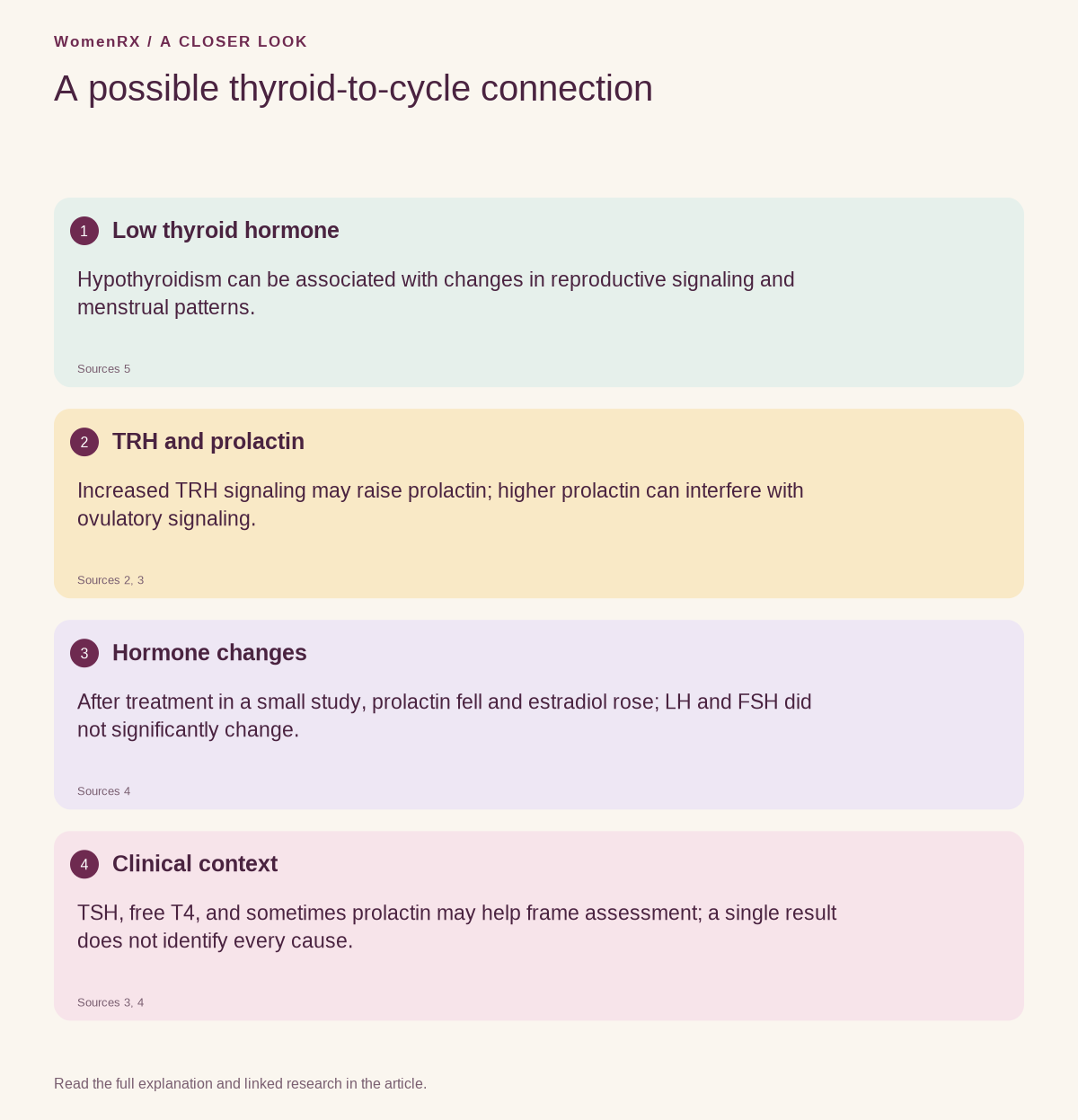
A possible thyroid-to-cycle connection
Low thyroid hormone: Hypothyroidism can be associated with changes in reproductive signaling and menstrual patterns.5
TRH and prolactin: Increased TRH signaling may raise prolactin; higher prolactin can interfere with ovulatory signaling.23
Hormone changes: After treatment in a small study, prolactin fell and estradiol rose; LH and FSH did not significantly change.4
Clinical context: TSH, free T4, and sometimes prolactin may help frame assessment; a single result does not identify every cause.34
Read the figure as text
This map separates a proposed signaling pathway from the hormone changes observed after treatment and the questions those findings do not answer.- Low thyroid hormone: Hypothyroidism can be associated with changes in reproductive signaling and menstrual patterns.5
- TRH and prolactin: Increased TRH signaling may raise prolactin; higher prolactin can interfere with ovulatory signaling.23
- Hormone changes: After treatment in a small study, prolactin fell and estradiol rose; LH and FSH did not significantly change.4
- Clinical context: TSH, free T4, and sometimes prolactin may help frame assessment; a single result does not identify every cause.34
More questions, answered
Does high prolactin mean hypothyroidism is the cause?
No. Hypothyroidism can be one possible contributor, but an association doesn’t identify the cause in an individual. The infertility-clinic study found higher prolactin among some women with hypothyroidism, but it cannot establish that thyroid deficiency caused each elevated result. 3
Will treating hypothyroidism restore fertility?
It may improve some hormone changes linked to overt hypothyroidism, but the small before-and-after study measured hormone levels rather than pregnancy or live-birth outcomes. It can’t promise that thyroid treatment alone will resolve fertility concerns. 4
Sources you can check
- LEVOTHYROXINE SODIUM TABLET [CARDINAL HEALTH 107, LLC] | US prescribing information and patient instructionsAccessed 2026-09-25Return to first citation
- Impact of thyroid function abnormalities on reproductive hormones during menstrual cycle in premenopausal HIV infected females at NAUTH, Nnewi, Nigeria.Ukibe NR, Ukibe SN, Emelumadu OF, Onyenekwe CC, Ahaneku JE, Igwegbe AO, Monago IN, Ilika AL. · PloS one · 2017Return to first citation
- Correlation of prolactin and thyroid hormone concentration with menstrual patterns in infertile women.Binita G, Suprava P, Mainak C, Koner BC, Alpana S. · Journal of reproduction & infertility · 2009Return to first citation
- Effect of Adequate Thyroid Hormone Replacement on the Hypothalamo-Pituitary-Gonadal Axis in Premenopausal Women with Primary Hypothyroidism.Bachimanchi B, Vaikkakara S, Sachan A, Praveen Kumar G, Venkatanarasu A, Sai Krishna Chaitanya P, Sreedivya B, Poojari R. · European thyroid journal · 2019Return to first citation
- Thyroid hormone receptors and reproduction.Dittrich R, Beckmann MW, Oppelt PG, Hoffmann I, Lotz L, Kuwert T, Mueller A. · Journal of reproductive immunology · 2011Return to first citation