Semaglutide and Pregnancy: What to Do Before or After a Positive Test
Planning ahead helps you set a medication stop date, and an unexpected exposure is a reason to make a plan, not to assume the worst.
Semaglutide is not generally used for weight loss during pregnancy, and the human evidence is too limited to establish that exposure is safe. If you’re planning to conceive, ask the prescriber for a product-specific stop date; published reviews differ on how long to wait. If you become pregnant while taking it, contact your prescriber promptly. Bring the product, dose, last-dose date, pregnancy timing, and other medicines. 1 4 5 7
The ingredient is shared, but the products aren’t interchangeable
Wegovy, Ozempic, and Rybelsus contain semaglutide, but their approved uses and pregnancy instructions can differ. Check the name on your pen, bottle, or prescription rather than relying on “semaglutide” alone. The reason you take it matters, too: guidance for a medicine used for weight reduction may not settle what to do when it’s being used to manage diabetes or another condition. 1 2
For Wegovy used for weight reduction, U.S. prescribing information says to discontinue it when pregnancy is recognized. It also says that weight loss offers no benefit during pregnancy and may harm the fetus. The Ozempic and Rybelsus tablet information says use during pregnancy only if the potential benefit justifies the potential risk. That difference is one reason to get a plan from the clinician managing your treatment, rather than applying one product’s instructions to every semaglutide prescription. 1 2
If you’re planning a pregnancy
Ask your prescriber about stopping semaglutide before you start trying, and agree on what will manage the condition it was treating afterward. Reviews do not give one consistent waiting interval: some recommend about eight weeks or longer, while another estimates at least 35 days. Those are review recommendations, not a personalized stop date. Your clinician can help apply guidance to your product and health needs. 4 5 6
If semaglutide is being used to manage diabetes, don’t leave a treatment gap without discussing a replacement plan. Medication decisions in pregnancy weigh potential fetal risks against the risks of leaving a health condition untreated. 2 3
If pregnancy happens during treatment
Contact the clinician who prescribed semaglutide and your pregnancy-care clinician promptly. Share when you took your last dose and when you learned about the pregnancy. If you use Wegovy for weight reduction, its prescribing information says to discontinue it once pregnancy is recognized. For other products or treatment reasons, ask the prescriber how to proceed and how to manage the underlying condition. Don’t stop or start other medicines on your own. 1 2 3
An exposure does not establish that a pregnancy will be harmed. A 2026 systematic review included five studies with 1,128 semaglutide-exposed pregnancies. It found no consistent increased risk of major birth defects, but the studies differed and had limitations, so they cannot establish that semaglutide is safe during pregnancy. Animal studies in product information found fetal effects, which is part of why use during pregnancy is approached cautiously. 1 7
If you were using Wegovy, its prescribing information lists a pregnancy exposure registry that monitors outcomes and gives the contact number 1-877-390-2760. You can ask your clinician whether registering is appropriate. 1
Bring these details to the conversation
A photo of the label or prescription can help identify the exact product. Note the dose, the date of your last dose, when you had a positive test or estimate conception may have occurred, and all other medicines you take. Include medicines for diabetes, supplements, and any recent treatment changes. These details help the clinician discuss both exposure and a plan for the condition semaglutide was treating. 1 2 3
It’s also reasonable to ask: “What should I use instead, if anything?” “How should we manage my blood sugar or other condition?” and “Does my product have a pregnancy exposure registry?” The key is to make decisions with the full picture, not to judge the pregnancy by exposure alone.
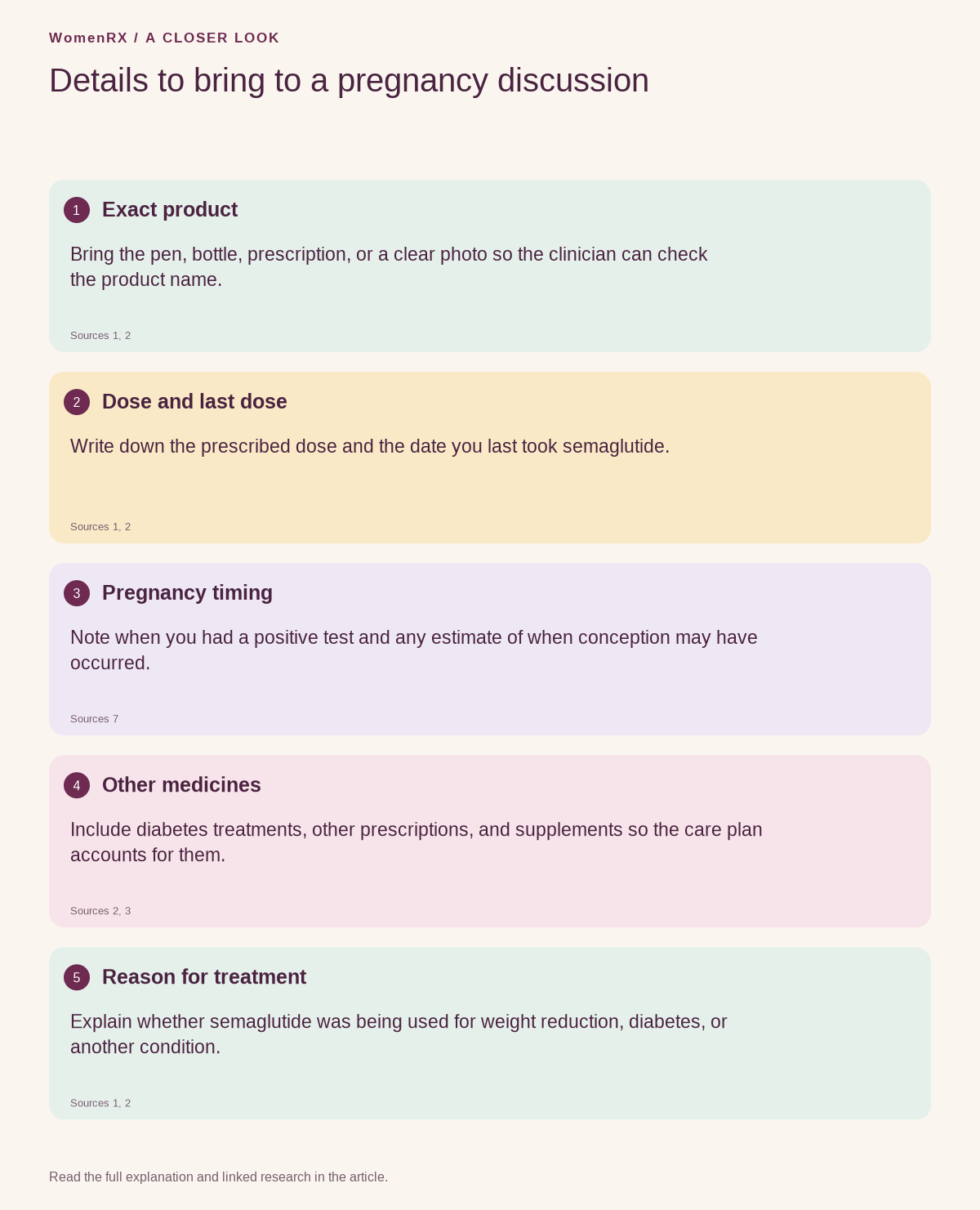
Details to bring to a pregnancy discussion
Exact product: Bring the pen, bottle, prescription, or a clear photo so the clinician can check the product name.12
Dose and last dose: Write down the prescribed dose and the date you last took semaglutide.12
Pregnancy timing: Note when you had a positive test and any estimate of when conception may have occurred.7
Other medicines: Include diabetes treatments, other prescriptions, and supplements so the care plan accounts for them.23
Reason for treatment: Explain whether semaglutide was being used for weight reduction, diabetes, or another condition.12
Read the figure as text
These details help the clinician identify the product, understand the timing of exposure, and plan care for the condition it was treating.- Exact product: Bring the pen, bottle, prescription, or a clear photo so the clinician can check the product name.12
- Dose and last dose: Write down the prescribed dose and the date you last took semaglutide.12
- Pregnancy timing: Note when you had a positive test and any estimate of when conception may have occurred.7
- Other medicines: Include diabetes treatments, other prescriptions, and supplements so the care plan accounts for them.23
- Reason for treatment: Explain whether semaglutide was being used for weight reduction, diabetes, or another condition.12
More questions, answered
Does semaglutide affect fertility or menstrual cycles?
It’s not possible to predict a change in fertility or cycle regularity for an individual taking semaglutide. A review describes emerging fertility findings for GLP-1 medicines in people with PCOS, but it also says the effects of semaglutide on human reproductive health are poorly understood. Those findings don’t establish that semaglutide improves fertility for everyone. 4
Does a positive test mean the fetus has been harmed?
No. Exposure alone cannot tell you what will happen. Human studies have not shown a consistent increase in major birth defects, but they are not strong enough to establish safety. Share the timing and product details with your clinician so you can discuss your situation and next steps. 1 7
Sources you can check
- WEGOVY (SEMAGLUTIDE) INJECTION, SOLUTION WEGOVY (SEMAGLUTIDE) TABLET [NOVO NORDISK PHARMACEUTICAL INDUSTRIES, LP] | US prescribing information and patient instructionsAccessed 2026-09-25Return to first citation
- OZEMPIC (ORAL SEMAGLUTIDE) TABLET RYBELSUS (ORAL SEMAGLUTIDE) TABLET [NOVO NORDISK PHARMACEUTICAL INDUSTRIES, LP] | US prescribing information and patient instructionsAccessed 2026-09-25Return to first citation
- Pregnancy and Medicines | MedlinePlusAccessed 2026-09-25Return to first citation
- GLP-1 Receptor Agonists and Fertility: What Is Known So Far?Becker AS, Castilhos JP, Shugair SAS, Colombo T, Hentschke M-. · JBRA assisted reproduction · 2026Return to first citation
- The effects of glucagon-like peptide-1 receptor agonists on fertility, contraception, and pregnancy: clinical perspectives.Dilbaz B, Ateş Ç. · The European journal of contraception & reproductive health care : the official journal of the European Society of Contraception · 2026Return to first citation
- GLP-1 receptor agonists and preconception planning: bridging the gap between obesity treatment and reproductive safety, a narrative review.Saad Alfaiz A. · Annals of medicine and surgery (2012) · 2025Return to first citation
- Impact of semaglutide exposure on fetal and neonatal outcomes in pregnant women: a systematic review.Mandal L, Andersen LU, Luef BM, Tanvig MH, Vinter CA. · European journal of obstetrics, gynecology, and reproductive biology · 2026Return to first citation