Pregnant While Taking Semaglutide? Your Next Steps
A positive test calls for a prompt medication review, but exposure alone can’t predict how a pregnancy will turn out.
If you’re taking Wegovy for weight reduction, its U.S. prescribing information says to discontinue it when pregnancy is recognized. If you take semaglutide for diabetes, contact your prescriber promptly to make a plan for blood sugar control rather than leaving diabetes untreated. Share your product, dose, last dose, and pregnancy timing; early exposure by itself does not determine an individual outcome. 1 2 3
Start with the exact product and why you take it
Contact the clinician who prescribes your semaglutide and the team providing your pregnancy care. Tell them the brand and form you use, why it was prescribed, your dose, when you last took it, and your best estimate of when the pregnancy began. A photo of the package or pharmacy label can help avoid confusion between injectable and oral products.
If you use Wegovy for weight reduction, its U.S. prescribing information says to discontinue it when pregnancy is recognized; it also states that weight loss offers no benefit during pregnancy and may cause fetal harm. If your semaglutide is being used to treat diabetes, contact your prescriber promptly about an alternative blood sugar plan. The product information identifies the risks of poorly controlled diabetes in pregnancy as a clinical consideration, so stopping without arranging ongoing diabetes care is not a complete plan. 1 2
Give your care team a clear exposure timeline
Write down the date of your positive test, the date of your last injection or tablet, your usual schedule, and any doses taken after you think the pregnancy may have begun. Include other diabetes medicines and any recent blood sugar information you already have. This helps the team understand the exposure and decide what follow-up is appropriate; it can’t, by itself, establish whether the medicine affected a pregnancy.
Semaglutide information recommends stopping it at least two months before a planned pregnancy because the medicine has a long half-life. That planning advice is different from assessing an unplanned early exposure: finding out after taking it does not tell you what the outcome will be. 1 2
What pregnancy studies can and can’t tell you
Human research is growing, but it doesn’t yet settle the risk. A systematic review of five studies involving 1,128 semaglutide-exposed pregnancies found mixed results and no clear association with major congenital malformations. The authors cautioned that differences between studies and risk of bias prevent firm conclusions. These findings can offer context, but they can’t calculate the risk for one person or prove that continued use throughout pregnancy is safe. 4
A broader review of 36 human studies of GLP-1-based medicines, a group that includes semaglutide, also found no consistent increase in major congenital malformations in adjusted analyses of exposure around conception or early pregnancy. However, the medicines and study populations varied, and evidence about continued treatment throughout pregnancy remained limited. 5
It also matters why the medicine was prescribed. In a Danish observational study of GLP-1 medicines, including semaglutide, an association with preterm birth was seen among people using these medicines for diabetes, but not among those using them for weight management. The researchers said diabetes-related factors might help explain the difference; an observational study can’t establish the cause. This is one reason diabetes care needs its own plan rather than being treated as the same situation as weight-loss treatment. 6
Consider the pregnancy exposure registry
The Wegovy prescribing information encourages pregnant people exposed to Wegovy, and their healthcare providers, to contact the manufacturer’s pregnancy exposure registry. Ask your care team whether joining is appropriate, particularly if you took Wegovy during pregnancy. A registry collects information about exposures and outcomes; participation does not predict your individual pregnancy outcome. 1
The useful next move is to share an accurate timeline and make a condition-specific treatment plan with your care team. Early exposure is a reason to review your care, not a verdict about the pregnancy.
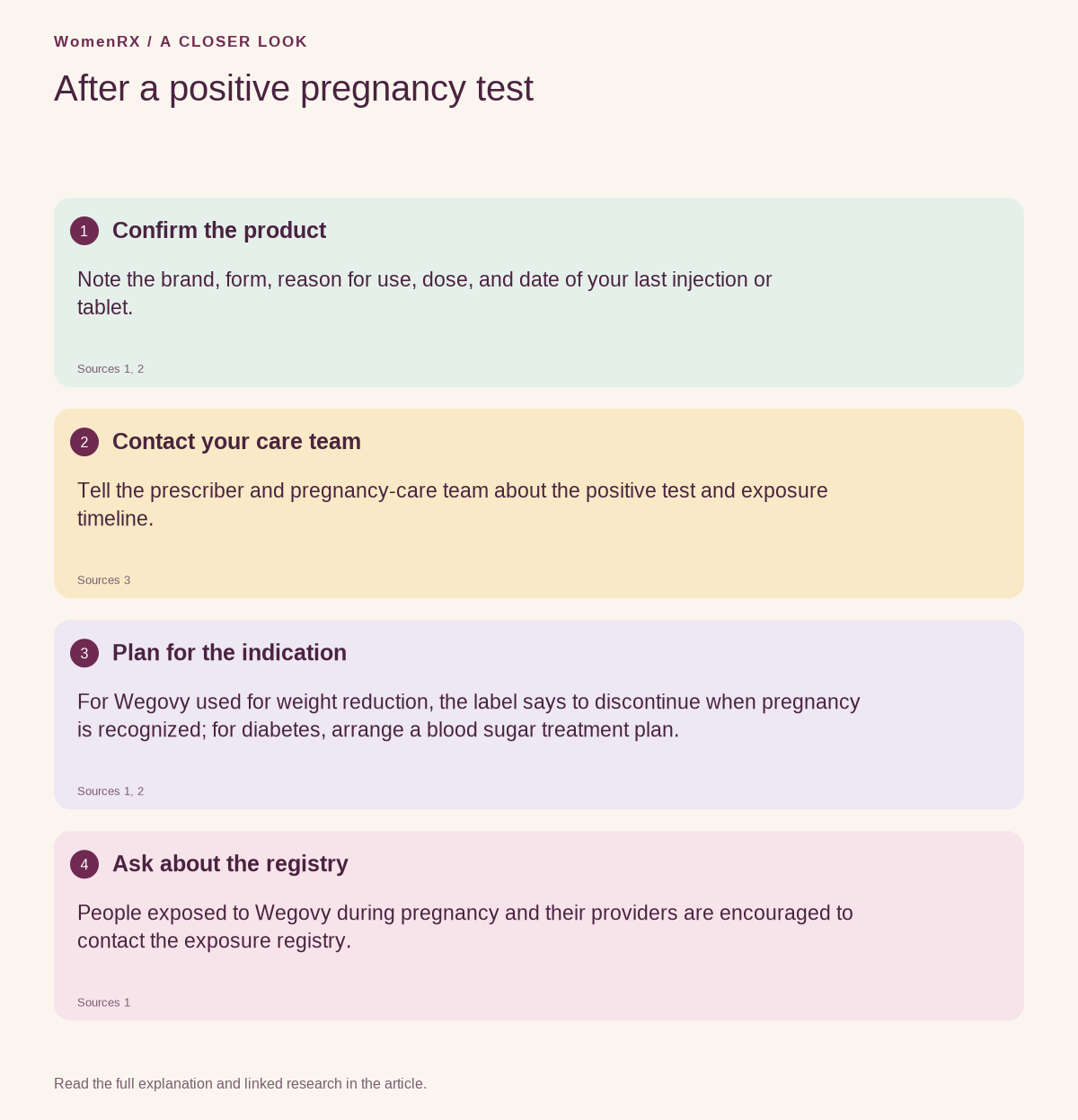
After a positive pregnancy test
Confirm the product: Note the brand, form, reason for use, dose, and date of your last injection or tablet.12
Contact your care team: Tell the prescriber and pregnancy-care team about the positive test and exposure timeline.3
Plan for the indication: For Wegovy used for weight reduction, the label says to discontinue when pregnancy is recognized; for diabetes, arrange a blood sugar treatment plan.12
Ask about the registry: People exposed to Wegovy during pregnancy and their providers are encouraged to contact the exposure registry.1
Read the figure as text
A practical sequence for reviewing semaglutide exposure while keeping diabetes care in view.- Confirm the product: Note the brand, form, reason for use, dose, and date of your last injection or tablet.12
- Contact your care team: Tell the prescriber and pregnancy-care team about the positive test and exposure timeline.3
- Plan for the indication: For Wegovy used for weight reduction, the label says to discontinue when pregnancy is recognized; for diabetes, arrange a blood sugar treatment plan.12
- Ask about the registry: People exposed to Wegovy during pregnancy and their providers are encouraged to contact the exposure registry.1
More questions, answered
Does taking semaglutide before I knew I was pregnant mean something is wrong?
No. Exposure alone can’t determine an individual outcome. Available human studies are limited and do not establish a clear increase in major birth defects, but they also can’t rule out risk or show that continued treatment throughout pregnancy is safe. Share your timing and treatment details with your care team. 4 5
What if I take semaglutide for diabetes?
Contact the prescriber promptly to arrange a pregnancy-appropriate blood sugar plan. The product information flags poorly controlled diabetes in pregnancy as a clinical consideration, so medication changes should account for the need to keep diabetes treated. 2 3
Sources you can check
- WEGOVY (SEMAGLUTIDE) INJECTION, SOLUTION WEGOVY (SEMAGLUTIDE) TABLET [NOVO NORDISK PHARMACEUTICAL INDUSTRIES, LP] | US prescribing information and patient instructionsAccessed 2026-09-25Return to first citation
- OZEMPIC (ORAL SEMAGLUTIDE) TABLET RYBELSUS (ORAL SEMAGLUTIDE) TABLET [NOVO NORDISK PHARMACEUTICAL INDUSTRIES, LP] | US prescribing information and patient instructionsAccessed 2026-09-25Return to first citation
- Pregnancy and Medicines | MedlinePlusAccessed 2026-09-25Return to first citation
- Impact of semaglutide exposure on fetal and neonatal outcomes in pregnant women: a systematic review.Mandal L, Andersen LU, Luef BM, Tanvig MH, Vinter CA. · European journal of obstetrics, gynecology, and reproductive biology · 2026Return to first citation
- Safety of GLP-1 and Dual GLP-1/GIP Receptor Agonists in Preconception, Pregnancy, and Lactation: A Systematic Review of Maternal, Fetal, and Neonatal Outcomes.Ozbek L, Shah E, Al-Shiab R, Inal A, Guldan M, Afsar B, Covic A, Kanbay M. · Diabetes, obesity & metabolism · 2026Return to first citation
- Periconceptional GLP-1 receptor agonist exposure and obstetric outcomes: a Danish nationwide cohort study.Hviid KVR, Banasik K, Mortensen LH, Madsbad S, Strandberg-Larsen K, Geiker NRW, Westergaard D, Nielsen HS. · Human reproduction open · 2026Return to first citation