Sulfur Burps on GLP-1 Medicines: Causes and Next Steps
Burping is reported with some GLP-1 medicines, but the sulfur smell itself hasn’t been established as a distinct side effect.
GLP-1 medicines can cause gastrointestinal effects, and burping is listed among common adverse reactions for liraglutide. Reports also link eructation with oral semaglutide and tirzepatide, but they don’t establish sulfur-smelling burps as a distinct effect. Track the pattern, and contact your prescriber if burps persist, worsen, or interfere with eating or drinking. Seek prompt care for persistent or severe abdominal pain or trouble keeping fluids down. 1 2 3
What the burps may mean
A sulfur smell can be unsettling, but the smell alone doesn’t show what’s causing it. The useful distinction is between burping as a gastrointestinal symptom and sulfur-smelling burps as a specific, proven medication effect. The US prescribing information for liraglutide lists eructation, the medical term for belching, among common adverse reactions. It does not single out a sulfur odor. 1
There are also reports of eructation with other medicines in this group. A study of reports submitted to the FDA’s adverse-event database found an eructation signal for oral semaglutide; a separate analysis of reports for tirzepatide found eructation among events with a strong reporting signal. These findings are reasons to take a new symptom seriously, not proof that a medicine caused it or a measure of how likely it is. Spontaneous reports don’t provide a reliable rate, and neither analysis establishes sulfur-smelling burps as a distinct effect. 2 3
So, a medication-related digestive effect is one possibility, especially if the symptom began after starting treatment or changing the dose. But the odor does not identify the cause, and other explanations are possible. A tirzepatide adverse-event reporting analysis found gastrointestinal events were reported more commonly among males. That finding doesn’t establish a difference in underlying risk or tell us whether women experience sulfur-smelling burps differently from men. 3
Track the pattern, not just the smell
As a practical way to keep the details straight, you could note:
- When the burps started, and whether that was after starting the medicine or a dose change.
- When they happen, such as after eating or at a particular time of day.
- Whether you also have nausea, vomiting, diarrhea, constipation, reflux, or abdominal pain.
- Whether the symptom is easing, recurring, or getting worse.
- Whether vomiting or diarrhea is making it hard to keep fluids down.
This kind of record can make it easier to describe the pattern if you discuss the symptom in care. It isn’t a way to diagnose the cause.
If the burps persist, get worse, or interfere with eating or drinking, contact the clinician who prescribes your medicine. You can describe the pattern you’ve noticed without waiting for a more serious symptom. If you can’t keep fluids down, seek prompt advice instead. 1
Know which symptoms need faster attention
Get prompt medical advice for persistent or severe abdominal pain, particularly if it radiates to your back or comes with nausea or vomiting. Liraglutide prescribing information identifies these as possible signs of acute pancreatitis and advises evaluation if pancreatitis is suspected. 1
Repeated vomiting or diarrhea also deserves attention if it leaves you unable to keep fluids down. Gastrointestinal reactions that lead to dehydration have been associated with kidney injury in postmarketing reports for liraglutide; its prescribing information calls for monitoring when reactions could cause volume depletion, especially during treatment initiation or dose escalation. 1
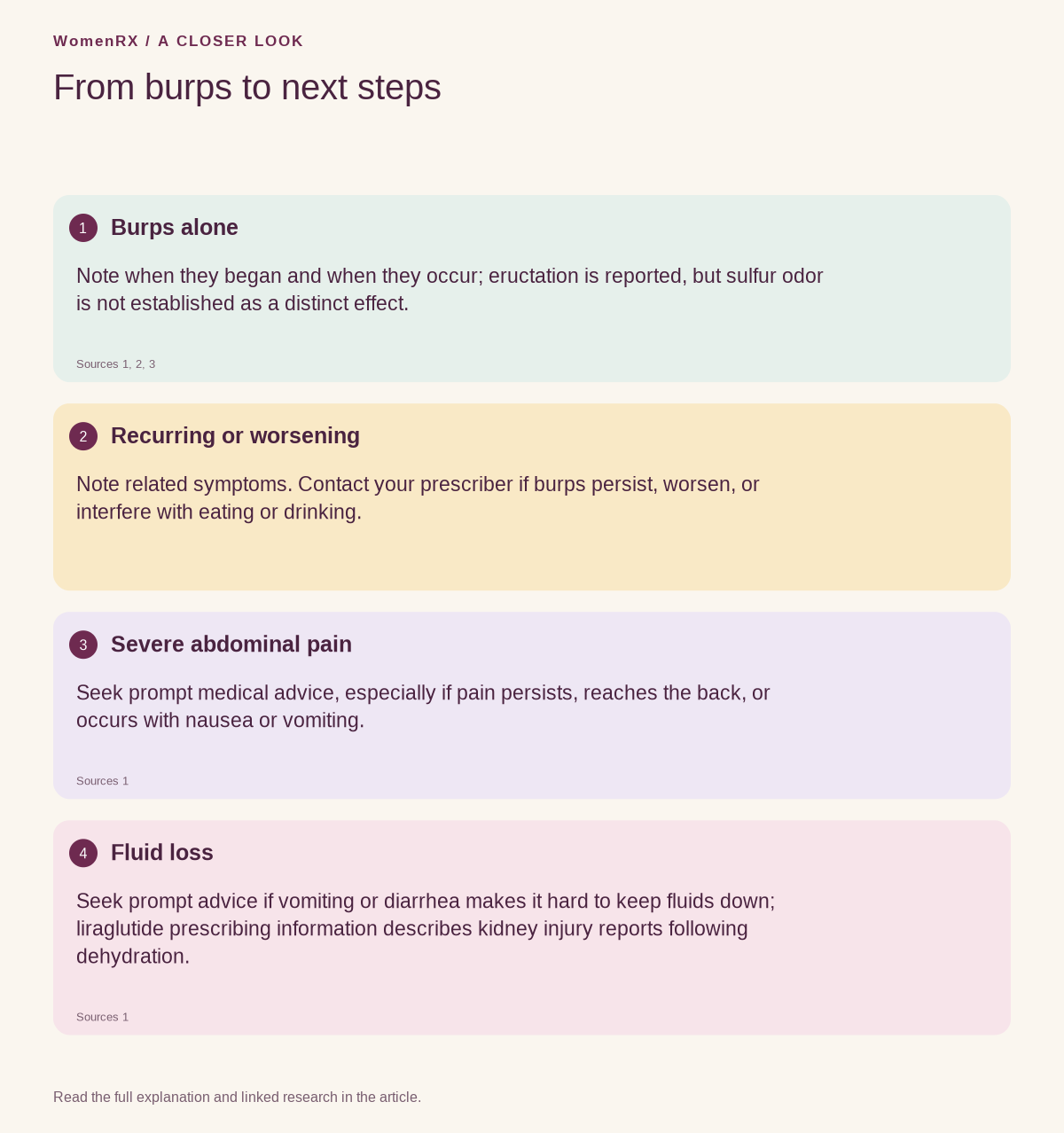
From burps to next steps
Burps alone: Note when they began and when they occur; eructation is reported, but sulfur odor is not established as a distinct effect.123
Recurring or worsening: Note related symptoms. Contact your prescriber if burps persist, worsen, or interfere with eating or drinking.
Severe abdominal pain: Seek prompt medical advice, especially if pain persists, reaches the back, or occurs with nausea or vomiting.1
Fluid loss: Seek prompt advice if vomiting or diarrhea makes it hard to keep fluids down; liraglutide prescribing information describes kidney injury reports following dehydration.1
Read the figure as text
Use the symptom pattern and accompanying signs to decide what to record, when to contact your prescriber, and when to seek prompt advice.- Burps alone: Note when they began and when they occur; eructation is reported, but sulfur odor is not established as a distinct effect.123
- Recurring or worsening: Note related symptoms. Contact your prescriber if burps persist, worsen, or interfere with eating or drinking.
- Severe abdominal pain: Seek prompt medical advice, especially if pain persists, reaches the back, or occurs with nausea or vomiting.1
- Fluid loss: Seek prompt advice if vomiting or diarrhea makes it hard to keep fluids down; liraglutide prescribing information describes kidney injury reports following dehydration.1
More questions, answered
Are sulfur burps a listed side effect?
Liraglutide prescribing information lists eructation, or belching, as a common adverse reaction, but doesn’t specify a sulfur smell. Oral semaglutide and tirzepatide have eructation reports in adverse-event databases; those reports can’t establish a cause or frequency. 1 2 3
Sources you can check
- SAXENDA (LIRAGLUTIDE) INJECTION, SOLUTION [NOVO NORDISK PHARMACEUTICAL INDUSTRIES, LP] | US prescribing information and patient instructionsAccessed 2026-09-25Return to first citation
- Adverse Events of Oral GLP-1 Receptor Agonist (Semaglutide Tablets): A Real-World Study Based on FAERS from 2019 to 2023.Xiong S, Gou R, Liang X, Wu H, Qin S, Li B, Luo C, Chen J. · Diabetes therapy : research, treatment and education of diabetes and related disorders · 2024Return to first citation
- Gastrointestinal adverse events associated with tirzepatide: A bibliometric and pharmacovigilance analysis.Shen P, Peng MS, Kim SJ, Joung KI, Kim KJ. · PloS one · 2026Return to first citation