Dehydration on GLP-1 Medications: Signs and Next Steps
Nausea, vomiting, or diarrhea can make it harder to replace lost fluid; reduced urination, dark urine, or a dry mouth are reasons to take that seriously.
Dehydration isn’t something to dismiss as a routine GLP-1 side effect. Nausea, vomiting, and diarrhea can reduce what you drink or increase fluid loss; dehydration has been linked to acute kidney problems in some reports. If you feel sick, try frequent small sips. Contact your care team promptly for signs such as dark or infrequent urine. Confusion needs urgent medical attention. 1245
Why stomach symptoms can become a fluid problem
Nausea, vomiting, and diarrhea are among the gastrointestinal effects reported with GLP-1-based medicines. The concern is not that every bout of nausea causes dehydration. It’s that losing fluid through vomiting or diarrhea, while taking in less because you feel sick or have little appetite, can leave your body short of fluid. 235
Kidney problems appear to be uncommon in the review evidence, but they matter when they occur. A review of clinical and safety evidence describes renal events as infrequent and often seen alongside gastrointestinal symptoms or volume depletion. An earlier review also discussed case reports of acute renal failure that were thought to be triggered by dehydration from gastrointestinal side effects. These reports do not tell us how often this happens or prove that the medication directly injured the kidneys. 45
Use symptoms and your ability to drink as signals
If you have mild nausea or a loose stool, notice whether you’re able to drink and whether your urination changes as symptoms continue. Urinating as usual now doesn’t rule out dehydration developing later. If nausea makes drinking difficult, try small, frequent sips of clear liquids rather than a large amount at once. MedlinePlus recommends contacting a healthcare provider for signs such as a dry mouth, urinating less often, or dark urine. 12
Contact your prescriber or another care team promptly if you notice those dehydration signs. If diarrhea continues for more than two days, MedlinePlus advises adults to contact a healthcare provider. You may need advice on replacing fluid and electrolytes, and on what to do about your treatment. 13
Confusion is a reason to get medical help right away. Don’t wait for thirst to be your only guide: losing fluid can outpace how much you’re able to drink, and people’s fluid needs vary. 2
A practical way to respond
When symptoms start, notice whether you can keep taking small sips and whether you’re still urinating. If you’re losing fluid through repeated vomiting or diarrhea, keep watching for a dry mouth, dark urine, or less frequent urination. Contact your care team if those signs appear, or if diarrhea lasts more than two days. A clinician can assess dehydration and decide whether you need treatment to replace fluids or electrolytes. Severe dehydration may require fluids given through an IV. 123
Don’t assume the medication is the only possible cause. Infections can cause diarrhea. 3 Nausea or vomiting can also occur during pregnancy. 1 If you’re pregnant or breastfeeding, mention that when speaking with your prescriber about symptoms, hydration, and medication decisions.
Kidney conditions make early advice more useful
If you have kidney disease or take medicines that make you urinate more, take dehydration signs seriously and seek prompt advice if they appear. The available review describes limited experience with GLP-1 medicines in some people with chronic kidney disease and discusses dehydration-related kidney injury reports. It doesn’t establish an individual risk level, so your own medical history and medicines matter. 24
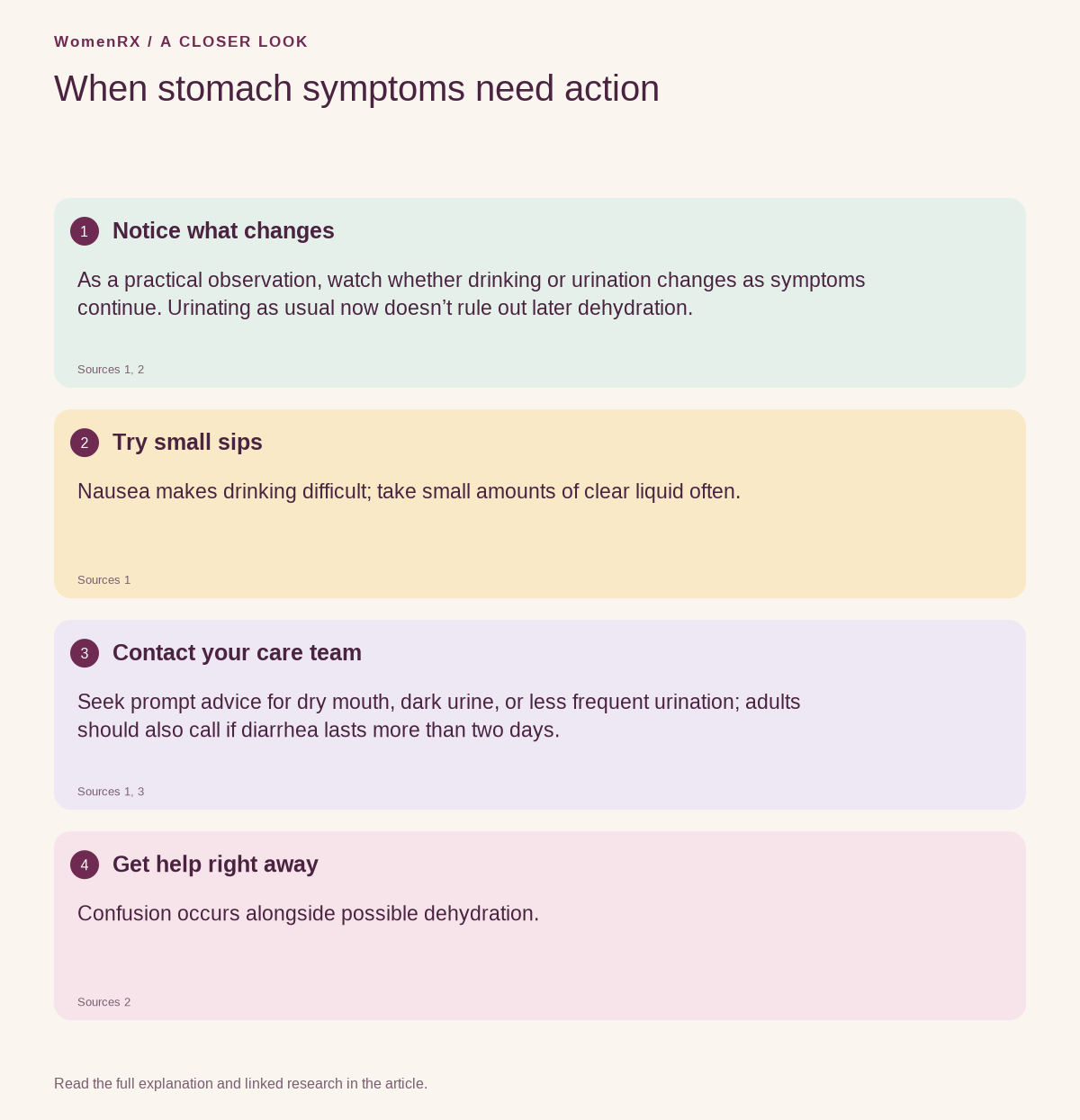
When stomach symptoms need action
Notice what changes: As a practical observation, watch whether drinking or urination changes as symptoms continue. Urinating as usual now doesn’t rule out later dehydration.12
Try small sips: Nausea makes drinking difficult; take small amounts of clear liquid often.1
Contact your care team: Seek prompt advice for dry mouth, dark urine, or less frequent urination; adults should also call if diarrhea lasts more than two days.13
Get help right away: Confusion occurs alongside possible dehydration.2
Read the figure as text
Use changes in drinking, urination, and thinking as practical signals. This is not a validated GLP-1-specific triage score.- Notice what changes: As a practical observation, watch whether drinking or urination changes as symptoms continue. Urinating as usual now doesn’t rule out later dehydration.12
- Try small sips: Nausea makes drinking difficult; take small amounts of clear liquid often.1
- Contact your care team: Seek prompt advice for dry mouth, dark urine, or less frequent urination; adults should also call if diarrhea lasts more than two days.13
- Get help right away: Confusion occurs alongside possible dehydration.2
More questions, answered
Does dark urine by itself prove I’m dehydrated?
No single symptom confirms dehydration. Dark or infrequent urine is a reason to take possible fluid loss seriously, especially if you also have vomiting or diarrhea or are struggling to drink. 1
Should I set a specific daily water goal?
There isn’t one fluid target for everyone. Needs vary, and illness can change them; avoid treating a fixed amount as a universal rule. 2
Sources you can check
- Nausea | Vomiting | MedlinePlusAccessed 2026-09-25Return to first citation
- Dehydration: MedlinePlusAccessed 2026-09-25Return to first citation
- Diarrhea | MedlinePlusAccessed 2026-09-25Return to first citation
- Pharmacokinetics and clinical use of incretin-based therapies in patients with chronic kidney disease and type 2 diabetes.Scheen AJ. · Clinical pharmacokinetics · 2015Return to first citation
- Adverse Events Associated with Incretin-Based Therapies: A Narrative Review on Mechanisms, Clinical Management, and Risk Mitigation.Tobaiqy M, Alqutub ST. · Drug design, development and therapy · 2026Return to first citation