Spotting Between Periods: When to Get It Checked
Even light bleeding between periods is worth checking; pregnancy possibility, pain, bleeding after sex, and menopause change what happens next.
If you’re spotting between periods, note when it happened, how much blood you saw, and whether it happens again, then arrange an assessment rather than assuming a light episode is harmless. A pregnancy test may be part of that assessment. If you’ve recently missed a period and have bleeding with abdominal or pelvic pain, seek urgent care because ectopic pregnancy is possible. 56
Start with the pattern, not the color
Spotting between periods means bleeding that isn’t part of your usual period. A small mark on underwear and bleeding that needs a period product are different amounts, but neither tells you the cause on its own. Hormonal contraception, polyps or fibroids, and sexually transmitted infections (STIs) are among the possible explanations. Bleeding between periods can sometimes have a more serious cause, so arrange an assessment even if it has happened only once. 5
A short record can make that conversation more useful: write down the date, whether the blood appeared between otherwise regular periods or after sex, how much there was, whether it returned, and any pain. Include your contraception and any chance of pregnancy. A cycle diary helps show when bleeding happens; it isn’t a reason to put off getting it checked. 56
Pregnancy possibility changes the first step
If pregnancy is possible, mention it when you arrange assessment. A clinician may include a pregnancy test when investigating bleeding between periods. 5
Seek urgent care if you’ve recently missed a period and have unusual bleeding with pain anywhere in your abdomen or pelvis. That combination can be a sign of an ectopic pregnancy and needs checking as soon as possible. Don’t wait for the bleeding to become heavy. 5
What contraception, a cesarean birth, and other symptoms can tell you
Hormonal contraception can cause unscheduled bleeding, and changing contraception can disturb your usual cycle. That makes it useful context, not a certain diagnosis. If the spotting is new, recurring, or happening after sex, tell the clinician which method you use and whether anything has changed. Other causes may still need to be considered. 56
If you’ve had a cesarean birth and your periods have resumed, mention it if you consistently notice spotting early in your cycle, particularly if the spotting is dark. A uterine scar defect is one possible contributor to this between-period pattern. This pattern concerns spotting between resumed periods, not bleeding soon after delivery. Spotting alone can’t tell you whether a scar defect is present. 4
Bleeding after sex deserves assessment too. Possible causes include changes on the surface of the cervix, cervical polyps, and vaginal dryness. An STI such as chlamydia is another possible cause of bleeding between periods. If an STI is a concern, say so when arranging care: testing may use a urine sample or a vaginal swab. Depending on your history and symptoms, an assessment may also include an examination of the vagina and cervix. 5
If your periods themselves are heavy enough to affect your daily life, describe that separately from the between-period spotting. Tell the clinician how often you change period products during a period; that detail helps communicate the heavier flow without guessing at a volume. 6
Perimenopause and menopause aren’t the same branch
Periods can become irregular just before menopause, but bleeding between periods still merits assessment. The question isn’t whether a changing cycle could explain it; it’s whether another cause needs checking. 56
After menopause, the threshold is clearer. Menopause is usually diagnosed in women over 45 who have gone more than a year without a period. Once you’re postmenopausal, arrange an assessment for any vaginal bleeding, even a single small spot or pink or brown discharge. Most people with postmenopausal bleeding are not diagnosed with endometrial cancer, but bleeding after menopause can be a sign of cancer. 31
What an assessment may involve
The next step depends on the bleeding pattern and your circumstances, not on a color-based guess. A clinician may ask about symptoms and medical history, then consider a pregnancy test, blood test, STI test, or examination. Ultrasound or a closer look at the cervix or inside the uterus may be needed in some cases. For example, a polyp can cause abnormal bleeding, but spotting alone can’t establish that one is present. 52
The useful distinction is this: recording a light episode helps describe it; it doesn’t replace assessment. A recently missed period with unusual bleeding and abdominal or pelvic pain calls for urgent care, and bleeding after menopause needs checking even when it’s scant. In between, details such as recurrence, contraception, bleeding after sex, and whether bleeding is becoming heavier help determine what to investigate. 516
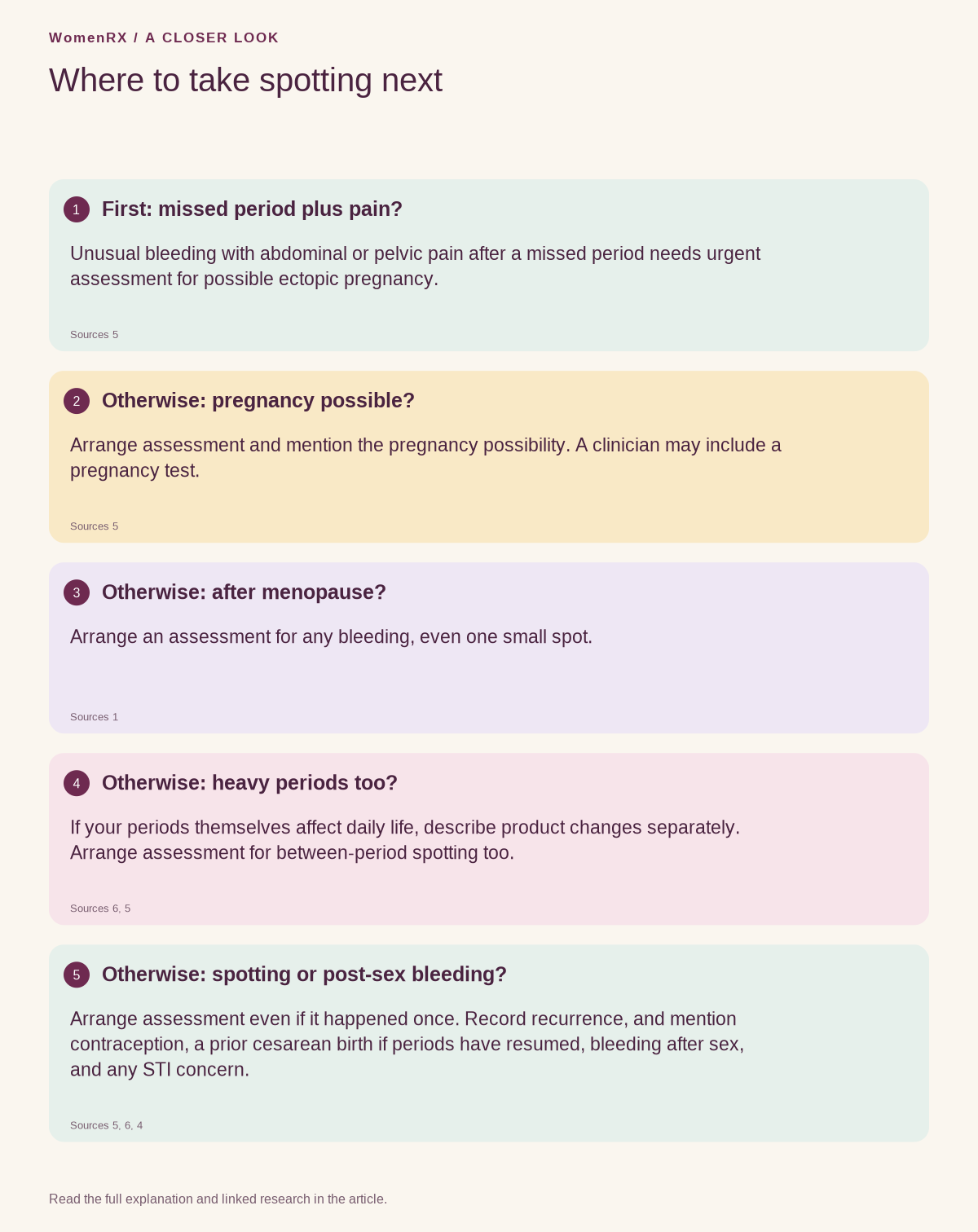
Where to take spotting next
First: missed period plus pain?: Unusual bleeding with abdominal or pelvic pain after a missed period needs urgent assessment for possible ectopic pregnancy.5
Otherwise: pregnancy possible?: Arrange assessment and mention the pregnancy possibility. A clinician may include a pregnancy test.5
Otherwise: after menopause?: Arrange an assessment for any bleeding, even one small spot.1
Otherwise: heavy periods too?: If your periods themselves affect daily life, describe product changes separately. Arrange assessment for between-period spotting too.65
Otherwise: spotting or post-sex bleeding?: Arrange assessment even if it happened once. Record recurrence, and mention contraception, a prior cesarean birth if periods have resumed, bleeding after sex, and any STI concern.564
Read the figure as text
Follow the branches in order, starting with the urgent combination. Even one episode of bleeding between periods or after sex needs assessment; recording whether it continues or recurs helps describe the pattern. 56- First: missed period plus pain?: Unusual bleeding with abdominal or pelvic pain after a missed period needs urgent assessment for possible ectopic pregnancy.5
- Otherwise: pregnancy possible?: Arrange assessment and mention the pregnancy possibility. A clinician may include a pregnancy test.5
- Otherwise: after menopause?: Arrange an assessment for any bleeding, even one small spot.1
- Otherwise: heavy periods too?: If your periods themselves affect daily life, describe product changes separately. Arrange assessment for between-period spotting too.65
- Otherwise: spotting or post-sex bleeding?: Arrange assessment even if it happened once. Record recurrence, and mention contraception, a prior cesarean birth if periods have resumed, bleeding after sex, and any STI concern.564
More questions, answered
Does spotting after sex count as bleeding between periods?
It’s worth mentioning separately, even if it happens between periods. Bleeding after sex has several possible causes, including cervical changes, polyps, and vaginal dryness, and should be assessed. 5
Can a polyp be diagnosed from a spotting pattern?
No. A polyp is one possible cause of abnormal bleeding, but the pattern alone doesn’t confirm it. Further examination or imaging may be considered depending on the assessment. 25
Sources you can check
- Postmenopausal bleeding - NHSAccessed 2026-09-25Return to first citation
- Guideline No. 447: Diagnosis and Management of Endometrial Polyps.Bougie O, Randle E, Thurston J, Magee B, Warshafsky C, Rittenberg D. · Journal of obstetrics and gynaecology Canada : JOGC = Journal d'obstetrique et gynecologie du Canada : JOGC · 2024Return to first citation
- Association of Endometrial Cancer Risk With Postmenopausal Bleeding in Women: A Systematic Review and Meta-analysis.Clarke MA, Long BJ, Del Mar Morillo A, Arbyn M, Bakkum-Gamez JN, Wentzensen N. · JAMA internal medicine · 2018Return to first citation
- Contemporary evaluation of women and girls with abnormal uterine bleeding: FIGO Systems 1 and 2.Jain V, Munro MG, Critchley HOD. · International journal of gynaecology and obstetrics: the official organ of the International Federation of Gynaecology and Obstetrics · 2023Return to first citation
- Vaginal bleeding between periods or after sex - NHSAccessed 2026-09-25Return to first citation
- Period problems - NHSAccessed 2026-09-25Return to first citation