Tinnitus in Perimenopause: What to Record and When to Get It Checked
Ringing during perimenopause isn’t necessarily hormonal; where you hear it and what happens alongside it can help you decide what to do next.
Tinnitus can begin during perimenopause, but the timing alone can’t tell you what caused it. Note whether the sound is in one or both ears, follows your heartbeat, or comes with a hearing change. Seek urgent assessment for sudden hearing loss, tinnitus after a head injury, or tinnitus with facial weakness or spinning vertigo. 1 2 5

Perimenopause may be the timing, not the explanation
Tinnitus means hearing a sound that isn’t coming from an outside source. It might ring, buzz, hiss, click, or roar. You may hear it in one ear, both ears, or somewhere in your head; it may come and go or stay constant. 1 2
If it starts while your periods are changing, it’s reasonable to wonder about a connection. But timing alone doesn’t establish that hormonal changes caused it. Hearing loss, loud-noise exposure, and certain medicines are recognized contributors. An ear examination may also find something treatable, such as wax buildup or an infection. 1 2
Rather than trying to identify the cause from the sound alone, start with the details that change the next step: a sudden drop in hearing, a sound that follows your heartbeat, or a sound that’s only on one side.
Make a brief ear-symptom log
A few notes are enough. Record:
- Where: left ear, right ear, both ears, or hard to locate.
- Sound and rhythm: ringing, buzzing, or another sound. Does it seem to match each heartbeat?
- Onset and pattern: when you first noticed it, whether it comes and goes, and whether it’s becoming more frequent or louder.
- What came with it: muffled or reduced hearing, spinning vertigo, facial weakness, or a recent head injury.
- Possible context: recent loud noise and any medicines you started or changed. Some medicines can contribute to tinnitus, so those details are worth sharing with the person who prescribed them. 1 2
- Daily effect: whether the sound is disturbing sleep or concentration.
For example, “buzzing in both ears a few times this week” describes a different pattern from “a new sound in my right ear that beats with my pulse.” The log helps you describe what’s happening; it can’t diagnose the cause.
Which patterns need care sooner?
Sudden hearing loss: seek urgent assessment. Don’t wait to see whether the ringing fades if your hearing has suddenly dropped. Sudden hearing loss may occur with tinnitus, and prompt evaluation matters. 2 5
A head injury, facial weakness, or spinning vertigo: seek urgent assessment. Tinnitus after a head injury, or tinnitus accompanied by facial weakness or a spinning sensation, shouldn’t wait for a routine visit. 2
A sound that matches your heartbeat: arrange an evaluation. This is called pulsatile tinnitus. Its rhythm matters because evaluation and any imaging decisions differ from those for nonpulsatile ringing. A clinician can examine your ears and assess your hearing before deciding what testing fits. 4
A sound in just one ear: arrange an assessment, especially if hearing differs between ears. One-sided tinnitus doesn’t automatically mean a serious condition or an MRI. Hearing results and the ear examination help guide whether imaging is useful. 3 4
Mild, occasional tinnitus without those features: note whether it changes. Arrange a non-urgent visit if it becomes regular or constant, gets worse, or affects sleep or concentration. 2
What an appointment can clarify
An initial assessment may include looking for wax buildup or infection and checking for hearing loss. Imaging isn’t the default first step for every kind of tinnitus: the sound’s rhythm, which ear is affected, hearing results, and examination findings help determine whether it’s appropriate. 2 4
Mention that the sound began during perimenopause if that’s when you noticed it. Bring the other details too. They give the clinician more to work with than the timing alone.
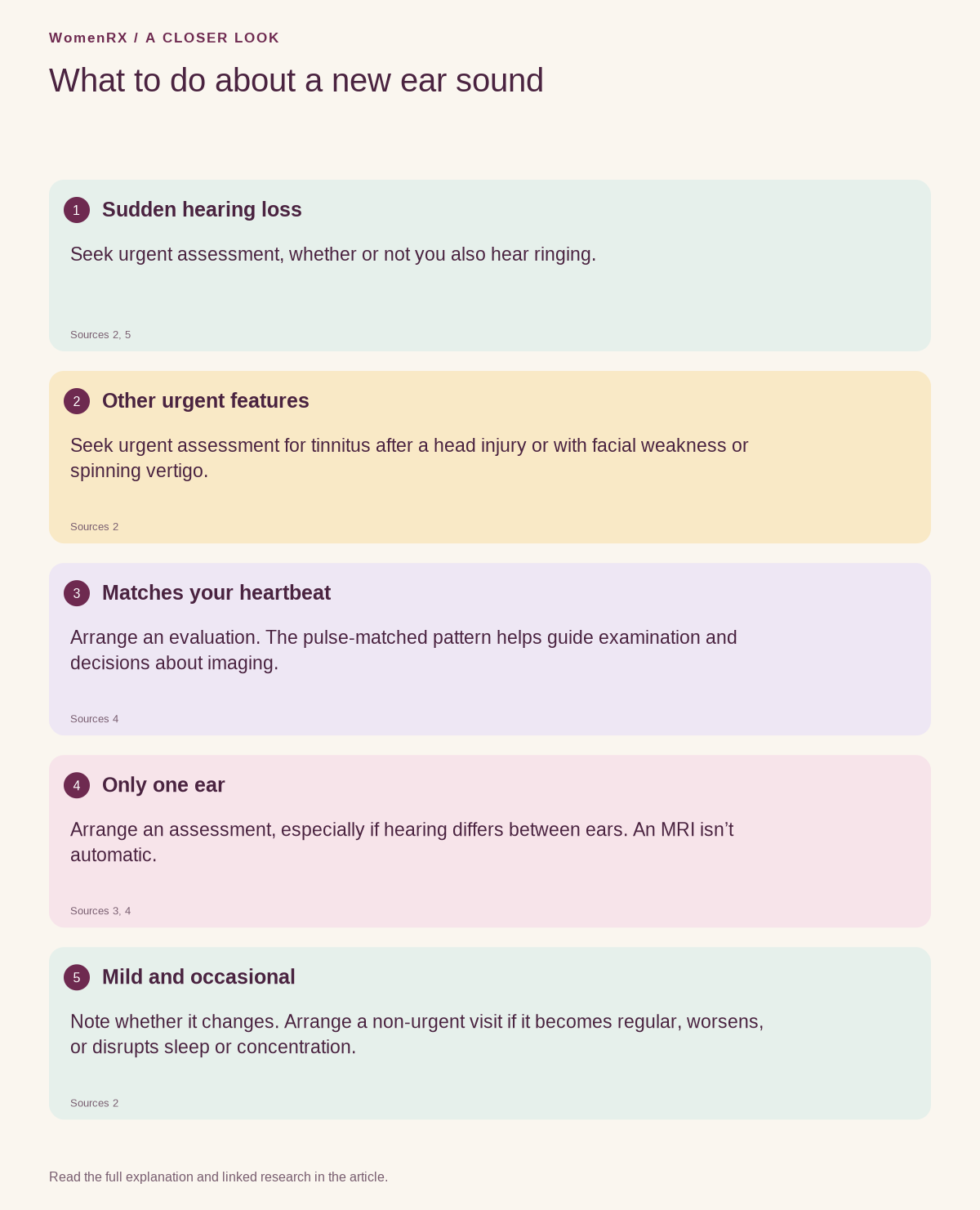
What to do about a new ear sound
Sudden hearing loss: Seek urgent assessment, whether or not you also hear ringing.25
Other urgent features: Seek urgent assessment for tinnitus after a head injury or with facial weakness or spinning vertigo.2
Matches your heartbeat: Arrange an evaluation. The pulse-matched pattern helps guide examination and decisions about imaging.4
Only one ear: Arrange an assessment, especially if hearing differs between ears. An MRI isn’t automatic.34
Mild and occasional: Note whether it changes. Arrange a non-urgent visit if it becomes regular, worsens, or disrupts sleep or concentration.2
Read the figure as text
Start with hearing changes and other urgent features. If none apply, use the sound’s rhythm, location, and persistence to choose the next step.- Sudden hearing loss: Seek urgent assessment, whether or not you also hear ringing.25
- Other urgent features: Seek urgent assessment for tinnitus after a head injury or with facial weakness or spinning vertigo.2
- Matches your heartbeat: Arrange an evaluation. The pulse-matched pattern helps guide examination and decisions about imaging.4
- Only one ear: Arrange an assessment, especially if hearing differs between ears. An MRI isn’t automatic.34
- Mild and occasional: Note whether it changes. Arrange a non-urgent visit if it becomes regular, worsens, or disrupts sleep or concentration.2
More questions, answered
Could a medicine be contributing to the ringing?
Possibly. Tinnitus can be a side effect of some medicines, including certain antibiotics, chemotherapy medicines, nonsteroidal anti-inflammatory drugs (NSAIDs), and aspirin. Note what you take and any recent changes, then ask your prescriber or pharmacist whether a medicine could be relevant. 1 2
Sources you can check
- Tinnitus | Tinnitus Treatment | MedlinePlusAccessed 2026-09-25Return to first citation
- Tinnitus - NHSAccessed 2026-09-25Return to first citation
- Congress of Neurological Surgeons Systematic Review and Evidence-Based Guidelines Update for the Role of Audiologic Screening in the Diagnosis and Management of Patients With Vestibular Schwannomas.Strickland BA, Honaker JA, Olson JJ. · Neurosurgery · 2026Return to first citation
- ACR Appropriateness Criteria® Tinnitus: 2023 Update.Expert Panel on Neurological Imaging, Jain V, Policeni B, Juliano AF, Adunka O, Agarwal M, Dubey P, Friedman ER, Gule-Monroe MK, Hagiwara M, Hunt CH, Lo BM, Oh ES, Rath TJ, Roberts... · Journal of the American College of Radiology : JACR · 2023Return to first citation
- Clinical Practice Guideline: Sudden Hearing Loss (Update) Executive Summary.Chandrasekhar SS, Tsai Do BS, Schwartz SR, Bontempo LJ, Faucett EA, Finestone SA, Hollingsworth DB, Kelley DM, Kmucha ST, Moonis G, Poling GL, Roberts JK, Stachler RJ, Zeitler DM, ... · Otolaryngology--head and neck surgery : official journal of American Academy of Otolaryngology-Head and Neck Surgery · 2019Return to first citation