How Is Perimenopause Recognized, and When Should Symptoms Be Checked?
Changing periods and symptoms can point toward perimenopause, but unusual bleeding deserves its own explanation.
Perimenopause is recognized from the overall pattern, especially age, menstrual changes, and symptoms such as hot flashes or night sweats. No single symptom or blood test can confirm it. Hormonal contraception or a history that makes periods hard to interpret can complicate the picture. Don’t assume new, unusually heavy, or between-period bleeding is simply perimenopause. 2 1 3
Think in patterns, not a checklist
Perimenopause is a transition, so the useful clue is often a change over time: your periods become less predictable, and symptoms such as hot flashes, night sweats, or vaginal dryness may appear. Age matters, too. A review of diagnostic studies in women aged 40 and older found that the likelihood of perimenopause increased with age, but no one symptom or test could confirm or rule it out on its own. 2
That means a hot flash can add context, but it can’t settle the question by itself. In clinical assessment, menstrual history and age are considered together, with symptoms adding clues rather than acting as a pass-or-fail test. 2
Give bleeding its own explanation
Cycle changes can happen during perimenopause, including when cycles occur without ovulation and estrogen levels fluctuate. But irregular bleeding has other possible causes. Clinicians describe abnormal uterine bleeding by changes in how often bleeding happens, how regular it is, how long it lasts, or how heavy it is. Possible causes include ovulation-related changes, medication effects, and structural problems such as polyps or fibroids. 1 3
As a general reference, a clinical study guide describes menstrual cycles as typically occurring every 24 to 38 days and bleeding as lasting 2 to 7 days. These ranges can help you describe what has changed; they are not a way to diagnose perimenopause. Bleeding between periods or flow that is unusually heavy deserves attention rather than an automatic perimenopause label. Sudden, excessive bleeding may need immediate assessment. 3
For example, periods that gradually become less predictable alongside new hot flashes give a different overall picture from sudden heavy bleeding or repeated bleeding between periods. Both can happen during the years around menopause, but the second pattern needs consideration of other causes. 1 3
Include contraception and medical history
Hormonal contraception matters when you’re interpreting bleeding: breakthrough bleeding can occur while using hormone medication. Mention your method and any recent changes when discussing a new bleeding pattern. Pregnancy also remains possible as fertility declines with age, so a missed period should not automatically be attributed to perimenopause. 3 1
If surgery or medical treatment has changed or stopped your periods, share that history when discussing your symptoms. Menstrual history is a central clue in recognizing perimenopause, and symptoms alone cannot confirm it. 2
It also helps to describe when the cycle change began, whether the timing or flow changed, and when symptoms such as hot flashes started. The point isn’t to diagnose yourself. It’s to make the pattern clear without overlooking a separate bleeding concern.
What a blood test can and can’t settle
A blood test is not a universal yes-or-no answer. In the diagnostic review, follicle-stimulating hormone levels were associated with perimenopause, but were not accurate enough on their own to establish or exclude it. The review concluded that assessment should rely on age and menstrual history rather than laboratory results alone. 2
Changing cycles and symptoms may make perimenopause a reasonable possibility. If bleeding is unusually heavy, occurs between periods, or becomes suddenly excessive, get that change assessed rather than assuming the transition explains it. 3
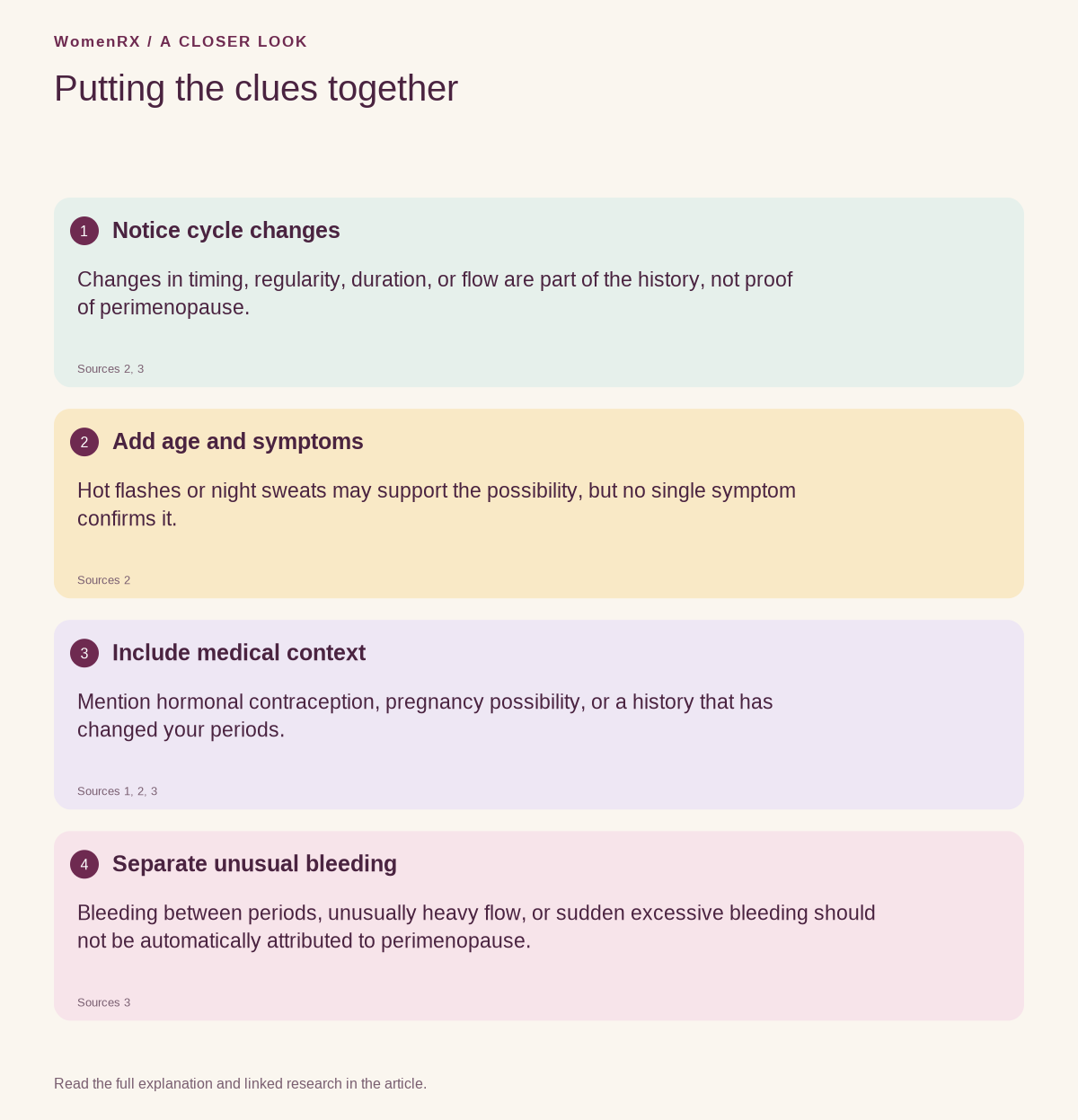
Putting the clues together
Notice cycle changes: Changes in timing, regularity, duration, or flow are part of the history, not proof of perimenopause.23
Add age and symptoms: Hot flashes or night sweats may support the possibility, but no single symptom confirms it.2
Include medical context: Mention hormonal contraception, pregnancy possibility, or a history that has changed your periods.123
Separate unusual bleeding: Bleeding between periods, unusually heavy flow, or sudden excessive bleeding should not be automatically attributed to perimenopause.3
Read the figure as text
Consider the pattern and context together, while giving concerning bleeding changes their own attention.- Notice cycle changes: Changes in timing, regularity, duration, or flow are part of the history, not proof of perimenopause.23
- Add age and symptoms: Hot flashes or night sweats may support the possibility, but no single symptom confirms it.2
- Include medical context: Mention hormonal contraception, pregnancy possibility, or a history that has changed your periods.123
- Separate unusual bleeding: Bleeding between periods, unusually heavy flow, or sudden excessive bleeding should not be automatically attributed to perimenopause.3
Sources you can check
- Hormonal Contraception in Perimenopause: What to Consider to Guide the Choice.Fidecicchi T, Caretto M, Chen G, Simi D, Montt Guevara MM, Giannini A, Luisi S, Simoncini T. · Seminars in reproductive medicine · 2025Return to first citation
- Is this woman perimenopausal?Bastian LA, Smith CM, Nanda K. · JAMA · 2003Return to first citation
- Abnormal Uterine BleedingMikes BA, Vadakekut ES, Sparzak PB. · 2025Return to first citation