When Does Perimenopause Usually Start, and How Is It Recognized?
The timing varies, so changes in your cycle and symptoms tell you more than an average age can.
Perimenopause often begins in the 40s, but there’s no single average starting age that can tell you when it begins for you. A clinical staging summary places the transition broadly between ages 40 and 55, often several years before the final period. Changes in cycle timing, sometimes alongside hot flashes or sleep problems, offer clues. Age alone isn’t a diagnosis. 15

Menopause age isn’t perimenopause start age
Perimenopause is the transition leading up to menopause. One clinical staging summary gives it a typical age range of 40 to 55 and describes it as occurring roughly 2 to 8 years before the final menstrual period. It puts the median age at menopause at about 51, with variation around the world. That median describes menopause, not the age when perimenopause starts. 1
Even a broad range can’t predict your timing. In an analysis of historical menstrual records, researchers found six groups with different transition patterns. For some women, changes in bleeding didn’t line up clearly with proposed markers of the transition. The researchers also cautioned that studies enrolling women within limited age ranges may miss some patterns. 3
Look for a changing pattern, not one symptom
Cycle timing is often a useful place to start. The staging summary lists a change of at least seven days in cycle length as one marker of irregularity. For example, if cycles that used to be fairly consistent begin arriving noticeably earlier or later, that pattern offers more context than your age alone. The seven-day marker isn’t a test you can use to diagnose yourself from one cycle. 13
Hot flashes can be another clue, but the staging summary specifies hot flashes without another cause. Symptoms can also appear while periods are still regular. Sleep changes may emerge early, though a review found that hot flashes and reproductive hormones do not fully explain sleep problems during this time. Poor sleep by itself, then, doesn’t establish perimenopause. 125
Menopause is a different milestone. For a natural transition, the staging summary defines it after 12 consecutive months without a period. Until then, cycle and symptom patterns may still be changing. 1
When an age chart is less useful
Changes before 40 deserve an individualized look rather than an assumption that they’re a typical midlife transition. The same is true when changes follow ovarian surgery or treatment that may affect ovarian function, such as chemotherapy. Early or surgical menopause and chemotherapy-induced ovarian insufficiency can have implications for bone health, making the circumstances behind a change worth discussing, not just the age when it happened. 4
The useful question isn’t “Am I the average age?” It’s “What has changed for me, and is there another reason it may be happening?” A shift in cycle timing together with new symptoms can make perimenopause plausible. An isolated symptom, an unusual age, or a history of treatment affecting ovarian function calls for a closer look rather than an age-based verdict. 1345
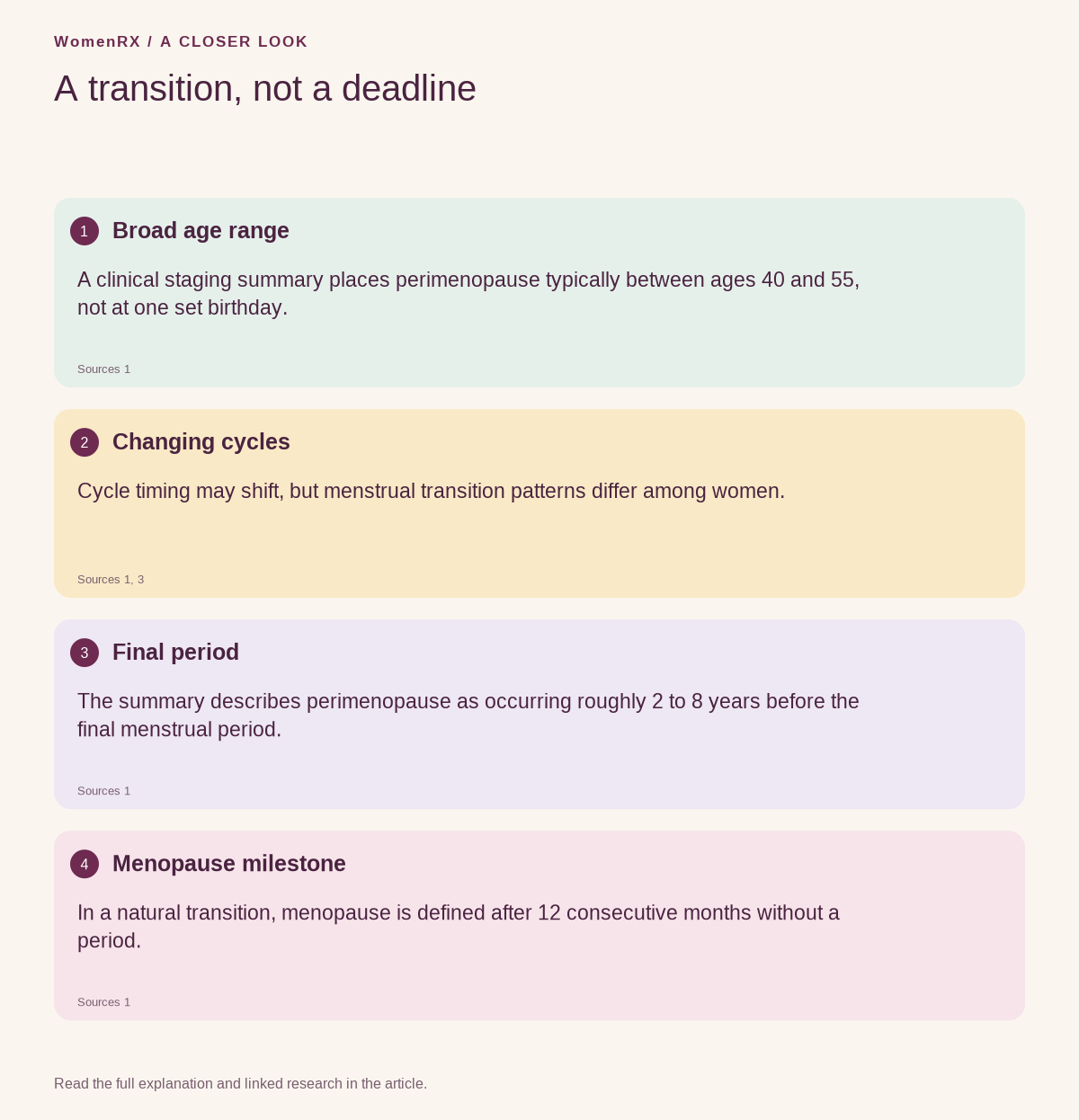
A transition, not a deadline
Broad age range: A clinical staging summary places perimenopause typically between ages 40 and 55, not at one set birthday.1
Changing cycles: Cycle timing may shift, but menstrual transition patterns differ among women.13
Final period: The summary describes perimenopause as occurring roughly 2 to 8 years before the final menstrual period.1
Menopause milestone: In a natural transition, menopause is defined after 12 consecutive months without a period.1
Read the figure as text
These milestones show why a population age range cannot pinpoint one person’s start date.- Broad age range: A clinical staging summary places perimenopause typically between ages 40 and 55, not at one set birthday.1
- Changing cycles: Cycle timing may shift, but menstrual transition patterns differ among women.13
- Final period: The summary describes perimenopause as occurring roughly 2 to 8 years before the final menstrual period.1
- Menopause milestone: In a natural transition, menopause is defined after 12 consecutive months without a period.1
Sources you can check
- Physical and mental health impact of perimenopause, menopause and post menopause in a diverse global population (MARIE Project- Global Chapter WP 2a): cross-sectional quantitative data from a mixed-methods study.Delanerolle G, Pathiraja V, Eleje GU, Toh TH, Rathnayake N, Tweneboah-Koduah F, Afful-Minta N, Mudalige T, Sun J, Dhanarisi J, Al-Kharusi L, Al-Riyami N, Mbwele B, Madan-Aggarwal I... · EClinicalMedicine · 2026Return to first citation
- Characteristics of Insurance-Covered Women Newly Diagnosed with Menopause Symptoms and Their Providers in the United States.Sullivan AP, Heo J, Hansen RN, Cameron J, Dow E, Bolling KR, Cameron J, LaRose A, Farej R. · Women's health reports (New Rochelle, N.Y.) · 2026Return to first citation
- Distinguishing 6 population subgroups by timing and characteristics of the menopausal transition.Huang X, Harlow SD, Elliott MR. · American journal of epidemiology · 2012Return to first citation
- CRITICAL IMPLICATIONS OF FEMALE BONE METABOLISM IN ORTHOPEDICS: STATE OF THE ART.Hecht S, Wittstein J, Kimura Y, Arias C. · Journal of ISAKOS : joint disorders & orthopaedic sports medicine · 2026Return to first citation
- Sleep disturbance and menopause.Carmona NE, Solomon NL, Adams KE. · Current opinion in obstetrics & gynecology · 2025Return to first citation