Perimenopause Supplements: Start With the Symptom
A supplement claim is more useful when the research matches your symptom, your stage of menopause, and the exact formula.
Start with what you want help with, whether that’s hot flashes, sleep, or changing periods. One trial in perimenopausal women reported improvements with a specific two-product combination, but it doesn’t establish that either product works alone. Most supplement research in a US-focused analysis concerned postmenopause. If bleeding is heavy or occurs between periods, finding its cause matters more than choosing a supplement. 2 3 1
Start with the symptom, not “hormone balance”
A product promising to support your hormones may sound relevant when your periods and sleep are changing. But that phrase doesn’t tell you what the product was tested to do. A hot-flash study can’t answer a bleeding question, and a study in people who have finished menopause may not answer the same question for someone whose cycles are still changing.
That life-stage distinction is easy to miss. A 2026 analysis of US-conducted or US-collaborative supplement research included 253 publications, 234 of which focused on postmenopause. It also found research spread across more than 80 ingredients, with limited replication. This describes where research has been concentrated; it isn’t a test showing that any particular supplement works or fails. 3
If hot flashes or night sweats are the problem
Here, the useful question is specific: Was this exact formula tested for hot flashes in people in perimenopause? One randomized, double-blind, placebo-controlled trial enrolled 106 women up to age 50 with perimenopause and mild-to-moderate vasomotor and psychosomatic symptoms. It tested Amberen, a succinate-based supplement, together with a vitamin B complex called Smart B. The researchers reported improvements across several symptom scales, including vasomotor symptoms. 2
That’s more directly relevant to perimenopausal hot flashes than a study limited to postmenopause. It’s still a narrow finding. The abstract doesn’t give effect sizes to show how large the changes were, and the trial didn’t test the two products separately. It can’t tell you that B vitamins alone relieve hot flashes, or that another blend with some similar ingredients will do the same. 2
If sleep is what you want back
First separate two experiences: Are night sweats waking you, or is sleep difficult even without them? Hot flashes and night sweats can be associated with sleep disturbance, but that connection doesn’t mean every sleep problem in midlife has the same cause. 4
The combination trial’s authors also reported better sleep among participants with mild-to-moderate perimenopausal symptoms. Because the study tested both products together and the abstract gives no size of the sleep benefit, it offers a reason to ask about that specific combination, not a reason to buy a general “menopause sleep” supplement. If your sleep trouble is separate from night sweats, check whether a product’s supporting study actually measured that kind of sleep problem. 2
The same distinction helps with mood claims. The trial reported improvements on anxiety, depression, and well-being scales, but it doesn’t establish that either ingredient alone treats a mood disorder. 2
If your periods are changing, pause before shopping
Cycles can become irregular during perimenopause, yet bleeding isn’t automatically caused by the transition. Changing ovarian function is one possibility; polyps, fibroids, pregnancy, and other conditions may also need consideration. A review of perimenopausal abnormal uterine bleeding describes evaluation to distinguish among causes, including premalignant or malignant changes. 1
If bleeding has become heavy or is happening between periods, make that the question you bring to a medical visit rather than trying a supplement to “regulate” it. Heavy bleeding that causes anemia needs prompt treatment, according to the review. The right next step depends on what’s causing the bleeding; a supplement claim can’t answer that question. 1
Check the product claim, then its safety
Once you’ve named the symptom, look past the front of the bottle:
- Match the people. Were participants in perimenopause, or was the research mainly about postmenopause? If continuing periods matter to your question, check whether the study actually reports participants’ menstrual status. 2 3
- Match the outcome. Did researchers measure your main concern, such as hot flashes or sleep, rather than a broad score covering many symptoms? 2
- Match the formula. The Amberen and Smart B trial tested a combination. Its findings don’t isolate either product or establish the results for a different formulation. 2
- Ask what safety was studied. The trial reported few adverse effects, described as mild and transient, among its participants. That finding doesn’t establish the safety of every product or answer questions about your other medicines. Keep the exact ingredient label handy when discussing a product with a pharmacist or clinician. 2
You don’t need to settle the entire supplement aisle. You need an answer to a smaller question: Is there evidence for this formula, for my symptom, in people at my stage of the transition? If the concern is abnormal bleeding, finding the cause comes first. 1 2 3
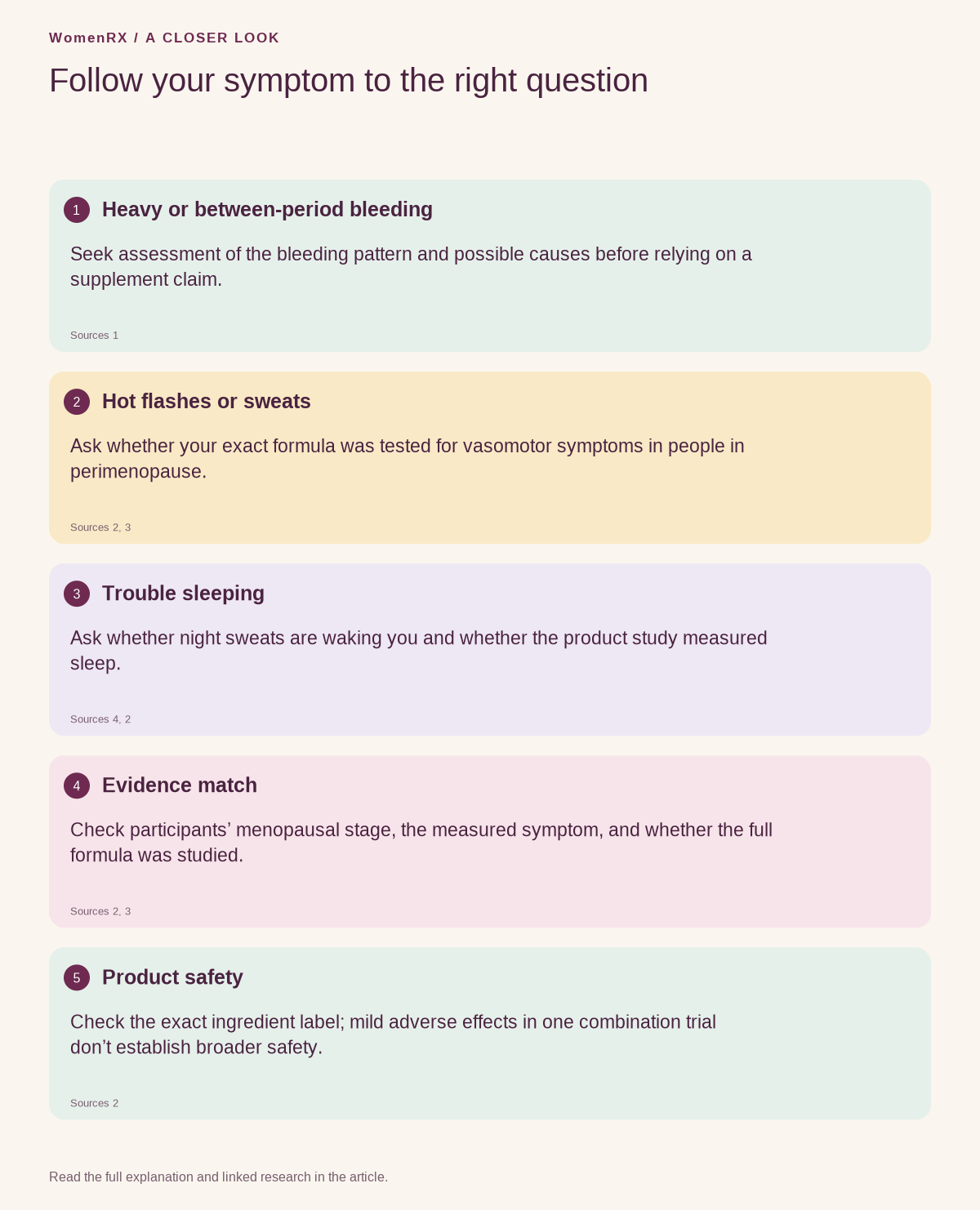
Follow your symptom to the right question
Heavy or between-period bleeding: Seek assessment of the bleeding pattern and possible causes before relying on a supplement claim.1
Hot flashes or sweats: Ask whether your exact formula was tested for vasomotor symptoms in people in perimenopause.23
Trouble sleeping: Ask whether night sweats are waking you and whether the product study measured sleep.42
Evidence match: Check participants’ menopausal stage, the measured symptom, and whether the full formula was studied.23
Product safety: Check the exact ingredient label; mild adverse effects in one combination trial don’t establish broader safety.2
Read the figure as text
The first step depends on what you want to change; product evidence and safety come after that.- Heavy or between-period bleeding: Seek assessment of the bleeding pattern and possible causes before relying on a supplement claim.1
- Hot flashes or sweats: Ask whether your exact formula was tested for vasomotor symptoms in people in perimenopause.23
- Trouble sleeping: Ask whether night sweats are waking you and whether the product study measured sleep.42
- Evidence match: Check participants’ menopausal stage, the measured symptom, and whether the full formula was studied.23
- Product safety: Check the exact ingredient label; mild adverse effects in one combination trial don’t establish broader safety.2
More questions, answered
Does the combination trial show that a vitamin B complex works on its own?
No. Researchers tested the vitamin B complex together with Amberen, not in a separate vitamin-only group. The reported improvements can’t be assigned to either component alone. 2
Sources you can check
- Perimenopausal abnormal uterine bleeding.Dreisler E, Frandsen CS, Ulrich L. · Maturitas · 2024Return to first citation
- Clinical Evaluation of Effectiveness and Safety of Combined Use of Dietary Supplements Amberen® and Smart B® in Women with Climacteric Syndrome in Perimenopause.Kachko VA, Shulman LP, Kuznetsova IV, Uspenskaya YB, Burchakov DI. · Advances in therapy · 2024Return to first citation
- Dietary supplements for menopausal symptoms and health: a bibliometric analysis of US research (2000-2024).Canino MC, Cohen B, Byrd C, Gahche JJ. · Menopause (New York, N.Y.) · 2026Return to first citation
- Psychosocial and socioeconomic burden of vasomotor symptoms in menopause: a comprehensive review.Utian WH. · Health and quality of life outcomes · 2005Return to first citation