Menopause Supplements: Start With the Reason You’d Take One
A product for hot flashes and a supplement to address a nutrient shortfall need different evidence checks.
Start with the job you want a supplement to do. Plant-based products may improve menopausal symptom scores in studies, but the findings don’t establish that a particular bottle will help you. Calcium and vitamin D supplements haven’t reliably prevented fractures, though a nutrient shortfall is a different reason to consider them. Your diet, bone health, and medicines help determine the next question. 1 2 4
Put a specific goal ahead of the label
“Menopause support” sounds appealing, but it doesn’t tell you what a product is meant to change. Are hot flashes interrupting your sleep? Are you concerned that your diet doesn’t provide enough of a nutrient? Or are you looking for a way to prevent a fracture after an osteoporosis diagnosis? Those questions call for different evidence.
Menopause stage matters when you’re deciding whether research applies to you, not because it automatically points to a supplement. Trials of plant-derived products have included women in perimenopause and postmenopause. A review of calcium and vitamin D for women with osteoporosis focused specifically on postmenopause. Neither finding means everyone at that stage needs the product. 3 4
For hot flashes, check the product behind the promise
A 2024 review of randomized, placebo-controlled trials found that plant-derived supplements improved pooled menopausal symptom measures, including hot-flash frequency. But the studies tested many different products, including soy-derived, red-clover-derived, and other plant supplements. The authors cautioned that the evidence was heterogeneous and generally needed more rigorous research. An average across unlike products isn’t a reliable prediction for the one on a store shelf. 4
That helps explain why recommendations have been cautious. A North American Menopause Society position statement did not recommend over-the-counter supplements or herbal therapies as proven hot-flash treatments because the evidence was negative, insufficient, or inconclusive. That statement predates the 2024 review, but the newer pooled finding still doesn’t resolve which specific product might provide a dependable benefit. 7 4
If hot flashes are substantially affecting your life, you don’t have to choose between trying a supplement and doing nothing. Established treatment approaches include hormone therapy and some nonhormonal prescription medicines; which option fits depends on your circumstances. That makes the comparison more useful than asking whether a product is simply “natural.” 6 Before trying a symptom product, check its exact ingredients against your medicines with a pharmacist or prescribing clinician. Potential interactions, adverse effects, cost, and limited long-term evidence all belong in the decision. 7
For bones, ask two separate questions
Am I getting enough of a nutrient? Start with what you regularly eat and any concern that your intake is insufficient. A public osteoporosis guideline recommends considering combined calcium and vitamin D supplementation when vitamin D intake is insufficient, although it grades that recommendation as weak and based on low-certainty evidence. That is a reason to assess a possible gap, not a reason for everyone to take the same supplement. 2
Will a supplement prevent a fracture? The answer is less reassuring. A 2026 review of 69 randomized trials involving 153,902 adults found little to no meaningful benefit from calcium, vitamin D, or their combination for preventing fractures and falls. Most trial participants lived in the community and were not at high risk, and the trials excluded people receiving osteoporosis drug treatment. Those results cannot settle every higher-risk or treated person’s individual need. 1
There’s also a postmenopause-specific distinction. In a review of 11 trials involving 43,869 postmenopausal women with osteoporosis, calcium plus vitamin D modestly improved bone mineral density at the pelvis, but not at several other measured sites. It did not significantly reduce overall fracture risk. A change in a bone-density measurement and proof of fewer fractures are not the same outcome. 3
If you’ve been diagnosed with osteoporosis or are taking prescribed treatment for it, treat the supplement question as part of that plan, not as a substitute for it. A public osteoporosis guideline recommends osteoporosis medication alongside lifestyle and fall-prevention measures for people with the condition. 2
Make the decision fit your situation
Before you buy, name the outcome you hope to change and look for evidence measuring that outcome. A hot-flash score, a vitamin D blood level, bone density, and fractures tell you different things. Then ask whether the research included people with your concern: someone in the menopause transition considering a symptom product is not in the same position as someone postmenopausal with osteoporosis. 1 3 4
Finally, bring the actual product label, your medication list, and your reason for considering it to a pharmacist or prescribing clinician. If your concern is nutrition, include what you typically eat and any health condition or prescribed bone treatment that might affect the decision. If it’s symptom relief, ask what benefit is realistic compared with other options. A specific goal makes it easier to weigh a possible benefit against uncertainty, adverse effects, interactions, cost, and effort. 7
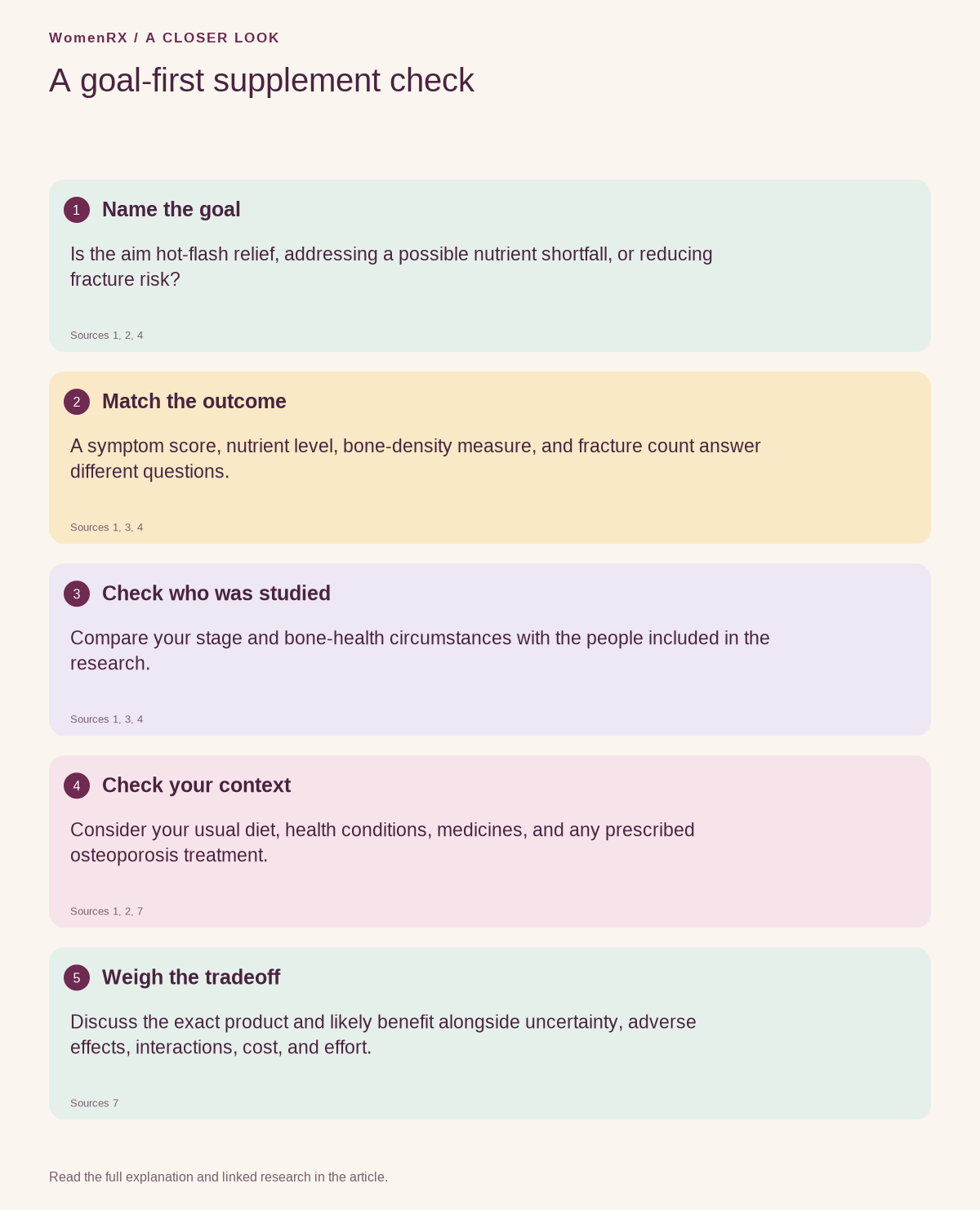
A goal-first supplement check
Name the goal: Is the aim hot-flash relief, addressing a possible nutrient shortfall, or reducing fracture risk?124
Match the outcome: A symptom score, nutrient level, bone-density measure, and fracture count answer different questions.134
Check who was studied: Compare your stage and bone-health circumstances with the people included in the research.134
Check your context: Consider your usual diet, health conditions, medicines, and any prescribed osteoporosis treatment.127
Weigh the tradeoff: Discuss the exact product and likely benefit alongside uncertainty, adverse effects, interactions, cost, and effort.7
Read the figure as text
Follow these questions to decide what evidence and personal details matter before choosing a product.- Name the goal: Is the aim hot-flash relief, addressing a possible nutrient shortfall, or reducing fracture risk?124
- Match the outcome: A symptom score, nutrient level, bone-density measure, and fracture count answer different questions.134
- Check who was studied: Compare your stage and bone-health circumstances with the people included in the research.134
- Check your context: Consider your usual diet, health conditions, medicines, and any prescribed osteoporosis treatment.127
- Weigh the tradeoff: Discuss the exact product and likely benefit alongside uncertainty, adverse effects, interactions, cost, and effort.7
More questions, answered
What about a supplement for menopause-related brain fog?
Evidence for improving cognition is not compelling. A review of 12 randomized trials found some encouraging results for soy, isoflavones, and ginkgo, but most studies had serious methodological flaws. That’s a different question from whether a product helps hot flashes, so a hot-flash claim shouldn’t stand in for evidence about thinking or memory. 5
Sources you can check
- Calcium, vitamin D, or combined supplementation to prevent fractures and falls: systematic review and meta-analysis.Massé O, Mercurio CM, Dupuis S, Al Sahwi M, Arruda A, Dallaire G, Desforges K, Dugré N, Williamson D. · BMJ (Clinical research ed.) · 2026Return to first citation
- Chinese Guideline on Risk Management of Osteoporosis in the General Public.Zhang S, Yuan J, Luo Z, Su J, Xia W, Yang K, Wei F, Osteoporosis Group, Chinese Association of Orthopaedic Surgeons, Youth Osteoporosis Group, Chinese Orthopaedic Association, Chin... · Orthopaedic surgery · 2026Return to first citation
- The effects of combined calcium and vitamin D supplementation on bone mineral density and fracture risk in postmenopausal women with osteoporosis: a systematic review and meta-analysis of randomized controlled trials.Cong B, Zhang H. · BMC musculoskeletal disorders · 2025Return to first citation
- Efficacy of plant-derived dietary supplements in improving overall menopausal symptoms in women: An updated systematic review and meta-analysis.Oh MR, Park JH, Park SK, Park SH. · Phytotherapy research : PTR · 2024Return to first citation
- Effects of herbal and dietary supplements on cognition in menopause: a systematic review.Clement YN, Onakpoya I, Hung SK, Ernst E. · Maturitas · 2011Return to first citation
- Hormone Therapy and Other Treatments for Symptoms of Menopause.Hill DA, Crider M, Hill SR. · American family physician · 2016Return to first citation
- Nonhormonal management of menopause-associated vasomotor symptoms: 2015 position statement of The North American Menopause Society.Menopause (New York, N.Y.) · 2015Return to first citation